Flexible Circuit Board with Reinforcement Ribs
Stiffeners are an important and common requirement for both flex boards and rigid flex printed circuit boards. They
increase the durability and reliability in a variety of applications.
The stiffeners are also mechanically functional and do not affect the electrical requirements for the
whole part. Multiple laminations are required if stiffeners are needed on both sides of a bend. This can
lead to increased cost and lead times. There are some situations in which stiffeners may be necessary.
Flexible PCB Stiffener Requirements
Flex PCB stiffener specifications include the
following categories:
• Reinforce connector areas for larger connectors to reduce stress or for repeated inserting of
connectors
• Minimum thickness ZIF (zero-insertion force).
• Localized bending constraint
• Create flat surfaces to place SMT pads, components and components
• Minimize component stresses
• Control heat dissipation in aluminum and steel
• Create arrays that are rigid enough to automate assembly without fixtures
What You Need to Know About Flex PCB Stiffeners
As a final step in manufacturing, stiffeners can be added to flex-circuits. They are applied using a
pressure-sensitive adhesive or thermoset adhesive. Pressure-sensitive adhesives are the most
cost-effective. Thermosetting adhesives (traditional prepregs for PCBs) require that the flexible PCB be
placed into the laminator in order to apply heat and pressure to cure the adhesive.
When specifying PCB stiffeners for use with plated-through-hole components, make sure that the stiffener
is on the same side as the board you will insert the component into. This will allow the pads to be
used. It is important to align the holes on the stiffener with the through-holes plated on the PCB in
these applications to allow component leads to easily pass through the holes. Customers must work
closely with their flexible PCB manufacturers to determine if the adhesive system and registration
method are adequate to meet customer needs.
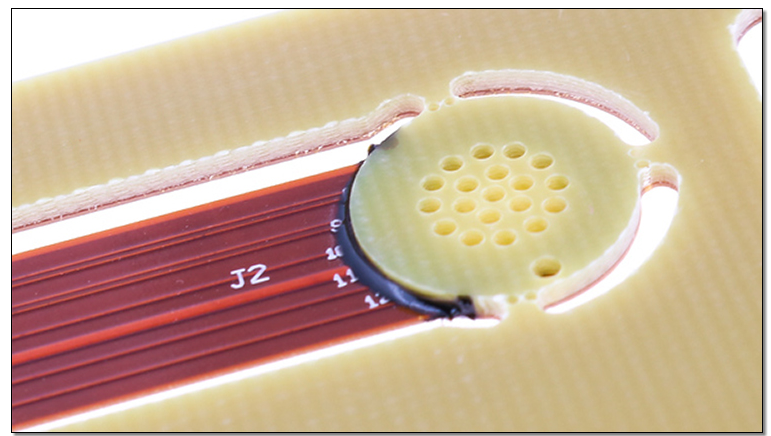
Addition of stiffeners on flex or rigid-flex PCBs can result in increased processing time, labor and
material costs. To avoid stress points and to reduce manufacturing time, the stiffeners on top and
bottom layers must overlap by at least 0.03 inches.
Stick to the most commonly used laminate thicknesses when selecting stiffeners thickness for rigid-flex
or flex PCBs. These include 0.010″, 0.031, 0.047″, and 0.062″. It is important to consult
with the manufacturer to find out what thicknesses are most common. This will help you avoid specifying
a thickness which could cause logistical and cost challenges.
Why Use Stiffeners for Flex Circuit Applications?
The following categories of applications are covered by the Flex PCB stiffener requirement:
Connector/component area rigid
Thickness requirements for ZIF (zero-insertion force).
Local bend restrictions
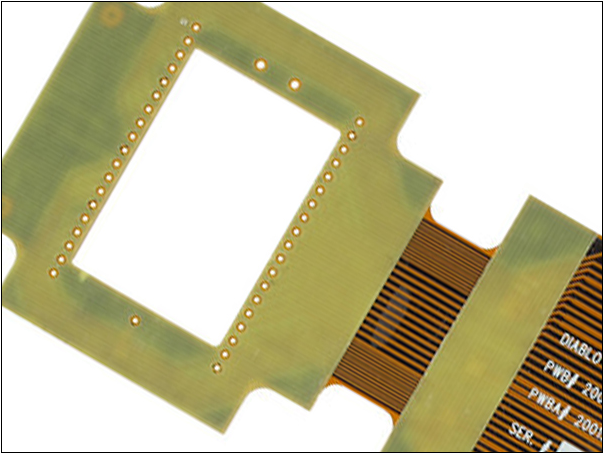
Component/Connector Stiffeners
Function:
Creates a localized rigid area over which components/connectors are attached.
Prevents flexing in component areas to protect solder joints.
Material Options:
FR4, Polyimide Aluminum, Stainless Steel
Available in different thicknesses
Attachment methods:
Thermal bonding using flexible adhesive
Pressure-sensitive adhesive
ZIF Stiffeners
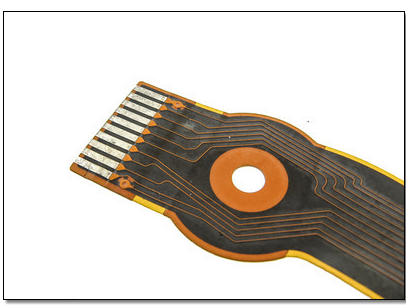
Function:
Increased thickness at the contact finger to meet ZIF connector specifications.
Material Options:
Only Polyimide
Different thicknesses are available to meet specific requirements
Attachment:
Thermal bonding using flex adhesive
Local Bend Constraints
Function:
Orinew Technology SMT: Limit the bend area to a specific place in the flexible design, to facilitate the final
assembly and to achieve specific bending or other end use requirements.
Material selection:
Polyimide FR4
Available in different thicknesses
Attachment:
Thermal bonding using flex adhesive
Pressure-sensitive adhesive