<h1> Accessories </h1> <p> Audio products accessories are any add-on or component used to complement an audio product. This may include audio cables, headphones, microphones, amplifiers, equalizers, speakers, and other audio equipment. Audio accessories can help improve the sound quality of an audio product and provide additional features and functionality. </p> <p>

<h1> Alarms, Buzzers, and Sirens </h1> <h2> 1. What are Alarms, Buzzers, and Sirens? </h2> <h3> 1) Buzzer </h3> <p> <strong>Active Buzzer</strong>: Built-in oscillation circuit, it will sound when powered on, but the tone is single. </p> <p> <strong>Passive Buzzer</strong>: It needs to be driven by an external pulse signal, the tone frequency can be controlled, and the cost is lower. </p> <p> <strong>Type Subdivision</strong>: Including piezoelectric (relying on piezoelectric ceramic vibration) and electromagnetic (driving the diaphragm through the electromagnetic coil). </p> <p> </p> <h3> 2) Alarm and Sirens </h3> <p> </p> <p> Especially used in high-intensity warning scenarios, such as ship alarm systems that must comply with specific military standards (such as MIL-DTL-0015303R). </p> <p> </p> <h2> 2. How do Alarms Work? </h2> <h3> 1) Sounding Principle </h3> <p> </p> <p> <strong>Piezoelectric</strong>: The audio signal is generated by the multivibrator to drive the piezoelectric ceramic to vibrate. </p> <p> <strong>Electromagnetic</strong>: The interaction between the electromagnetic coil and the magnet drives the diaphragm to sound. </p> <p> </p> <h3> 2) Drive Circuit </h3> <p> </p> <p> Commonly used NPN/PNP transistor or MOS tube drive, pay attention to the current limiting resistor and bleeder diode protection circuit. </p> <p> </p> <p> When the microcontroller is driven, an external current amplifier chip (such as ULN2003) is required to provide sufficient driving capacity. </p> <p> </p> <h2> 3. What are Alarms, Buzzers, and Sirens Used For? </h2> <p> <strong>Consumer Electronics</strong>: Prompt tone generation for computer motherboards, printers, electronic toys, and other devices. </p> <p> <strong>Industrial and Security</strong>: Fire alarm and equipment failure warning. </p> <p> </p> <p> <strong>Automotive Electronics</strong>: Reversing radar, safety system alarm. </p> <p> </p> <p> <strong>Ship and Military</strong>: Ship alarm devices that meet specific standards. </p> <p> </p> <h2> 4. How to Choose Alarms, Buzzers, and Sirens? </h2> <p> <strong>Parameter Considerations</strong>: Operating voltage (1.5V-15V), sound pressure level, frequency range (1.5kHz-5kHz), etc. </p> <p> </p> <p> <strong>Note</strong>: Some devices need to select the packaging type according to the scenario (such as a piezoelectric buzzer with a resonance box to enhance the volume). </p> <p> </p> <h2> 5. Alarms, Buzzers, and Sirens FAQs </h2> <h3> 1) In which scenarios are alarm systems widely used? </h3> <p> Mainly used for building fire warning and intelligent evacuation, such as real-time danger notification and crowd guidance through sound and light alarm equipment. </p> <p> </p> <h3> 2) What safety regulations should be considered when using alarm equipment? </h3> <p> Fire safety guidelines must be followed, such as regularly checking the status of the equipment, ensuring that the installation location meets emergency evacuation requirements, and avoiding false triggering of electromagnetic interference. </p> <p> </p> <h3> 3) What are the regulatory requirements for alarm systems? </h3> <p> Some scenarios (such as vehicle seat belt warning systems) must comply with specific regulations, such as allowing exemptions from alarm triggering in specific startup modes, but still meeting basic safety standards. </p> <p> </p> <h3> 4) How to design user-friendly alarm prompts? </h3> <p> The alarm sound must clearly distinguish different emergency levels (such as a short buzzer sound for a mild warning, and a continuous siren sound for a high-risk state) and reduce environmental noise interference. </p> <p>
<h1> Amplifiers </h1> <p> Amplifiers are core devices used in electronic systems to enhance the amplitude, power or current of electrical signals. Their core function is to convert the energy of input signals into higher-intensity output signals through electronic components (such as transistors, electron tubes or integrated circuits) while maintaining the basic characteristics of the signal. </p> <p> </p> <h2> 1. What are the Main Types of Amplifiers? </h2> <h3> 1)Power Amplifiers </h3> <p> Boost low-power signals to a level sufficient to drive high-power loads (such as speakers, antennas, etc.), and are widely used in audio systems, radio frequency communications, and industrial equipment. Typical types include: </p> <p> <strong>Class A Amplifiers</strong>: Always work in the linear region, with low signal distortion but low efficiency. </p> <p> <strong>Class D Amplifiers</strong>: Using switching mode, the efficiency can reach more than 90%, and they are suitable for portable devices. </p> <p> </p> <h3> 2)Operational Amplifiers (Op-Amps) </h3> <p> Characterized by high-precision amplification of voltage signals, they support circuit designs such as inverting proportional amplification and differential amplification, and are widely used in signal conditioning, filtering and mathematical operations. </p> <p> </p> <h3> 3)Sensor Signal Amplifiers </h3> <p> Specially used to amplify weak signals of sensors such as temperature, light intensity, and pressure to improve measurement accuracy. </p> <p> </p> <h3> 4)RF Amplifiers </h3> <p> Used in wireless communication systems (such as mobile phones and radios) to enhance the strength of transmitted signals to expand coverage. </p> <p> </p> <h2> 2. What are Amplifiers Used for? </h2> <p> <strong>Audio Processing</strong> </p> <p> Microphone signal amplification, sound system speaker driving, and signal enhancement in headphones/recording equipment. </p> <p> </p> <p> <strong>Industrial Control</strong> </p> <p> Sensor signal amplification is used for automated equipment monitoring (such as acceleration and pressure detection). </p> <p> </p> <p> <strong>Communication System</strong> </p> <p> Increase the strength of RF signals in base stations, mobile phones, and TV signal transmitters. </p> <p> </p> <p> <strong>Medical Equipment</strong> </p> <p> Amplification and processing of bioelectric signals (such as electrocardiograms). </p> <p> </p> <h2> 3. What are the Technical Principles of Amplifiers? </h2> <p> <strong>Transistor Amplification</strong>: Use transistors such as BJT or FET to achieve current/voltage amplification and form the core unit of the amplifier. </p> <p> <strong>Negative Feedback Mechanism</strong>: Stabilize gain and reduce distortion through feedback networks, which is common in operational amplifier design. </p> <p> <strong>Multi-stage Amplification</strong>: Cascade multiple amplifiers to increase signal strength step by step (such as pre-amplification + power amplification). </p> <p> </p> <h2> 4. What are the Key Parameters of Amplifiers? </h2> <p> <strong>Gain</strong>: The amplitude ratio of the output signal to the input signal (expressed in decibels). </p> <p> <strong>Bandwidth</strong>: The frequency range in which the amplifier works effectively. </p> <p> <strong>Efficiency</strong>: The ratio of output power to input power, the power amplifier needs to be optimized. </p> <p> <strong>Distortion</strong>: The degree of nonlinear distortion of the signal, low distortion design is crucial for high-fidelity audio systems. </p> <p> </p> <h2> 5. What is the Development Trend of Amplifiers? </h2> <p> Modern amplifiers are developing towards high efficiency (such as GaN material application), high integration (SoC integrated op amp module), and intelligence (adaptive gain adjustment) to meet the low power consumption requirements of 5G communications, the Internet of Things, and portable devices. </p> <p> </p> <h2> 6. Amplifiers FAQs </h2> <h3> 1) What are the core advantages of low-voltage precision op amps? </h3> <p> Some low-voltage op amps (such as Renesas products) achieve high-precision signal processing through ultra-low offset voltage and auto-zeroing technology, which is suitable for scenarios such as high-side current detection. </p> <p> </p> <h3> 2) How to optimize the circuit performance of ultra-low offset auto-zero amplifiers? </h3> <p> Pay attention to power supply stability, PCB layout anti-interference design, and avoid thermal errors caused by temperature gradients. </p> <p> </p> <h3> 3) What are the main differences between analog VGA and digital VGA? </h3> <p> Analog VGA controls gain through external voltage (dB is linearly related to voltage), while digital VGA (DVGA) controls gain through digital signals (such as DAC) and is suitable for high-frequency signal conditioning. </p> <h3> </h3> <h3> 4) What are the typical application scenarios of VGA? </h3> <p> Including automatic gain control (AGC), dynamic range compression, and adaptive adjustment of signal strength in communication systems. </p> <p> </p> <h3> 5) What are the power supply requirements of photoelectric sensor amplifiers? </h3> <p> A regulated DC power supply with positive and negative dual outputs is required, the ripple voltage must be ≤3 mVp-p, and the current capacity must be ≥100 mA. A single power supply will cause the device to not work. </p> <p> </p> <h3> 6) How to correctly connect the power cord when using a photoelectric sensor amplifier? </h3> <p> Red connects to the positive output terminal, black connects to the common terminal (COM), and blue connects to the negative output terminal. Incorrect wiring may cause malfunctions. </p> <p> </p> <h3> 7) What are the core functions of the mixer amplifier? </h3> <p> Supports multi-channel input mixing, EQ adjustment, reverb/delay effect addition, and output volume control, suitable for live sound reinforcement and recording scenarios. </p> <p> </p> <h3> 8) What are the classifications and functions of feedback amplifiers? </h3> <p> It is divided into positive feedback (used for oscillators and waveform generation) and negative feedback (improving stability and reducing distortion), which are widely used in power amplifiers and voltage stabilization circuits. </p> <p>
<h1> Buzzer Elements, Piezo Benders </h1> <h2> 1. Buzzer Elements Overview </h2> <h3> 1) What is the Structure and Principle of Buzzer Elements? </h3> <p> A buzzer is an integrated electronic sounder that is driven by DC voltage and generates audio signals through the vibration of internal electromagnets or piezoelectric materials. Its core components include electromagnetic coils, diaphragms, or piezoelectric ceramics. After power is turned on, sound waves are oscillated through electromagnetic induction or mechanical deformation. </p> <p> </p> <h3> 2) What are the Types of Buzzer Elements? </h3> <p> <strong>By driving mode</strong>: </p> <p> It is divided into two categories: active (with its own oscillation circuit, direct drive to produce sound) and passive (requires external square wave signal drive). </p> <p> </p> <p> <strong>By construction type</strong>: </p> <p> <strong>√Electromagnetic</strong>: Use the interaction between the coil and the magnet to drive the metal diaphragm to vibrate and produce sound. </p> <p> <strong>√Piezoelectric</strong>: Relying on the inverse piezoelectric effect of piezoelectric ceramics, the sound is produced by the deformation caused by voltage changes. </p> <p> </p> <h3> 3) What are the symbols and logos of Buzzer Elements in the Circuit? </h3> <p> In the circuit, it is represented by the letter "H" or "HA", and the old standard may use symbols such as "FM" and "LB". </p> <p> </p> <h3> 4) What are Buzzer Elements Used for? </h3> <p> Widely used in computer motherboards, printers, alarms, automotive electronics (such as reversing radar), medical equipment, etc., as a source of prompt sounds or alarm signals. </p> <p> </p> <h2> 2. Piezo Benders Overview </h2> <h3> 1) What are the Principles and Characteristics of Piezo Benders? </h3> <p> It is the core component of the piezoelectric buzzer and uses polarized piezoelectric ceramic materials. When voltage is applied, the material bends due to the inverse piezoelectric effect, and the deformation amplitude is positively correlated with the voltage intensity, thereby converting electrical energy into mechanical vibration and outputting sound. </p> <p> </p> <h2> 2) What are the Advantages of Piezo Benders? </h2> <p> √Fast response speed and low power consumption; </p> <p> √Compact structure, suitable for miniaturization design; </p> <p> √No electromagnetic coil is required, and the anti-electromagnetic interference ability is strong. </p> <p> </p> <h3> 3) What are Piezo Benders Used for? </h3> <p> Common in high-precision equipment (such as medical sensors), portable electronic products (such as smartwatch alarm modules), and acoustic systems that require high-frequency response. </p> <p> </p> <h3> 4) How to Choose Piezo Benders? </h3> <p> <strong>√Packaging type</strong> </p> <p> Plug-in type: convenient for manual welding, common in traditional equipment. </p> <p> Surface Mounted Device (SMD): Adapts to automated production and improves PCB aesthetics and stability. </p> <p> </p> <p> <strong>√Selection Recommendations </strong> </p> <p> Requires comprehensive consideration based on drive mode (active/passive), frequency requirements, packaging form, and working environment (such as humidity, and temperature) </p> <p>
<h1> Guitar Parts, Accessories </h1> <p> Guitar parts or guitar accessories include different styles of control knobs, picks, cables, audio plugs, arm tips, bridge assemblies, cigar guitar kits, clips, tuners, nut, tuners, wall mounts, and various types of pedals including synthesizer, tremolo, reverb, phase shift, octave, overdrive, distortion, delay, etc. </p> <p>
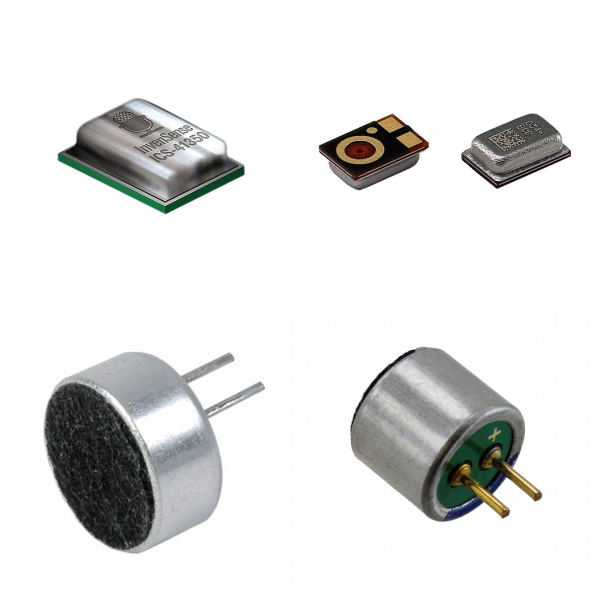
<h1> Microphones </h1> <h2> 1. Microphones Overview </h2> <p> Microphone is a transducer device that converts sound wave signals into electrical signals. It is widely used in communication equipment, consumer electronics, medical instruments, and other fields. Its core function is based on the conversion of mechanical vibration caused by sound pressure changes and electrical parameters (such as capacitance and voltage). </p> <p> </p> <h2> 2. What is the Classification and Working Principle of Microphones? </h2> <h3> 1) Dynamic Microphone </h3> <p> </p> <p> <strong>Principle</strong>: Using electromagnetic induction, sound waves drive the diaphragm to drive the coil to move in the magnetic field, generating induced current. </p> <p> <strong>Features</strong>: Simple structure and durability, but low sensitivity, poor high-frequency response, suitable for human voice recording. </p> <p> </p> <h3> 2) Capacitive Microphone </h3> <p> </p> <p> <strong>Principle</strong>: Sound pressure causes the capacitance between the diaphragm and the backplate to change, and the bias voltage is provided by the charge pump. The signal is output after ASIC amplification. </p> <p> <strong>Subtypes</strong>: </p> <p> <strong>√MEMS Microphone</strong>: The silicon-based diaphragm is etched using micro-electromechanical technology, and the ASIC chip is integrated. It has the characteristics of small size and good consistency. </p> <p> <strong>√Electret Microphone </strong>: The built-in electret material provides a fixed charge, and no external bias power supply is required. It is often used in consumer electronics products. </p> <p> </p> <h3> 3) Piezoelectric Microphone </h3> <p> </p> <p> <strong>Principle</strong>: Utilize the mechanical stress-voltage effect of piezoelectric materials to directly convert vibration into electrical signals, and it has been gradually applied to the MEMS field in recent years. </p> <p> </p> <h2> 3. What are the Structural Features of Microphones? </h2> <p> <strong>MEMS Microphone</strong>: </p> <p> It is composed of a silicon diaphragm and a perforated backplate to form a variable capacitor. The front cavity/back cavity design affects the frequency response characteristics (such as the large front cavity of the Top type and the low high-frequency resonance point). </p> <p> </p> <p> Packaging forms include COB (Chip On Board) and surface mounting, supporting digital/analog output. </p> <p> <strong>Electret Microphone</strong>: </p> <p> It includes an electret backplate and a field effect transistor to simplify the circuit design, but it needs to be matched with an impedance-matching circuit. </p> <p> </p> <h2> 4. What are the Key Parameters of Microphones? </h2> <p> <strong>Sensitivity</strong>: Expressed in dBV (analog) or dBFS (digital), reflecting the efficiency of converting sound pressure into electrical signals. </p> <p> <strong>Frequency Response</strong>: Determines the microphone's ability to capture sound waves of different frequencies, such as the Top type MEMS has a narrow frequency response range. </p> <p> </p> <p> <strong>Signal-to-noise Ratio (SNR)</strong>: Related to thermal noise, MEMS microphones reduce noise by optimizing diaphragm materials (such as silicon nitride). </p> <p> <strong>Maximum Sound Pressure Level (SPL)</strong>: The upper limit of sound pressure that a microphone can withstand. Digital MEMS usually supports 120 dB SPL. </p> <p> </p> <h2> 5. What are Microphones Used for? </h2> <p> <strong>Consumer Electronics</strong> : Mobile phones, headphones (MEMS-based). </p> <p> <strong>Industrial and Medical</strong> : Voice-controlled equipment, hearing aids (requires high sensitivity and low noise). </p> <p> <strong>Professional Audio</strong> : Recording equipment, stage microphones (dynamic/capacitive-based). </p> <p> </p> <h2> 6. What are the Development Trends of Microphones? </h2> <p> <strong>Integration</strong> : High integration of MEMS and ASIC chips to improve signal processing efficiency. </p> <p> <strong>Miniaturization</strong> : Silicon-based processes drive microphone size down to the millimeter level to meet the needs of wearable devices. </p> <p> <strong>Multimodal Fusion </strong>: Combining piezoelectric and capacitive technologies to optimize frequency response and signal-to-noise ratio. </p> <p> </p> <h2> 7. Typical Brands for Microphones </h2> <p> Analog </p> <p> Goertek </p> <p> Infineon </p> <p> SparkFun </p> <p> TDK </p> <p> And so on... </p> <p> </p> <h2> 8. Microphones FAQs </h2> <h3> 1) How to choose a suitable microphone? </h3> <p> <strong>Type is Determined by Purpose</strong>: Condenser microphones are preferred in recording studios; dynamic microphones can be considered for live broadcasts or outdoor scenes; MEMS microphones are recommended for mobile devices. </p> <p> <strong>Interface Compatibility</strong>: Pay attention to the device interface type (such as 3.5mm, USB, or Lightning). Some iPhones require external microphones to be connected via adapters. </p> <p> <strong>Performance Parameters</strong>: Pay attention to signal-to-noise ratio (SNR), sensitivity, and frequency response range. For example, MEMS microphones have the advantages of ultra-low noise and phase matching. </p> <p> </p> <h3> 2) How to solve the microphone connection problem? </h3> <p> <strong>External Microphone for iOS Devices</strong>: If the device does not have a 3.5mm interface (such as iPhone 7 and above), you need to use a Lightning to 3.5mm adapter or a USB microphone that supports digital signals. </p> <p> <strong>Wireless Microphone Interference</strong>: Check whether the wireless frequency band conflicts and ensure that the distance between the transmitter and the receiver is within the effective range. </p> <p> </p> <h3> 3) How do the technical parameters of the microphone affect the use effect? </h3> <p> <strong>Signal-to-noise Ratio (SNR)</strong>: The higher the value, the lower the background noise (e.g. MEMS microphones can reach 74dB SNR). </p> <p> <strong>Sensitivity</strong>: Determines the ability to pick up sound. Condenser microphones are usually more sensitive than dynamic microphones. </p> <p> <strong>Total Harmonic Distortion (THD)</strong>: Low distortion (e.g. <1%) can ensure sound reproduction, especially in high-voltage sound fields (e.g. instrument recording). </p> <p> </p> <h3> 4) What are the differences between microphones in different application scenarios? </h3> <p> <strong>Live Broadcast/Game</strong>: Low latency and high clarity are required. It is recommended to choose a USB condenser microphone or a professional gaming headset microphone. </p> <p> <strong>Conference/Lecture</strong>: Lavalier microphones or array microphones (such as the built-in solution of Huawei IdeaHub devices) can improve voice clarity. </p> <p> <strong>Music Recording</strong>: Condenser microphones are suitable for vocals and strings, while dynamic microphones are more suitable for percussion or electric guitar. </p> <p> </p> <h3> 5) What are the Common problems and solutions for using microphones? </h3> <p> <strong>Too much Background Noise</strong>: Check the stability of the power supply (condenser microphones require stable phantom power), or replace the microphone with a higher SNR. </p> <p> <strong>Insufficient Sensitivity</strong>: Adjust the device gain setting, or choose a microphone type with higher sensitivity (such as a condenser). </p> <p> <strong>Compatibility Issues</strong>: Confirm that the operating system or software driver supports it. Some professional microphones require the installation of specific drivers. </p>
<h1> Speakers </h1> <p> Speakers are core components used to convert electrical signals into audible sound waves. </p> <p> </p> <h2> 1. Speakers Overview </h2> <h3> 1) What are Speakers? </h3> <p> <strong>Definition</strong>: Loudspeaker/Speaker is a transducer device that converts electronic signals into sound waves. Its core function is to achieve electroacoustic conversion. </p> <p> <strong>Structural Composition</strong>: Usually composed of a diaphragm, voice coil, magnet, and other components. Some high-end models use a combination of multiple units (such as tweeter, midrange, and woofer) to cover the full frequency band. </p> <p> </p> <h3> 2) What are the Types of Speakers? </h3> <p> <strong>By Use</strong>: Including audio speakers, mobile phone receivers (Receiver), micro speakers, etc.. </p> <p> <strong>By Frequency Band</strong>: </p> <p> <strong>√Tweeter</strong>: Responsible for high-frequency band (such as >2kHz); </p> <p> <strong>√Mid-range driver</strong>: Covering mid-range (such as 300Hz–2kHz); </p> <p> <strong>√Woofer</strong>: Specializing in low-frequency band (such as <300Hz). </p> <p> </p> <h2> 2. What are the Technical Parameters and Selection Points of Speakers? </h2> <h3> 1) Key Parameters </h3> <p> <strong>Frequency response</strong>: such as 900 Hz (specific models); </p> <p> <strong>Sound pressure level (SPL)</strong>: typical value is 92 dB; </p> <p> <strong>Impedance</strong>: common 8 Ohms; </p> <p> <strong>Power</strong>: ranging from milliwatts (such as 300 mW) to kilowatts; </p> <p> <strong>Size and installation</strong>: SMD micro speakers with a diameter of 15 mm and a depth of 2.8 mm are suitable for compact spaces. </p> <p> </p> <h3> 2) Selection Considerations </h3> <p> <strong>Application Scenarios</strong>: need to match device requirements (such as mobile phones, audio systems, industrial alarms); </p> <p> <strong>Environmental Tolerance</strong>: operating temperature range (such as -20 °C to +85 °C), dust and water resistance, etc. </p> <p> <strong>Material Selection</strong>: such as Neodymium Iron Boron magnets (Neodymium Iron Boron) to improve efficiency, polyester film (Mylar) diaphragm optimizes high-frequency response. </p> <p> </p> <h2> 3. Where are Speakers Used? </h2> <p> <strong>Consumer Electronics</strong>: integrated micro speakers in mobile phones, headphones, smart speakers and other devices; </p> <p> <strong>Industrial Equipment</strong>: such as alarms, and sensor feedback systems; </p> <p> <strong>Professional Audio</strong>: multi-unit combination systems are used in theaters, stages, and other scenes. </p> <p> </p> <h2> 4. Positioning in Electronic Components </h2> <p> <strong>Packaging form</strong>: Board Mount is the mainstream, suitable for automated production; </p> <p> <strong>Supporting components</strong>: often designed in collaboration with power amplifier chips and filters to optimize sound quality; </p> <p> <strong>Standardized logo</strong>: abbreviated as SPEAKER in circuit design software (such as Proteus) to facilitate schematic drawing. </p> <p> </p> <h2> 5. What is the Development Trend of Speakers? </h2> <p> <strong>Miniaturization</strong>: MEMS technology promotes the development of ultra-small speakers; </p> <p> <strong>High fidelity</strong>: Digital signal processing (DSP) and multi-band frequency division technology improve sound quality; </p> <p> <strong>Integration</strong>: form an intelligent acoustic system with microphones, sensors, etc. </p> <p> </p> <h2> 6. Speakers FAQs </h2> <h3> 1) How to choose the right speaker? </h3> <p> Consider the usage scenario (home, professional recording, etc.), power requirements, and sound quality preferences, and give priority to matching the amplifier performance. </p> <p> </p> <p> For surround sound systems, it is recommended to choose products that are consistent with the brand of the main speakers. For example, Bose surround speakers need to be paired with smart soundbars of the same brand to achieve the best effect. </p> <p> </p> <p> It is recommended to use high-quality oxygen-free copper wire and avoid being close to electromagnetic interference sources; the main speakers should be arranged in an equilateral triangle with the listener. </p> <p> </p> <h3> 2) What is the difference between passive and active speakers? </h3> <p> Passive speakers require an external amplifier, while active speakers have built-in amplifiers. The latter is suitable for simplifying system configuration. </p> <p> </p> <h3> 3) What are the advantages of speaker transmission line design? </h3> <p> Compared with traditional bass reflex design, transmission lines can provide deeper a low-frequency response, but the technology is complex, and the cost is high, so they are not widely adopted. </p> <p>