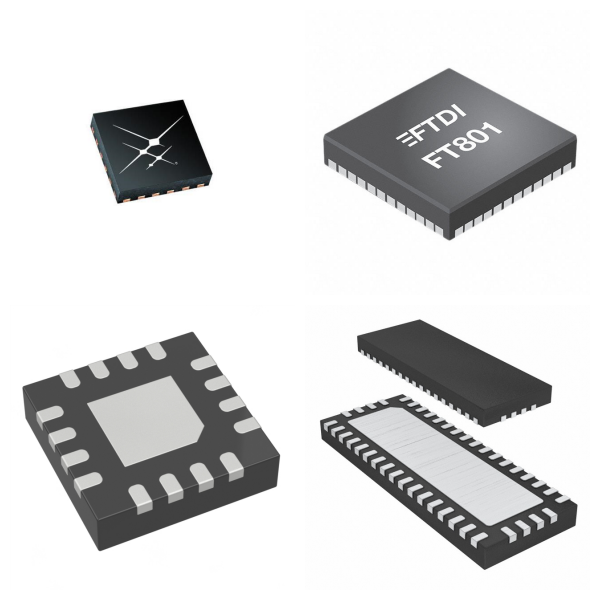
New title

<h1> Amplifiers </h1> <h2> 1. What are Linear Amplifier ICs?‌ </h2> <p> A linear amplifier IC is an integrated circuit based on amplifier design, which belongs to the category of analog integrated circuits. Its core function is to perform distortion-free linear amplification of the input signal, and the output signal maintains the same waveform and proportional relationship with the input signal, which is suitable for scenarios with high signal quality requirements (such as audio amplification and communication systems). </p> <p>   </p> <h2> 2. What are the ‌Core Characteristics of Linear Amplifier ICs?‌ </h2> <p> <strong>‌Linear Relationship‌</strong>: The input and output signals are in strict linear proportion, the amplification factor is stable, and it is suitable for precise signal processing. </p> <p> <strong>‌Low Distortion‌</strong>: Within the rated operating range, the integrity of the signal waveform can be maintained to avoid nonlinear distortion. </p> <p> <strong>‌High Precision‌</strong>: The integrated process makes the internal components have good consistency of characteristics and high proportional accuracy, and improves circuit stability. </p> <p>   </p> <h2> 3. ‌Typical Representative Devices of Linear Amplifier ICs‌ </h2> <p> ‌Operational amplifier (Op-Amp)‌ is the most common linear amplifier IC, with high gain, wide frequency response, and multi-purpose (such as signal conditioning, filtering, comparison) and other characteristics. It is the core component of analog circuit design. </p> <h2>   </h2> <h2> 4. What are the ‌Main Application Areas of Linear Amplifier ICs?‌ </h2> <p> <strong>‌Audio Processing‌</strong>: sound system, microphone preamplifier </p> <p> <strong>‌Communication System‌</strong>: RF signal amplification, base station signal conditioning </p> <p> <strong>‌Instrumentation‌</strong>: sensor signal amplification, precision measurement circuit </p> <p> <strong>‌Power Management‌</strong>: regulator control loop, feedback regulation </p> <p>   </p> <h2> 5. ‌Difference from Nonlinear Elements‌ </h2> <p> <strong>Linear amplifier ICs are active linear elements, which are different from nonlinear elements such as diodes and transistors</strong>: </p> <p> <strong>‌Linear Elements‌</strong>: the input-output relationship can be described linearly (such as operational amplifiers working in the linear region); </p> <p> <strong>‌Nonlinear Elements‌</strong>: input and output are exponential or switching characteristics (such as diode rectification and digital logic gates). </p> <p>   </p> <h2> 6. ‌Manufacturing Process of Linear Amplifier ICs‌ </h2> <p> Mainly manufactured using bipolar process‌ or BiCMOS process‌. High-performance models may combine ion implantation and MOS process (such as switched capacitor filter technology) to achieve better frequency response and energy consumption control. </p> <p>   </p> <h2> 7. Summary </h2> <p> Linear signal amplification integrated circuits represented by operational amplifiers have low distortion and high precision characteristics, making them the core components of analog circuits and widely used in consumer electronics, industrial control, and communications. </p> <p>
<h1> Analog Multipliers, Dividers </h1> <p> Linear analog multipliers and dividers ICs are integrated circuits dedicated to performing multiplication and division operations on analog signals. They are widely used in mixed analog and digital systems to achieve high-performance mathematical operations. </p> <p>   </p> <h2> 1. What are Linear Analog Multipliers and Dividers ICs?  </h2> <p> These devices belong to the category of analog integrated circuits. They can directly perform multiplication (such as V out =k×V in1×V in2)and division(such as V out =k×V in1/V in2 ) operations on continuous analog signals. They are often used in scenarios such as signal modulation, demodulation, or error correction. They are usually integrated into active component designs to improve calculation accuracy and response speed. </p> <h2>   </h2> <h2> 2. What are the ‌Technical Features of Linear Analog Multipliers and Dividers ICs? </h2> <p> <strong>High Precision and High Speed</strong>: Modern variants are optimized for traditional problems of low precision, low speed, and single function, suitable for real-time signal processing needs. </p> <p> <strong>Mixed Signal Processing Capability</strong>: Can be seamlessly integrated into analog-to-digital conversion systems to process complex signals to expand functional flexibility. </p> <p>   </p> <h2> 3. What are Linear Analog Multipliers and Dividers ICs Used for? </h2> <p> In radio engineering and communication equipment, they are used for signal gain control, frequency synthesis, or power calculation. </p> <p>   </p> <p> As a core component of intelligent microelectronic systems, it supports mixed mathematical operations in microprocessors, such as sensor signal conditioning or feedback control. </p> <p>   </p> <p> The development of such ICs reflects the key role of analog integrated circuits in improving system integration and performance. </p> <p>
<h1> Comparators </h1> <h2> 1. What are Linear Comparators? </h2> <p> <strong>‌Basic Definition‌</strong>: A linear comparator is an electronic circuit that compares the magnitude relationship of two analog input signals and outputs a high/low level digital signal as the comparison result. When the input signal exceeds the preset threshold, the output is high level, otherwise the output is low level. </p> <p> <strong>‌The Meaning of "Linear"</strong>: refers to the response stage before the input signal reaches the threshold, there is a linear relationship between the output and the input; but the overall function is still to trigger the state jump through the threshold, rather than continuously amplifying the signal. </p> <p>   </p> <h2> 2. What are the Key Characteristics of Linear Comparators? </h2> <p> <strong>‌Response Characteristics‌</strong>: The linear response to the input signal is limited to a specific range near the threshold, and it is essentially still a discontinuous switching device. </p> <p> <strong>‌Difference from Hysteresis Comparator‌</strong>: Hysteresis comparators (such as Schmitt triggers) form a hysteresis loop through positive feedback to resist interference, while linear comparators do not have this feature, and the output may be falsely triggered due to noise. </p> <p> <strong>‌Basis for Component Classification‌</strong>: Although it is called "linear", its working mode involves state mutations and belongs to the category of nonlinear components; the "linear" in the name only describes the local characteristics before the threshold. </p> <p>   </p> <h2> 3. What are Linear Comparators Used for? </h2> <p> <strong>‌Signal Interface Conversion‌</strong>: used for threshold detection of analog signals in analog-to-digital converters (ADCs) to achieve the transition from analog to digital signals. </p> <p> <strong>‌Protection and Monitoring Circuit‌</strong>: used for voltage monitoring, overvoltage/undervoltage protection systems, and real-time detection of power supply or signal anomalies. </p> <p> <strong>‌Sensor Signal Processing‌</strong>: cooperate with sensors (such as photosensors and pressure sensors) to compare signals and trigger subsequent control logic. </p> <p>   </p> <h2> 4. Actual Product Examples for Linear Comparators </h2> <p> Some domestic analog chip manufacturers (such as Linearin) have launched high-performance comparator product lines, covering low power consumption, high precision, and other types, which are used in industrial control, the Internet of Things, and automotive electronics. </p> <p>   </p> <h2> 5. ‌Summary‌ </h2> <p> Linear comparators are key threshold judgment devices in analog circuits. Their "linear" characteristics are reflected in the local linear response of the input before the threshold. They are suitable for scenarios that require precise level detection, but attention should be paid to anti-interference design to avoid false triggering. </p> <p>   </p> <p>
<h1> Video Processing </h1> <p> Linear video processing ICs are a type of integrated circuits that are specifically designed for processing video signals. They are mainly used in the fields of amplification, routing, timing recovery, and quality optimization of analog video signals. These devices usually belong to the category of linear (analog) circuits, emphasizing linear processing and low-distortion characteristics of signals to ensure the clarity and stability of video transmission. </p> <p>   </p> <h2> 1. What are the ‌Functions and Types‌ of Linear Video Processing ICs? </h2> <p> <strong>‌Video Amplifier‌</strong>: used to enhance the amplitude of weak video signals to ensure that the strength of the output signal meets the requirements of display devices; for example, the LT6551 series video amplifier supports multi-channel operation, has high bandwidth and fast conversion rate, and is suitable for high-definition video systems. </p> <p> <strong>‌Crosspoint Switch‌</strong>: realizes the routing and matrix switching of video signals, and supports multi-input and multi-output configurations; for example, the M21260G-12 device provides a 4x4 crosspoint function and integrates a 3G reclock unit to restore clock synchronization and reduce signal jitter. </p> <p>   </p> <p> <strong>‌Signal Conditioner‌</strong>: Includes anti-interference filtering and gain control modules, used to pre-process video signals, improve signal-to-noise ratio, and reduce distortion, and usually works with amplifiers in the signal chain. </p> <p>   </p> <h2> 2. What are Linear Video Processing ICs Used for? </h2> <p> This type of IC is widely used in video surveillance systems, broadcasting and television equipment, medical imaging instruments, and consumer electronics products, responsible for key video signal link management, such as stable signal distribution and enhancement in camera signal transmission, video switchers, and display driver circuits. Its design focuses on low power consumption, high integration, and anti-interference capabilities to adapt to the miniaturization requirements of modern video equipment. </p> <p>   </p> <h2> 3. What are the ‌Technical Features‌ of Linear Video Processing ICs? </h2> <p> As part of the signal chain chip, linear video processing ICs often use surface mount packages (such as MSOP or QFN), support high-speed signal processing (bandwidth can reach hundreds of megahertz), and rely on precision linear components (such as operational amplifiers) to maintain signal linearity. </p> <p>   </p> <p> In summary, linear video processing ICs provide efficient and reliable signal management solutions for video systems through professional analog signal processing technology. </p> <p>   </p> <h2> 4. Linear Video Processing ICs FAQs </h2> <p> <strong>‌Q1</strong>: What common problems may you encounter when using linear video processing ICs in your design? ‌ </p> <p> Common problems include unstable output voltage (caused by load changes or input power fluctuations), switching noise and electromagnetic interference (EMI) problems (caused by high-frequency switching processes), and overheating problems (such as excessive voltage difference or poor heat dissipation leading to performance degradation). In addition, the device may have failure modes such as open circuit, short circuit, or parameter drift, affecting system stability. </p> <p>   </p> <p> <strong>‌Q2</strong>: How to solve the output instability and noise problems of linear video processing ICs? ‌ </p> <p> For output instability, add input/output decoupling capacitors to smooth the voltage regulation, and improve the response speed by optimizing the feedback loop control. For noise and EMI, it is recommended to use LC filters for output filtering, shorten the signal line path to isolate the noise source, and design a good ground plane layout to reduce interference. At the same time, choosing ICs with low capacitance design can further optimize high-frequency performance. </p> <p>   </p> <p> <strong>‌Q3</strong>: How to diagnose and deal with the failure of linear video processing ICs? ‌ </p> <p> Failure diagnosis can be done in a variety of ways: first, verify that the device is working properly through electrical performance tests (such as functional tests and parameter tests); then use non-destructive techniques such as X-ray fluoroscopy or ultrasonic scanning microscopy (C-SAM) to check internal defects (such as solder joint failure or delamination problems); finally, combine failure mode analysis (such as SEM or TEM microscopy) to identify the root cause (such as metallization layer damage or oxidation problems). Solutions include replacing damaged units or optimizing environmental adaptability design (such as operating temperature range). </p> <p>   </p> <p> <strong>‌Q4</strong>: How to ensure the long-term reliability and environmental adaptability of linear video processing ICs? ‌ </p> <p> To ensure reliability, aging tests and dynamic performance monitoring (such as forward transconductance and node capacitance checks) are required to simulate long-term operating conditions. At the same time, selecting devices with wide temperature adaptability (typical operating temperature range is -55°C to 125°C) and optimizing heat dissipation design (such as adding a heat sink or improving PCB layout) can prevent overheating failures. Regular failure analysis (including physical inspection and coding feature verification) helps to detect potential problems in advance. </p> <p>

Linear

1. What are Linear ICs?

‌Linear ICs‌ refer to integrated circuits that process analog signals and have a linear relationship between input and output. These devices process continuous signals by amplification, voltage/current regulation, or filtering, and the output signal maintains a proportional relationship with the input signal without changing the original waveform. Unlike digital integrated circuits, linear ICs focus on high-precision control of analog signals.


2. What are the Core Features of Linear ICs?

‌Linear Transmission Characteristics

The input and output signals strictly follow a linear proportional relationship (such as Vout=k*Vin) to ensure that the signal processing process is distortion-free.


‌Stability and Low Noise

The performance is stable underrated working conditions, and suitable for scenarios with high signal accuracy requirements (such as audio amplification and voltage stabilization circuits).


‌Frequency Response Consistency

The response to different frequency signals within the effective bandwidth remains consistent to avoid frequency distortion.


3. What are the Main Functions and Applications of Linear ICs?

Function

Typical Application Scenarios

Representative Devices

Signal Amplification

Audio Equipment (speakers, headphones, power amplifiers)

Operational Amplifier

Voltage/Current Regulation

Power Supply Voltage Regulator Circuit, Sensor Signal Conditioning

Linear Regulator (LDO)

Filtering

Noise Suppression, Signal Extraction (such as a low-pass filter)

Active Filter IC

Signal Comparison and Conversion

Analog Switch, Analog-to-digital Conversion Interface

Voltage Comparator

4. Positioning of Linear ICs in Electronic Systems

Relationship with Passive Components: Linear ICs often work with linear passive components such as resistors, capacitors, and inductors to form a complete analog circuit system.

Distinguishing from Nonlinear Components: Unlike nonlinear components such as diodes and transistor switching circuits, linear ICs work in the amplification area rather than the switching state to maintain signal continuity.

Technological Evolution: As the core branch of analog ICs, its process and packaging technology are continuously optimized to meet the requirements of high integration and low power consumption (such as CMOS process linear ICs).


5. Linear ICs FAQs

1) What are the key factors affecting linearity? ‌

‌Device Characteristics‌: transistor threshold voltage drift, nonlinear effects of parasitic capacitance/resistance.

‌Working Conditions‌: bias voltage stability, and saturation distortion caused by excessive input signal amplitude.

‌Process Deviation‌: parameter fluctuations during the manufacturing process affect consistency.


2) ‌Why are Linear ICs less efficient? How to optimize? ‌

When linear ICs (especially linear power supplies) step down the voltage through a series regulator, the excess energy is dissipated as heat energy, and the efficiency is usually 50%~80%.

‌Optimization Direction‌: Use low-dropout regulators (LDOs) to reduce voltage drop losses; heat dissipation design needs to be strengthened in high-temperature scenarios.


3) What are the typical failure modes of Linear ICs? ‌

‌Overheating Failure‌: Long-term overload or insufficient heat dissipation leads to thermal breakdown (accounting for more than 15% of failures).

‌Parameter Drift‌: Temperature changes cause resistance/capacitance value offsets, affecting amplification accuracy.

‌Interface Failure‌: Aging of solder joints and corrosion of pins lead to poor contact.


6. Summary

Linear ICs are the cornerstone of analog electronic systems. With their high-precision signal processing capabilities, they are widely used in consumer electronics, industrial control, communication equipment, and other fields. Their design focuses on maintaining the linear fidelity of signals, complementing the functions of digital ICs, and jointly supporting the operation of modern electronic devices.