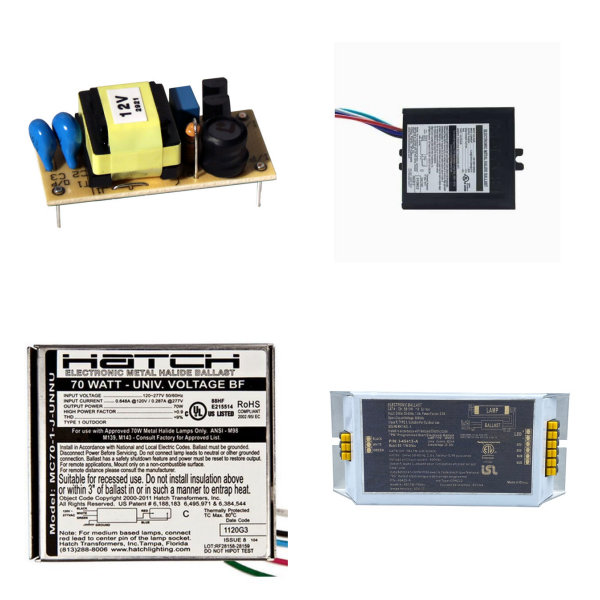
<h1> Ballasts, Inverters </h1> <h2> 1. Ballasts Overview </h2> <h3> 1)Definition and Function </h3> <p> A ballast is a power conversion device that provides stable current and voltage for discharge lamps (such as fluorescent lamps). It is mainly used to limit current, prevent lamp overload, and ensure voltage requirements at startup. </p> <p> </p> <h3> 2)Electronic Ballasts </h3> <p> <strong>Technical Principle</strong>: Adopt high-frequency switching technology (such as power bipolar transistors or MOSFET) to convert industrial frequency power into high-frequency current (kilohertz level), significantly improving the luminous efficiency and energy efficiency of lamps. </p> <p> </p> <p> <strong>Advantages</strong>: Compared with traditional inductive ballasts, it is smaller, has lower power consumption, and supports a dimming function, which is suitable for energy-saving lighting systems. </p> <p> </p> <p> <strong>Application Scenarios</strong>: Widely used in commercial lighting, industrial lighting, and household energy-saving lamps. </p> <p> </p> <h3> 3)Core Features </h3> <p> High-frequency operation reduces flicker and improves visual comfort; </p> <p> </p> <p> Adapts to the negative impedance characteristics of fluorescent lamps to ensure stable operation. </p> <p> </p> <h2> 2. Inverters Overview </h2> <h3> 1)Definition and Function </h3> <p> Inverters are electronic devices that convert direct current into alternating current, supporting output requirements of different voltages and frequencies, and are commonly used in power conversion, drive equipment, and new energy systems. </p> <p> </p> <h3> 2)Resonant Inverters </h3> <p> <strong>Technical Principle</strong>: Use resonant circuits to achieve zero current or zero voltage switching (ZCS/ZVS), reduce switching losses, and improve efficiency. Typical types include Class-L and Class-M topologies. </p> <p> <strong>Advantages</strong>: Suitable for high-voltage applications (such as high-voltage requirements when fluorescent lamps are started), and have strong adaptability to load changes. </p> <p> </p> <h3> 3)Application Areas </h3> <p> <strong>Electronic Ballast</strong>: Combined with resonant inverters, it can achieve an efficient starting and stable power supply for fluorescent lamps; </p> <p> </p> <p> <strong>New Energy Systems</strong>: Used in high-voltage power conversion scenarios such as solar inverters and electric vehicle charging devices. </p> <p> </p> <h2> 3. Relevance and Development Trends </h2> <p> <strong>Synergy</strong>: Electronic ballasts often integrate inverter modules to optimize the overall performance of lighting systems through high frequency and resonance technology; </p> <p> </p> <p> <strong>Technology Trends</strong>: Develop towards higher frequency and lower loss semiconductor devices (such as GaN, SiC) to promote intelligent and integrated design. </p>
<h1> Circuit Board Indicators, Arrays, Light Bars, Bar Graphs </h1> <h2> 1. What are Circuit Board Indicators, Arrays, Light Bars and Bar Graphs? </h2> <p> <strong>Single LED Indicators</strong> </p> <p> Including 3mm prismatic SMD LEDs (such as 591-2601-013F blue LEDs), 5mm dome diffused LEDs (such as MV67538MP6 red LEDs), etc., usually mounted in a patch or through-hole mode. </p> <p> </p> <p> <strong>Arrays and Light Strips</strong> </p> <p> Such as SSP-LT6002UP24 green LED light tube (24V), SSP-CS836U12 red LED light strip (12V), etc., support multi-LED integrated design, suitable for long strip lighting or signal indication. </p> <p> </p> <p> <strong>Bar Graphs</strong> </p> <p> For example, the KWL-R1025 series green bar graph module contains 10 DIP-arranged LEDs for dynamic data display or progress indication. </p> <p> </p> <h2> 2. What are the Technical Parameters of Circuit Board Indicators, Arrays, Light Bars and Bar Graphs? </h2> <p> <strong>Color and Wavelength</strong>: Covering red (626nm, 525nm), blue (470nm), green (520nm), and other spectrums. </p> <p> </p> <p> <strong>Voltage and Power Consumption</strong>: Operating voltage range 2.1V to 24V, power consumption from 105mW to higher power design. </p> <p> </p> <p> <strong>Installation Method</strong>: Support SMD, through hole and right-angle installation, adapt to different circuit board layout requirements. </p> <p> </p> <h2> 3. What are Circuit Board Indicators, Arrays, Light Bars and Bar Graphs Used for? </h2> <p> <strong>Industrial Control</strong>: Equipment status indicator, sensor feedback display. </p> <p> </p> <p> <strong>Consumer Electronics</strong>: Home appliance panel backlight, smart touch interface. </p> <p> </p> <p> <strong>Automotive Electronics</strong>: Instrument panel lighting, signal indication inside and outside the car. </p> <p> </p> <p> <strong>Communication and Security</strong>: Network equipment status monitoring, security system alarm indication. </p>
<h1> Cold Cathode Fluorescent (CCFL) & UV Lamps </h1> <h2> 1. What is Cold Cathode Fluorescent Lamp (CCFL)? </h2> <p> <strong>CCFL Basic Structure</strong> </p> <p> CCFL is a low-pressure glow discharge lamp, which is composed of a slender glass tube, inert gas (argon, neon, krypton), and trace mercury. The inner wall is coated with three-primary color phosphors, and the two ends are made of cold cathode materials such as nickel and tantalum. Its core feature is that it does not need to heat the cathode, and directly stimulates electron emission through a high-voltage electric field. </p> <p> </p> <p> <strong>Luminescence Mechanism</strong> </p> <p> In the startup phase, a high voltage of 1500-1800V is applied to trigger mercury atoms to release 253.7nm ultraviolet rays; </p> <p> </p> <p> Ultraviolet rays excite the phosphor to convert into visible light, and the voltage drops to 500-800V in the maintenance phase to work stably. </p> <p> </p> <p> The secondary electron emission characteristics of the cold cathode (ion bombardment of the cathode surface to release electrons) are the key to maintaining glow discharge. </p> <p> </p> <h2> 2. What are the Technical Features of Cold Cathode Fluorescent Lamps (CCFL)? </h2> <h3> 1) Performance Advantages </h3> <p> <strong>Long life</strong>: up to 30,000 hours in normal use, the number of switching times does not affect the life (significantly compared with incandescent lamps); </p> <p> </p> <p> <strong>Environmental Adaptability</strong>: wide operating temperature range (-28℃~40℃), stable brightness; </p> <p> </p> <p> <strong>High Brightness and Low Consumption</strong>: uniform light emission and low energy consumption, color rendering is better than ordinary fluorescent lamps. </p> <p> </p> <h3> 2) Driving Requirements </h3> <p> CCFL needs to be matched with high-frequency AC power supply (40-80kHz). Because the lamp tube has nonlinear negative resistance characteristics, a dedicated transformer or inverter is required to control the voltage and current. </p> <p> </p> <h2> 3. What are Cold Cathode Fluorescent Lamps (CCFL) Used for? </h2> <p> <strong>Display Technology </strong> </p> <p> As a TFT-LCD backlight, it is widely used in liquid crystal displays, TVs and laptops; </p> <p> </p> <p> Provide uniform lighting in advertising light boxes, scanners, and other equipment. </p> <p> </p> <p> <strong>Special Scenarios</strong> </p> <p> Combined with soft light board technology, it can be made into a flat light source for commercial lighting or personalized advertising boards; </p> <p> </p> <p> In UV-related applications, although the ultraviolet rays released by mercury vapor are mainly used to excite phosphors, their wavelength characteristics can also be adapted to specific UV demand scenarios (such as disinfection or photochemical reactions). </p> <p> </p> <h2> 4. Relationship with UV Light Sources </h2> <p> CCFL's ultraviolet generation depends on mercury vapor discharge, but conventional designs are mainly based on visible light output. If UV output needs to be enhanced, the phosphor coating or gas composition needs to be adjusted. Such variants may be used in medical or industrial fields, but standard CCFLs are still dominated by backlighting and general lighting. </p> <p> </p> <h2> 5. Technology evolution of Cold Cathode Fluorescent Lamps (CCFL) </h2> <p> Although LEDs are gradually replacing CCFLs in the backlight field, their advantages in high brightness, low cost and large-size displays still retain a certain market position. Future technology iterations may focus on energy efficiency improvement and UV band optimization. </p> <p> </p> <h2> 6. CCFL FAQs </h2> <h3> 1) How does CCFL work? </h3> <p> CCFL uses a high-voltage electric field to stimulate the ionization of inert gas (including mercury vapor) to generate ultraviolet light (253.7nm). The ultraviolet light is converted into visible light after irradiating the fluorescent layer on the tube wall. Its core is glow discharge rather than thermal electron emission. </p> <p> </p> <h3> 2) Does CCFL generate ultraviolet light directly? </h3> <p> CCFL generates ultraviolet light during operation, but these ultraviolet rays are mainly used to stimulate the phosphor to emit light, and the final output is visible light. If the fluorescent layer is intact, there is very little ultraviolet leakage; if the lamp tube is damaged, there may be a risk of ultraviolet leakage. </p> <p> </p> <h3> 3) What are the main application areas of CCFL? </h3> <p> <strong>Backlight</strong>: Backlight modules are widely used in liquid crystal displays (such as TVs and computer screens). </p> <p> <strong>Lighting</strong>: Building outline lights, advertising light boxes, and other scenes, because of pure colors and strong penetration. </p> <p> <strong>Industrial equipment</strong>: scanners, medical instruments, etc. </p> <p> </p> <h3> 4) What are the advantages and disadvantages of CCFL compared with LED backlight? </h3> <p> <strong>Advantages</strong>: low cost, mature technology, good luminous uniformity. </p> <p> <strong>Disadvantages</strong>: high energy consumption, short life (about 30,000 hours), mercury-containing, and not environmentally friendly. </p> <p> LEDs are gradually replacing CCFLs due to energy saving and long life, but CCFLs still have cost advantages in the field of large-size displays. </p> <p> </p> <h3> 5) What factors affect the life of CCFL? </h3> <p> The cold cathode design allows it to last up to 30,000 hours, and the number of switches does not affect the life. </p> <p> Light decay is mainly caused by phosphor aging or mercury consumption, and proper maintenance can delay decay. </p> <p> </p> <h3> 6) What are the safety precautions in the use of CCFL? </h3> <p> <strong>High voltage risk</strong>: A special inverter is required to provide hundreds of volts of high-frequency voltage, and improper operation may cause electric shock. </p> <p> <strong>Mercury pollution</strong>: After damage, it must be treated as hazardous waste to avoid contact with mercury vapor. </p> <p> </p> <h3> 7) Can CCFL be used for ultraviolet (UV) lighting? </h3> <p> Ordinary CCFL designs are mainly based on visible light output, and ultraviolet light is only an intermediate product. If a UV light source is required, a special design is required (such as no phosphor coating or specific wavelength optimization), but the search results do not mention such applications. </p>
<h1> Display Backlights </h1> <h2> 1. Display Backlights Overview </h2> <p> Display Backlights are one of the core components of liquid crystal displays (LCDs). It is located behind the screen and provides illumination for the liquid crystal layer by uniform light emission to ensure clear images. Since liquid crystals themselves do not emit light, the brightness and uniformity of the backlight module directly affect the display effect. </p> <p> </p> <h2> 2. What is the Composition Structure of Display Backlights? </h2> <p> <strong>The backlight module mainly includes the following components</strong>: </p> <p> </p> <p> <strong>Light source</strong>: including LED (light-emitting diode), CCFL (cold cathode fluorescent lamp), etc., among which LED has become the mainstream choice due to its long life and low power consumption; </p> <p> </p> <p> <strong>Light guide plate</strong>: converts linear or point light sources into uniform surface light to reduce brightness differences; </p> <p> </p> <p> <strong>Optical film</strong>: such as diffusion film and brightening film, used to improve light uniformity and brightness efficiency; </p> <p> </p> <p> <strong>Drive circuit</strong>: controls the brightness and power consumption of the light source, and supports dynamic dimming technology (such as SEPIC power module). </p> <p> </p> <h2> 3. What are the Types of Display Backlights? </h2> <h3> 1)By light source layout </h3> <p> <strong>Edge-emitting type</strong>: The light source is located on the side of the light guide plate, with a thin and light structure, suitable for portable devices such as mobile phones and laptops; </p> <p> <strong>Direct-down type</strong>: The light source is distributed on the back of the panel, with higher brightness, and is mostly used in large-size devices such as TVs and monitors. </p> <p> </p> <h3> 2)By light source type </h3> <p> <strong>LED backlight</strong>: High color reproduction, support for a wide color gamut, widely used in consumer electronics and vehicle-mounted displays; </p> <p> </p> <p> <strong>CCFL backlight</strong>: Early mainstream technology, gradually replaced due to power consumption and volume issues. </p> <p> </p> <h2> 4. What are Display Backlights Used for? </h2> <p> <strong>Consumer electronics</strong>: Ultra-thin LED edge backlight is preferred for small and medium-sized devices such as smartphones and tablets; </p> <p> </p> <p> <strong>Display devices</strong>: TVs and monitors rely on direct-down backlight to achieve high brightness and HDR effects; </p> <p> </p> <p> <strong>Industrial and automotive</strong>: High-brightness LED backlight is adapted to complex lighting environments, such as car navigation systems. </p> <p> </p> <h2> 5. Development Trends of Display Backlights </h2> <p> <strong>High brightness and energy saving</strong>: Improve energy efficiency by optimizing optical diaphragms and driving circuits, such as SEPIC modules supporting a 4000:1 dimming ratio; </p> <p> </p> <p> <strong>Flexible display</strong>: Combined with Mini/Micro LED technology, promote the development of curved screens and foldable devices; </p> <p> </p> <p> <strong>Integrated design</strong>: Reduce module thickness, improve assembly efficiency, and adapt to ultra-thin terminal requirements. </p> <p> </p> <h2> 6. Display Backlights FAQs </h2> <h3> 1) How long is the life of the backlight? </h3> <p> <strong>The life of the backlight depends on the type</strong>: </p> <p> The life of the backlight of an LCD monitor is usually more than 50,000 hours. If used for 5 hours a day, the theoretical life can reach 27 years. </p> <p> </p> <p> LED backlights have gradually replaced traditional CCFLs in high-brightness applications (such as car navigation), and their life and energy efficiency are better. </p> <p> </p> <h3> 2) How to set the backlight to always be on or adjust the sleep time? </h3> <p> Dell laptops can turn on the backlight through the combination of FN + F5/F10 keys, and set the Keyboard Backlight Timeout option to Never in the BIOS to achieve always on. </p> <p> </p> <p> Other devices can adjust the backlight sleep strategy through system power management or firmware settings. Please refer to the device manual for details. </p> <p> </p> <h3> 3) Why does the LED backlight have color difference problems? </h3> <p> There may be a color difference (ΔE*_(ab) ≥10) when the LED backlight and the broad-spectrum light source are visually matched, mainly due to differences in the spectral characteristics of the light source. The use of the color matching functions updated by the CIE TC 1-36 committee can significantly reduce color differences. </p> <p> </p> <h3> 4) What types of backlights are there? How to choose? </h3> <p> <strong>LED backlight</strong>: The mainstream choice, supports multiple color combinations (such as amber, red, green, and white), suitable for compact devices. </p> <p> <strong>CCFL backlight</strong>: Gradually replaced by LED, but still used in some low-cost scenarios. </p> <p> <strong>Quantum dot backlight</strong>: Can improve color gamut performance, requires a dedicated optical module. </p> <p> </p> <h3> 5) Does the backlight still work when displaying a black screen? </h3> <p> Yes. After the LCD monitor is powered on, the backlight continues to emit light, even if the screen is completely black, the backlight is still in operation. </p>
<h1> Display Bezels, Lenses </h1> <h2> 1. Display Bezels, Lenses Overview </h2> <p> <strong>Display Bezels</strong> </p> <p> Mainly used to fix and protect the display panel and as a connecting component between the display device and the external structure. </p> <p> </p> <p> Some high-end designs will increase the screen-to-body ratio and optimize the user experience through narrow bezel technology. </p> <p> </p> <p> <strong>Lenses</strong> </p> <p> A key component in optoelectronics devices is used to adjust light distribution, focus, or diffuse display content. </p> <p> </p> <p> Common applications include anti-glare treatment, viewing angle optimization, and color enhancement, especially in liquid crystal displays (LCDs) and organic light-emitting diodes (OLEDs). </p> <p> </p> <h2> 2. Technical Characteristics and Materials of Display Bezels, Lenses </h2> <p> <strong>Material selection:</strong> </p> <p> The bezel is mostly made of lightweight metal or high-strength plastic, taking into account heat dissipation and durability. </p> <p> </p> <p> The lens material must have high transmittance and anti-aging properties, such as optical grade polycarbonate or glass. </p> <p> </p> <p> <strong>Integrated design:</strong> </p> <p> Modern display technologies (such as IGZO and LTPS panels) achieve higher resolution and energy efficiency by optimizing the lens and bezel structure. </p> <p> </p> <h2> 3. Where are Display Bezels, Lenses Used? </h2> <p> <strong>Consumer electronics</strong>: Smartphones, tablets, etc. pursue ultra-thin frames and anti-reflective lens designs. </p> <p> </p> <p> <strong>Industrial equipment</strong>: Durable dust-proof and waterproof frames and high-brightness lenses are required to adapt to complex environments. </p> <p> </p> <p> <strong>Automotive dashboard</strong>: High-temperature resistant lenses and impact-resistant frames are used to ensure display stability. </p> <p> </p> <h2> 4. Supply Chain and Procurement of Display Bezels, Lenses </h2> <p> Such devices can be purchased through professional electronic component platforms, supporting customized parameters (such as size and transmittance). </p> <p> </p> <p> When purchasing, you need to pay attention to compatibility certification (such as vehicle-mounted or medical standards). </p>
<h1> Display, Monitor - LCD Driver/Controller </h1> <h2> 1. LCD Driver/Controller Overview </h2> <p> LCD (liquid crystal display) drivers and controllers are core components of electronic display systems, responsible for converting digital signals into visible images. Drivers drive liquid crystal pixels by precisely controlling voltage/current and adjusting transmittance to achieve image display; Controllers manage data flow, timing, and image processing, acting as a bridge between the processor and the display. The two work together to ensure the accuracy and smoothness of displayed content. </p> <p> </p> <h2> 2. Functional Segmentation </h2> <p> <strong>LCD Driver:</strong> </p> <p> Directly drives LCD pixels and supports static or dynamic drive modes. </p> <p> </p> <p> It is divided into segment code type (for simple character display) and matrix type (for high-resolution graphic display). </p> <p> </p> <p> Common types include TFT (thin film transistor) drivers and STN (super twisted nematic) drivers. </p> <p> </p> <p> <strong>LCD controller:</strong> </p> <p> Processes input signals (such as RGB, MIPI DSI, LVDS) and generates timing signals (line synchronization, frame synchronization). </p> <p> </p> <p> Integrates image enhancement functions (such as gamma correction, and contrast adjustment). </p> <p> </p> <h2> 3. Where is LCD Driver/Controller Used? </h2> <p> <strong>Consumer Electronics</strong>: smartphones, tablets, smartwatches. </p> <p> </p> <p> <strong>Industrial and Medical</strong>: HMI panels, medical monitors (requires high reliability and wide temperature support). </p> <p> </p> <p> <strong>Automotive Electronics</strong>: instrument panels, central control screens (anti-electromagnetic interference and wide temperature design). </p> <p> IoT devices: low-power home display terminals. </p> <p> </p> <h2> 4. What are the Technical Features of LCD Driver/Controller? </h2> <p> <strong>Interface Support</strong>: SPI, I2C, parallel interface, and high-speed interface (MIPI DSI). </p> <p> </p> <p> <strong>Resolution and Color</strong>: Supports Full HD to 4K, 16-bit to 24-bit true color. </p> <p> </p> <p> <strong>Power Management</strong>: dynamic backlight control, sleep mode (suitable for portable devices). </p> <p> </p> <p> <strong>Integration Solution</strong>: SoC integrated drive and control (simplified design, such as COG packaging). </p> <p> </p> <h2> 5. Selection Points for LCD Driver/Controller </h2> <p> <strong>Number of channels and resolution</strong>: The number of driver channels needs to match the screen pixel matrix. </p> <p> </p> <p> <strong>Power supply voltage</strong>: 1.8V to 5V, suitable for different system designs. Temperature range: industrial grade (-40 °C~85 °C) and automotive grade (-40 °C~105 °C). </p> <p> </p> <p> <strong>Compatibility</strong>: Supports mainstream MCU interfaces and operating system driver libraries. </p> <p> </p> <h2> 6. Market Trends of LCD Driver/Controller </h2> <p> <strong>High integration</strong>: Integrated driver and control chips reduce PCB footprint. </p> <p> </p> <p> <strong>Energy-saving innovation</strong>: Local dimming technology improves energy efficiency. </p> <p> </p> <p> <strong>Flexible display support</strong>: New driver solutions for foldable devices. </p> <p> </p> <p> <strong>Intelligence</strong>: Built-in image processing algorithms (such as AI image quality optimization). </p> <p> </p> <h2> 7. Design Challenges of LCD Driver/Controller </h2> <p> <strong>Signal integrity</strong>: EMI suppression and impedance matching for high-speed interfaces. </p> <p> </p> <p> <strong>Cost and performance balance</strong>: The demand for low-cost solutions in consumer electronics. </p> <p> </p> <p> <strong>Multi-screen collaboration</strong>: Synchronous control technology in automotive multiscreen systems. </p> <p> </p> <h2> 8. LCD Driver/Controller FAQs </h2> <h3> 1) What are the core functions of an LCD controller? </h3> <p> The LCD controller (LCDC) is a dedicated integrated circuit that connects the host CPU and the LCD panel. It is responsible for converting the received display data into synchronization signals and data outputs that match the specifications of the LCD panel. Some controllers also support image scaling, rotation, overlay, and built-in frame buffer functions. </p> <p> </p> <h3> 2) How to choose an LCD controller suitable for a specific processor? </h3> <p> If you use an ARM7 processor, you can choose an MSC interface controller that supports 8-bit data parallel port and is compatible with 800x600 resolution. For applications that require full-color display (such as WQVGA), controllers such as Epson S1D13781 can be adapted to development boards such as Arduino Due. Some MCUs (such as TM4C129XNCZAD) have built-in LCD controllers to simplify hardware/firmware development. </p> <p> </p> <h3> 3) What types of input signals does the LCD controller support? </h3> <p> Multimedia interface controllers usually support signal sources such as S-terminal, VGA (PC input), component video, and composite video. Some controllers (such as GraphicLCDCtrl) need to be used with external frame buffers and asynchronous SRAM devices. </p> <p> </p> <h3> 4) How does an industrial computer drive TFT-LCD through an LCD controller? </h3> <p> If the industrial computer outputs a VGA signal, it needs to be transferred through a multimedia interface controller to adapt to the display requirements of TFT-LCD. Some solutions need to combine an external controller with a frame buffer to drive an LCD panel without a built-in controller. </p> <p> </p> <h3> 5) How does an LCD panel without a built-in controller work? </h3> <p> It needs to be used with an external Graphic LCD controller (such as the Infineon solution) and a frame buffer, and image rendering is achieved through a graphics library such as SEGGER emWin. </p> <p> </p> <h3> 6) How does an LCD controller handle image color and refresh? </h3> <p> Use a color description board (Palette) to convert compressed encoding or raw RGB data into actual color values. STN screens use passive refresh (such as instantaneous dithering technology), while TFT screens use active refresh mode and directly output pixel data. </p> <p> </p> <h3> 7) How to achieve multi-layer overlay or dynamic image processing? </h3> <p> Some controllers (such as Epson S1D13781) have built-in memory and image processing units, supporting real-time zooming, rotation, and multi-layer overlay functions. </p> <p> </p> <h2> 9. Summary </h2> <p> As the "hub" of display technology, LCD drivers and controllers continue to evolve towards high performance, low power consumption, and high integration. Despite the competition from new technologies such as OLED, its advantages in cost-sensitive and large-size applications are still irreplaceable. In the future, with the advancement of smart cars and Industry 4.0, high reliability and intelligence will become key development directions. </p>
<h1> Electroluminescent </h1> <h2> 1. Electroluminescent Wire Overview </h2> <p> Electroluminescent (EL) refers to the physical phenomenon of exciting materials to produce light radiation through electric fields. The principle is: applying voltage to the two poles to form an electric field, exciting electrons to hit the luminescent center, causing electron transition, recombination, and emission. This technology does not require traditional light sources and directly converts electrical energy into light energy. </p> <p> </p> <h2> 2. What is Electroluminescent Wire Used for? </h2> <p> <strong>Display Technology</strong>: such as flexible screens, OLED (organic electroluminescent devices), etc., with high luminous efficiency, wide viewing angle, fast response, and bendable characteristics. </p> <p> </p> <p> <strong>Lighting Equipment</strong>: used in scenes such as backlight sources and indicator lights. </p> <p> </p> <p> <strong>Test Equipment</strong>: String EL test power supply can simulate actual working conditions and detect the electroluminescent performance of components. </p> <p> </p> <h2> 3. What are the Key Component Types of Electroluminescent Wire? </h2> <p> <strong>Organic Electroluminescent</strong>: It is composed of an anode, a light-emitting layer, an electron transport layer, and a cathode, and uses electron transport materials containing cyano and aromatic rings to improve performance. </p> <p> </p> <p> <strong>Traditional Electroluminescent</strong>: such as electroluminescent screens based on inorganic materials, commonly found in early display devices. </p> <p> </p> <h2> 4. What are the Technical Advantages of Electroluminescent Wire? </h2> <p> <strong>High efficiency and energy saving</strong>: high luminous efficiency and long device life. </p> <p> </p> <p> <strong>Flexible design</strong>: supports flexible, transparent, and ultra-thin forms. </p> <p> </p> <p> <strong>Cost controllable</strong>: optimization of materials and manufacturing processes reduces production costs. </p> <p> </p> <h2> 5. Testing and Verification of Electroluminescent Wire </h2> <p> EL testing requires the use of dedicated power supply equipment (such as string EL test power supply), through multi-channel output, programmable control, and automated data acquisition to ensure component performance and reliability. </p> <p> </p> <h2> 6. Electroluminescent Wire FAQs </h2> <h3> 1) What is the power supply requirement for Electroluminescent Wire? </h3> <p> EL wire usually requires high-voltage AC power (such as 80-150V, frequency 400-2000Hz), which can be converted into the required parameters by a dedicated inverter. The power frequency and voltage directly affect the brightness and color stability. </p> <p> </p> <h3> 2) What is the service life of Electroluminescent Wire? </h3> <p> The typical life is 3000-5000 hours, and the actual life is affected by the following factors: </p> <p> Frequency of use (continuous operation will shorten the life); </p> <p> Ambient temperature (high temperature accelerates aging, low temperature may reduce brightness). </p> <p> </p> <h3> 3) How to maintain and use an Electroluminescent Wire? </h3> <p> Avoid repeated bending or mechanical shock to prevent the internal conductor from breaking; </p> <p> The recommended operating temperature is between -20°C and 60°C; </p> <p> When storing for a long time, the power supply must be disconnected and kept dry. </p> <p> </p> <h3> 4) How to choose the color of Electroluminescent Wire? </h3> <p> By adjusting the composition of the phosphorescent material coating, a variety of colors such as blue, green, and white can be produced, but it should be noted that the luminous efficiency and service life of different colors may vary. </p> <p> </p>
<h1> Fiber Optic Attenuators </h1> <p> Fiber attenuators are key components for ensuring signal integrity and equipment safety in optical communication networks. </p> <p> </p> <h2> 1. Fiber Optic Attenuators Overview </h2> <p> An Optical Attenuator is a passive optical device that reduces the power of optical signals by absorption, scattering, or reflection to ensure that the optical receiver is not overloaded and balances the optical power in multichannel systems. Its function is opposite to that of optical amplifiers and is widely used in fiber-optic communications, test equipment, and medical fields. </p> <p> </p> <h2> 2. What are the Types of Fiber Optic Attenuators? </h2> <h3> 1) According to the attenuation adjustment method </h3> <p> <strong>Fixed attenuator</strong>: The attenuation value is fixed (such as 3dB, 10dB), suitable for stable scenarios, and commonly used in OTU modules or optical power protection. </p> <p> </p> <p> <strong>Adjustable Attenuator (VOA)</strong>: The attenuation value can be adjusted manually or electrically (such as MEMS technology), used to dynamically adjust the light intensity, and supports 1-60dB range adjustment. </p> <p> </p> <h3> 2) According to the application scenario </h3> <p> <strong>Wavelength Division Multiplexing Attenuator</strong>: Used for power balancing in multi-wavelength systems. </p> <p> </p> <p> <strong>Interface type</strong>: including SC, LC, FC, ST, etc., adapted to different fiber connectors. </p> <p> </p> <h2> 3. How do Fiber Optic Attenuators Work? </h2> <p> Based on the energy loss mechanism of optical signals, including absorption materials, MEMS reflection adjustment, etc. For example, MEMS changes the spot offset through voltage drive to control the energy of the output fiber. </p> <p> </p> <p> Fixed attenuators mostly use attenuation fibers doped with metal ions to achieve power adjustment. </p> <p> </p> <h2> 4. Where are Fiber Optic Attenuators Used? </h2> <p> <strong>Optical communication system</strong>: prevent optical module overload and extend the transmission distance. </p> <p> </p> <p> <strong>Wavelength division multiplexing (WDM) system</strong>: balance the power of each wavelength channel and improve transmission performance. </p> <p> </p> <p> <strong>Test and instrument</strong>: used for optical power meter calibration, EDFA module gain control, and ROADM components. </p> <p> </p> <h2> 5. Technical Parameters and Manufacturers </h2> <p> <strong>Key indicators</strong>: insertion loss, attenuation range, wavelength compatibility, return loss, etc. </p> <p> </p> <p> <strong>Typical products</strong>: MEMS attenuator, with small size, low insertion loss characteristics, supports customized requirements (such as polarization maintenance, special wavelength). </p> <p> </p> <h2> 6. Selection Recommendations for Fiber Optic Attenuators </h2> <p> Choose a fixed/adjustable type according to system requirements and match the interface (such as LC for high-density scenarios and FC for patch panels). </p> <p> </p> <p> Give priority to attenuators with low insertion loss and high stability in long-distance or high-sensitivity scenarios. </p> <p> </p> <p> <strong>Fiber Optic Attenuators FAQs</strong> </p> <h3> 1) How to choose the right fiber interface type? </h3> <p> <strong>The interface type of the fiber attenuator needs to match the system connector. Common interfaces include</strong>: </p> <p> <strong>SC interface</strong>: flat shell, commonly used in network equipment. </p> <p> <strong>LC interface</strong>: small design, suitable for high-density environments (such as SFP modules). </p> <p> <strong>FC interface</strong>: metal shell, screw fastening, high stability, mostly used in fiber distribution frames. </p> <p> <strong>ST interface</strong>: round shell, screw fastening, common in 10Base-F networks. </p> <p> </p> <h3> 2) What is the impact of polarization-dependent loss (PDL) of variable attenuators? </h3> <p> Polarization-dependent loss refers to the deviation of attenuation as the polarization state of the input light changes. High PDL will cause signal fluctuations, especially in polarization-sensitive systems (such as coherent communications), attenuators with PDL<0.1dB need to be selected to ensure performance. </p> <p> </p> <h3> 3) What are the calibration cycles and maintenance recommendations for attenuators? </h3> <p> <strong>Calibration cycle</strong>: It is recommended to calibrate once every 6-12 months. The cycle should be shortened for high-frequency use or harsh environments (high temperature, vibration). </p> <p> <strong>Maintenance</strong>: Clean the fiber end face regularly to avoid dust or scratches; the mechanical stability of the adjustment knob of the variable attenuator needs to be checked. </p> <p> </p> <h3> 4) What is the compatibility of the attenuator with the fiber sensor? </h3> <p> Fiber sensors (such as intensity modulation sensors) require precise control of the input optical power. The attenuator can be used to adjust the light source output to avoid sensor saturation. It is necessary to ensure that the operating wavelength of the attenuator matches the sensor light source (such as 1310nm or 1550nm). </p> <p> </p> <h3> 5) How to choose the attenuator in the optical module test? </h3> <p> <strong>When testing optical modules, it is necessary to simulate loss scenarios of different transmission distances</strong>: </p> <p> <strong>Fixed attenuator</strong>: used to verify the bit error rate of the module under fixed loss. Variable <strong>attenuator</strong>: Dynamically adjust the power to test the receiving sensitivity and overload point. </p> <p> </p> <h3> 6) What is the specific role of the attenuator in the wavelength division multiplexing (WDM) system? </h3> <p> <strong>In WDM systems, attenuators are used to</strong>: </p> <p> Balance the power of each wavelength channel to avoid signal distortion caused by uneven gain. </p> <p> Adjust the input power of the erbium-doped fiber amplifier (EDFA) to prevent nonlinear effects. </p> <p> </p> <h3> 7) Is it necessary to use attenuators in high-power fiber laser systems? </h3> <p> High-power laser systems (such as fiber lasers) need to reduce the output power through attenuators to protect subsequent optical components (such as focusing mirrors and detectors) from thermal damage. It is recommended to choose a dedicated attenuator that can withstand high power (such as >30dBm) and has a reflection loss of >55dB. </p>
<h1> Fiber Optic Receivers </h1> <p> Fiber Optic Receivers are core electronic components in fiber optic communication systems, responsible for converting optical signals into electrical signals and restoring the original transmission information through signal processing. Fiber optic receivers play a key role in high-speed, high-reliability communication scenarios, and their technological evolution continues to promote the performance of optical communication networks. </p> <p> </p> <h2> 1. Fiber Optic Receivers Overview </h2> <p> Fiber optic receivers are mainly used to detect weak optical signals transmitted through optical fibers, and output high-quality electrical signals for subsequent equipment through photoelectric conversion, amplification, and shaping. Its core function is to ensure that optical signals can still be restored with high fidelity after long-distance transmission. </p> <p> </p> <h2> 2. What are the Core Components of Fiber Optic Receivers? </h2> <p> <strong>Photodetectors</strong>: usually use PIN photodiodes or avalanche photodiodes (APDs) to convert optical signals into electrical signals. </p> <p> </p> <p> <strong>Signal Processing Circuits</strong>: including preamplifiers, equalizers, and clock recovery circuits to optimize signal quality and eliminate noise and distortion in transmission. </p> <p> </p> <p> <strong>Interface Components</strong>: such as FC connectors or panel mounting structures, ensuring physical connection with optical fiber and external devices. </p> <p> </p> <h2> 3. What are the Types of Fiber Optic Receivers? </h2> <h3> 1)By transmission rate </h3> <p> <strong>1Gbps</strong>: Suitable for traditional Ethernet and low-speed communication scenarios. </p> <p> </p> <p> <strong>10Gbps/25Gbps</strong>: Used in data centers and high-performance networks. </p> <p> </p> <p> <strong>40Gbps/100Gbps</strong>: Supports core networks and ultra-large-scale data transmission. </p> <p> </p> <h3> 2)By interface type </h3> <p> <strong>SFP/SFP+</strong>: Small pluggable modules that support flexible deployment. </p> <p> </p> <p> <strong>Fixed panel type</strong>: Such as G7881-32, suitable for industrial-grade equipment. </p> <p> </p> <h3> 3)By fiber type </h3> <p> <strong>Single-mode fiber receiver</strong>: The operating wavelength is mostly 1310nm/1550nm, and the transmission distance can reach tens of kilometers. </p> <p> </p> <p> <strong>Multimode fiber receiver</strong>: supports short-distance transmission (hundreds of meters to 2 kilometers), commonly used wavelength 850nm/1300nm. </p> <p> </p> <h2> 4. Where are Fiber Optic Receivers Used? </h2> <p> <strong>Communication network</strong>: used for optical signal reception of optical terminals, base stations, and backbone networks. </p> <p> </p> <p> <strong>Data center</strong>: supports high-speed data transmission between servers and switches. </p> <p> </p> <p> <strong>Industrial automation</strong>: achieves stable signal transmission in harsh environments (such as -40 °C to 85 °C wide temperature range). </p> <p> </p> <p> <strong>Medical equipment</strong>: used for high-precision optical imaging systems. </p> <p> </p> <h2> 5. Selection Points for Fiber Optic Receivers </h2> <p> <strong>Wavelength and rate matching</strong>: needs to be compatible with the transmitter light source and system bandwidth. </p> <p> </p> <p> <strong>Sensitivity and dynamic range</strong>: determines the receiver's ability to detect weak signals. </p> <p> </p> <p> <strong>Environmental adaptability</strong>: such as temperature and anti-electromagnetic interference performance. </p> <p> </p> <p> <strong>Interface compatibility</strong>: such as connector types such as FC and LC. </p> <p> </p> <h2> 6. Typical Model Examples for Fiber Optic Receivers </h2> <p> <strong>G7871</strong>: Supports 1250Mbps, operates at 1300-1550nm wavelength, and is suitable for Gigabit Ethernet and SDH systems. </p> <p> </p> <p> <strong>DLR1000FC</strong>: Panel-mounted receiver designed for long-distance single-mode fiber. </p> <p> </p> <h2> 7. Fiber Optic Receivers FAQs </h2> <h3> 1) What is the basic working principle of a fiber optic receiver? </h3> <p> Fiber optic receivers convert optical signals into electrical signals through photoelectric sensors. Their core components include photodetectors (such as photodiodes) and signal amplification circuits. When the optical signal is interrupted or restored, the sensor outputs the corresponding switch signal, generating a voltage compatible with TTL logic through the load resistor. </p> <p> </p> <h3> 2) How to select the load resistor to optimize performance? </h3> <p> <strong>Resistance value range</strong>: Precision resistors from 10Ω to 100KΩ are recommended. Increasing the resistance value will reduce the frequency response, and it is necessary to balance the mechanical design and signal stability. </p> <p> <strong>Key parameters</strong>: Select resistors with a tolerance of ≤±0.1% and TCR≤25 ppm/℃ to ensure low noise and high reliability. </p> <p> <strong>Drive current</strong>: Avoid excessive LED drive current to avoid reducing system reliability. </p> <p> </p> <h3> 3) What are the installation precautions for a fiber optic receiver? </h3> <p> <strong>Test method</strong>: It is necessary to combine an optical power meter and a bit error rate tester to verify the receiving sensitivity and signal integrity. </p> <p> <strong>Installation environment</strong>: Avoid excessive bending of the optical fiber, ensure the interface is clean, and prevent optical signal attenuation. </p> <p> </p> <h2> 4) How to improve the system's anti-interference ability? </h2> <p> <strong>Shielding design</strong>: Use a metal shell to reduce electromagnetic interference. </p> <p> <strong>Resistor selection</strong>: Preferentially use resistors with a moisture resistance of ≤0.5% and high life stability. </p>
<h1> Fiber Optics - Switches, Multiplexers, Demultiplexers </h1> <p> As core components in optical fiber communication systems, optical fiber switches, multiplexers, and demultiplexers play a key role in optical signal routing, wavelength management, and system capacity expansion. </p> <p> </p> <h2> 1. Core Component Functions </h2> <p> <strong>Optical fiber switches</strong>: Dynamically switch optical signals between multiple channels through electrical or optical control, supporting optical network reconstruction and redundant backup. Current mainstream technologies include integrated optical switches based on lithium niobate (LiNbO₃) waveguides and silicon-based reconfigurable photonic devices. </p> <p> </p> <p> <strong>Multiplexers</strong>: Combine optical signals of different wavelengths into a single optical fiber for transmission, improving optical fiber utilization. Typical implementation methods include grating couplers and wavelength selection devices based on metasurfaces. </p> <p> </p> <p> <strong>Demultiplexers</strong>: Separate specific wavelengths from composite signals to support parallel processing of optical signals. Its performance depends on the waveguide dispersion characteristics and grating design optimization. </p> <p> </p> <h2> 2. Key Technology Progress </h2> <p> <strong>Integration and miniaturization</strong>: Silicon-based photonic integration technology significantly reduces device size and improves reliability through high-density waveguide design; </p> <p> </p> <p> <strong>High-speed modulation capability</strong>: All-fiber modulators based on plasma metasurfaces have achieved GHz-level modulation rates; </p> <p> </p> <p> <strong>Polarization and wavelength management</strong>: Silicon-based devices solve polarization sensitivity problems through polarization diversity technology and expand application scenarios. </p> <p> </p> <h2> 3. Application Areas </h2> <p> <strong>Optical communication and optical interconnection</strong>: Supports long-distance, high-bandwidth data transmission, suitable for data center optical interconnection and 5G/6G networks; </p> <p> </p> <p> <strong>Fiber-optic sensing system</strong>: Efficient monitoring of distributed sensor networks through multiplexing technology; </p> <p> </p> <p> <strong>Optical computing and quantum communication</strong>: Reconfigurable photonic devices provide the hardware foundation for optical matrix operations and quantum state control. </p> <p> </p> <h2> 4. Technology Trends </h2> <p> <strong>Material Innovation</strong>: Organic materials and silicon-based hybrid integration (Silicon-plus Photonics) promote breakthroughs in device performance; </p> <p> </p> <p> <strong>Intelligent Control</strong>: Combining electro-optical feedback with AI algorithms to achieve adaptive optical signal control; </p> <p> </p> <p> <strong>Multimode fiber compatibility</strong>: Device design for multimode fiber systems has become a research hotspot to reduce mode field mismatch losses. </p> <p> </p> <p> Fiber switches, multiplexers, and demultiplexers are continuously developing towards high performance and high integration, laying the foundation for the next generation of optical communications and photonic computing systems. </p>
<h1> Fiber Optics - Transceiver Modules </h1> <h2> 1. What are Fiber Optic Transceiver Modules? </h2> <p> An optical transceiver module is a device that realizes the bidirectional conversion of optical-electrical/electrical-optical signals. It consists of optoelectronics devices (transmitters and receivers), functional circuits, and optical interfaces. </p> <p> </p> <p> <strong>Transmitter</strong>: Converts the electrical signal generated by the device into an optical signal and transmits it through optical fiber; </p> <p> </p> <p> <strong>Receiver</strong>: Restores the received optical signal to an electrical signal for the device to process. </p> <p> </p> <p> Its core value lies in improving signal transmission rate, extending transmission distance, and enhancing anti-interference ability. </p> <p> </p> <h2> 2.What are the Key Components of Fiber Optic Transceiver Modules? </h2> <p> <strong>The optical module mainly includes the following components</strong>: </p> <p> </p> <p> <strong>Transmitter assembly (TOSA)</strong>: Uses semiconductor laser (LD) or light-emitting diode (LED) to generate optical signals and adjusts the optical power through the driving circuit. </p> <p> </p> <p> <strong>Receiver assembly (ROSA)</strong>: Uses photodiode (PIN or APD) to convert optical signals into electrical signals and outputs them after processing by the preamplifier. </p> <p> </p> <p> <strong>Optical interface</strong>: Physical connection components that adapt to different types of optical fibers (single mode/multimode). </p> <p> </p> <h2> 3. How do Fiber Optic Transceiver Modules Work? </h2> <p> <strong>Sending process</strong>: input electrical signal → driver chip processing → laser/light-emitting diode modulates optical signal → optical fiber transmission. </p> <p> </p> <p> <strong>Receiving process</strong>: optical fiber inputs optical signal → photodiode converts to electrical signal → amplifies and shapes → outputs to the device. </p> <p> </p> <p> Some modules support single-fiber bidirectional transmission (BiDi), which distinguishes the receiving and sending signals by wavelength and saves optical fiber resources. </p> <p> </p> <h2> 4. What are Fiber Optic Transceiver Modules Used for? </h2> <p> Optical transceiver modules are widely used in the following fields: </p> <p> </p> <p> <strong>Data Center</strong>: high-bandwidth, low-latency server and switch interconnection. </p> <p> </p> <p> <strong>Communication Network</strong>: long-distance signal transmission of 5G base stations, backbone networks, and metropolitan area networks. </p> <p> </p> <p> <strong>Industry and Security</strong>: video surveillance, industrial control, and other scenarios with high anti-interference requirements. </p> <p> </p> <h2> 5. What are the Technical Parameters of Fiber Optic Transceiver Modules? </h2> <p> <strong>Key parameters include</strong>: </p> <p> </p> <p> <strong>Packaging type</strong>: SFP, QSFP, CFP, etc., adapted to different device interfaces. </p> <p> </p> <p> <strong>Transmission rate</strong>: Covering 10Gbps to 400Gbps, 800G modules are gradually commercialized. </p> <p> </p> <p> <strong>Wavelength and distance</strong>: Single-mode (1310/1550nm, transmission distance up to 100 kilometers) and multimode (850nm, short distance). </p> <p> </p> <p> <strong>Power consumption and compatibility</strong>: Low power consumption design and matching with fiber type (such as OM3/OM4 multimode fiber). </p> <p> </p> <h2> 6. Development Trend of Fiber Optic Transceiver Modules </h2> <p> <strong>High rate and integration</strong>: Silicon photonics (SiPh) and co-packaged optics (CPO) promote the evolution of modules to 800G/1.6T. </p> <p> </p> <p> <strong>Intelligence and pluggability</strong>: Support digital diagnostics (DDM) function, and real-time monitoring of optical power and temperature. </p> <p> </p> <p> <strong>Green energy saving</strong>: Optimize circuit design to reduce power consumption and adapt to the sustainable development needs of data centers. </p> <p> </p> <h2> 7. Fiber Optic Transceiver Modules FAQs </h2> <h3> 1) How can the compatibility of fiber optic transceiver modules be ensured? </h3> <p> The wavelength and fiber type of the devices at both ends need to be matched (e.g., short-wave modules with multimode fiber, and long-wave modules with single-mode fiber). </p> <p> </p> <p> Some manufacturers provide "fully compatible" modules, which are strictly tested to ensure compatibility with mainstream devices. </p> <p> </p> <h3> 2) What should be noted when using fiber optic transceiver modules? </h3> <p> Avoid excessive bending or looping of the fiber to reduce signal attenuation. </p> <p> </p> <p> The connectors need to be kept clean to prevent dust/oil from affecting signal coupling. </p> <p> </p> <p> When not in use for a long time, the interface needs to be covered with a protective cover. </p> <p> </p> <h3> 3) What are the common causes of failure of fiber optic transceiver modules? </h3> <p> <strong>Environmental factors</strong>: dust pollution, physical damage (e.g., fiber breakage). </p> <p> </p> <p> <strong>Configuration errors</strong>: wavelength/fiber type mismatch, interface misalignment. </p> <p> </p> <p> <strong>Hardware aging</strong>: laser power reduction or circuit failure. </p> <p> </p> <h3> 4) How do you choose the right fiber optic transceiver modules? </h3> <p> <strong>Transmission distance and rate</strong>: Select the transmission distance (short distance/long distance) and rate (1G/10G/25G, etc.) supported by the module according to network requirements. </p> <p> </p> <p> <strong>Fiber type</strong>: Single-mode fiber is suitable for long distances, and multimode fiber is suitable for short distances. </p> <p> </p> <p> <strong>Compatibility</strong>: Confirm the interface type (such as SFP, QSFP) and protocol matching between the module and the device. </p> <p> </p> <h3> 5) What are the certification standards for fiber optic transceiver modules? </h3> <p> Common certifications include CE, RoHS, ISO, etc. to ensure that the product meets environmental and safety requirements. </p> <p> </p> <p> Some manufacturers provide industry compatibility certification (such as Cisco and Huawei). </p> <p> </p> <h3> 6) What are the application scenarios of fiber optic transceiver modules with different rates? </h3> <p> <strong>1G/10G module</strong>: Applicable to enterprise LAN and data center access layer. </p> <p> </p> <p> <strong>25G/40G/100G modules</strong>: used in high-speed scenarios such as cloud computing and high-performance computing. </p> <p> </p> <p> <strong>400G modules</strong>: for ultra-large-scale data centers and AI networks. </p> <p> </p> <h3> 7) How to extend the service life of fiber optic transceiver modules? </h3> <p> <strong>Environmental control</strong>: avoid high temperature and high humidity environments and ensure good heat dissipation. </p> <p> </p> <p> <strong>Regular maintenance</strong>: clean the optical interface and check whether the fiber bending radius meets the standard. </p>
<h1> Fiber Optics - Transmitters - Discrete </h1> <p> Fiber Optics - Transmitters - Discrete is mainly used to realize the conversion of electrical signals to optical signals in optical fiber communication systems. Its core function is to convert electrical signals into optical signals of specific wavelengths through semiconductor devices and transmit them efficiently through optical fibers. </p> <p> </p> <h2> 1. Discrete Fiber Optic Transmitters Overview </h2> <h3> 1) Core devices </h3> <p> <strong>Laser diodes</strong>: As the main light source, they have high power and narrow spectrum characteristics and are suitable for long-distance communication. </p> <p> </p> <p> <strong>Light-emitting diodes (LED)</strong>: They have low cost, but limited output power and modulation speed, and are often used in short-distance transmission scenarios. </p> <p> </p> <h3> 2) Discrete characteristics </h3> <p> Such devices usually exist in independent packages rather than integrated into optical modules, which facilitates flexible replacement and customized design. </p> <p> </p> <p> Typical packaging forms include TO-CAN, butterfly packages, etc., which need to be used in conjunction with drive circuits to achieve stable output. </p> <p> </p> <h2> 2. What are the Key Parameters of Discrete Fiber Optic Transmitters? </h2> <p> Such devices play a key role in optical fiber communication systems, and their performance directly affects transmission distance, bandwidth, and system reliability. </p> <p> </p> <p> <strong>Wavelength Range</strong> </p> <p> Common bands are 850nm (multimode fiber), 1310nm, and 1550nm (single-mode fiber), which meet different transmission distance requirements. </p> <p> </p> <p> <strong>Modulation Rate</strong> </p> <p> High-speed transmitters support 10Gbps to 100Gbps and above, suitable for data centers and backbone networks. </p> <p> </p> <p> <strong>Temperature Stability</strong> </p> <p> Devices with built-in thermoelectric coolers (TEC) can adjust the temperature to ensure the stability of output wavelength and power. </p> <p> </p> <h2> 3. Where are Discrete Fiber Optic Transmitters Used? </h2> <p> <strong>Communication Infrastructure</strong> </p> <p> Optical transmitters used in scenarios such as fiber to the home (FTTH), 5G base stations, and metropolitan area networks. </p> <p> </p> <p> <strong>Industrial and Consumer Electronics</strong> </p> <p> High-precision signal transmission in fiber optic sensors, medical devices (such as endoscopes), and laser radars (LiDAR). </p> <p> </p> <h2> 4. Technology Development Trends of Discrete Fiber Optic Transmitters </h2> <p> <strong>Integration</strong> </p> <p> Discrete devices are gradually transitioning to monolithic integration (such as silicon photonics technology) to improve energy efficiency and reduce packaging complexity. </p> <p> </p> <p> <strong>Application of new materials</strong> </p> <p> Compound semiconductor materials such as indium phosphide (InP) and gallium arsenide (GaAs) improve device performance and support higher modulation rates. </p> <p> </p> <h2> 5. Discrete Fiber Optic Transmitters FAQs </h2> <p> <strong>Q1</strong>: What is the core function of discrete fiber optic transmitters? </p> <p> Discrete fiber optic transmitters achieve high-speed signal transmission through electro-optical conversion. They adopt independent packaging design and can be integrated into optical modules or communication equipment. They are suitable for short-distance and high-density scenarios. </p> <p> </p> <p> <strong>Q2</strong>: What are the main application areas of discrete fiber optic transmitters? </p> <p> It is mainly used in data center interconnect (DCI), telecommunications infrastructure, metropolitan area networks, and industrial control systems that require high bandwidth and low latency. </p> <p> </p> <p> <strong>Q3</strong>: What are the technical advantages of discrete fiber optic transmitters? </p> <p> Compactness and compatibility: Support pluggable form factors (such as QSFP-DD) to meet high-density deployment requirements; </p> <p> </p> <p> <strong>High-performance transmission</strong>: Adopt coherent technology to support DWDM and long-distance transmission (such as 80 km link); </p> <p> </p> <p> <strong>Flexibility</strong>: Can adapt to a variety of devices through standardized interfaces (such as MSA standards). </p> <p> </p> <p> <strong>Q4</strong>: What parameters should be considered when selecting discrete fiber optic transmitters? </p> <p> <strong>Modulation technology</strong>: such as PAM-4 or coherent modulation, which affects the transmission rate and distance; </p> <p> </p> <p> <strong>Power consumption and heat dissipation</strong>: need to match the power supply and cooling capacity of the equipment; </p> <p> </p> <p> <strong>Fiber type</strong>: choose single-mode or multi-mode fiber according to the scenario. </p> <p> </p> <p> <strong>Q5</strong>: What are the representative discrete fiber transmitters on the market? </p> <p> <strong>Coherent pluggable module</strong>: supports 100G/400G Ethernet, suitable for telecommunications and DCI scenarios; </p> <p> </p> <p> <strong>High-reliability transceiver</strong>: designed for harsh environments, using materials such as GaN to improve stability. </p> <p> </p> <p> <strong>Q6</strong>: What is the role of discrete fiber transmitters in 5G networks? </p> <p> <strong>Fronthaul/midhaul network</strong>: connect base stations and core networks at 25G/100G rates to reduce end-to-end latency; </p> <p> </p> <p> <strong>Millimeter wave backhaul</strong>: cooperate with coherent technology to achieve efficient fiber carrying of millimeter wave signals and expand coverage. </p>
<h1> Fiber Optics Transmitters - Drive Circuitry Integrated </h1> <p> <strong>Product Definition and Function</strong> </p> <p> This type of component is a fiber optic transmitter with an integrated drive circuit, which is mainly used to convert electrical signals into optical signals and transmit them through optical fiber. Its core components usually include a drive circuit, laser diode or LED light source, and fiber optic interface module. </p> <p> </p> <p> <strong>Typical Product Models and Parameters</strong> </p> <p> <strong>GP1FM513TZ</strong>: Produced by Sharp, supports 13.2Mbps transmission rate, uses DIP package, and complies with RoHS standards; </p> <p> </p> <p> <strong>TOTX179P</strong>: Toshiba product, transmission rate 12.8Mbps, packaged as DIP-3, suitable for medium and short distance communication2; </p> <p> </p> <p> <strong>TOTX141P</strong>: Also a Toshiba series, the integrated design of packaging and drive circuit is suitable for industrial scenarios. </p> <p> </p> <p> <strong>Technical Features and Materials</strong> </p> <p> The integrated design realizes the efficient packaging of optoelectronics devices and drives circuits through multi-layer multi-chip module (MCM) technology. Some products use germanium oxide (GeO₂) as a waveguide material to optimize the refractive index and light absorption performance. </p> <p> </p> <p> <strong>Application Scenarios</strong> </p> <p> Mainly used in communication networks, industrial control, security monitoring and smart home, etc., to meet the needs of high-speed, anti-electromagnetic interference optical fiber transmission. </p>
<h1> HeNe Laser Heads </h1> <h2> 1. What are HeNe Laser Heads? </h2> <p> The HeNe laser head is the core component of the HeNe laser (HeNe Laser). It generates stimulated emission through a mixture of helium and neon gases under low-pressure discharge and outputs continuous laser light of a specific wavelength. Its typical wavelength is 632.8 nm (red light), and there are also variants such as green light (543.5 nm) and yellow light (594 nm). </p> <p> </p> <h2> 2. What are the Key Parameters of HeNe Laser Heads? </h2> <p> <strong>Output power</strong>: Covering the range of 0.3 mW to 35 mW, such as Pacific Lasertec's 25-LHP-828 model outputs 25 mW red light, and the Lumentum 1100 series provides high power stability and low noise performance. </p> <p> </p> <p> <strong>Wavelength and polarization</strong>: The main wavelength 632.8 nm (red light) is optional for random polarization or linear polarization, and green light models (such as 543.5 nm) are often used for special applications. </p> <p> </p> <p> <strong>Mode characteristics</strong>: Longitudinal mode spacing is about 165 MHz, spectral bandwidth is about 1400 MHz (FWHM) and has a long coherence length (about 30 cm). </p> <p> </p> <p> <strong>Stability</strong>: Long-term power drift <5% (8 hours), amplitude noise peak-to-peak value <2%. </p> <p> </p> <h2> 3. What are HeNe Laser Heads Used for? </h2> <p> <strong>Industry and scientific research</strong>: metrology, interferometry, clean room monitoring, flow cytometry, confocal microscopy, etc. </p> <p> </p> <p> <strong>Medical and biotechnology</strong>: medical equipment calibration, imaging system, food sorting. </p> <p> </p> <p> <strong>OEM integration</strong>: As a modular component, it can be integrated into the customer's own system to support customized needs. </p> <p> </p> <h2> 4. What are the Technical Features of HeNe Laser Heads? </h2> <p> <strong>Gain medium</strong>: Helium-neon mixed gas (ratio 5:1 to 20:1), excited by high-voltage discharge. </p> <p> </p> <p> <strong>Optical resonant cavity</strong>: A combination of a flat high-reflection mirror and an output coupling mirror is used, with a transmittance of about 1%. </p> <p> </p> <p> <strong>Heat dissipation and sealing</strong>: Tight cathode design accelerates discharge heat dissipation, and hard-sealed internal reflectors extend service life. </p> <p> </p> <p> <strong>Environmental adaptability</strong>: Operating temperature range -20 °C to 80 °C, supports high altitude and humidity environments. </p> <p> </p> <h2> 5. Mainstream Brands and Models of HeNe Laser Heads </h2> <p> <strong>Pacific Lasertec</strong>: Provides red light (25-LHP-828), green light (25-LGP-151-230), and stabilized frequency models, compatible with Melles Griot specifications. </p> <p> </p> <p> <strong>Lumentum 1100 series</strong>: Covers multiple wavelengths (red/green/yellow/orange), known for low noise and high stability, suitable for precision instruments. </p> <p> </p> <h2> 6. Safety and Certification of HeNe Laser Heads </h2> <p> Complies with IEC 60825-1 (Class 3B), CE, FDA, and other standards to ensure safe use in industrial and laboratory environments. </p> <p> </p> <p> <strong>HeNe Laser Heads FAQs</strong> </p> <h3> 1) What precautions should be taken when installing and using HeNe Laser Heads? </h3> <p> Do not apply bending force to the laser housing, otherwise, the laser cavity components may be offset or damaged, affecting the beam quality, power, or directivity. </p> <p> </p> <p> It is recommended to use a cage assembly or ring accessories to fix the housing to avoid directly taking it through the housing. </p> <p> </p> <p> It should be handled with care during installation to avoid impact and vibration to prevent the internal glass components from breaking. </p> <p> </p> <h3> 2) What wavelengths and output powers do HeNe laser heads support? </h3> <p> Some models support multi-wavelength tuning, such as 543 nm, 594 nm, 604 nm, 612 nm , and 633 nm, with corresponding output powers of 0.3 mW, 0.6 mW, 0.5 mW, 2.5 mW , and 4.0 mW. </p> <p> </p> <p> The typical output power of the red light model (632.8 nm) is 1.6 mW. </p> <p> </p> <h3> 3) What are the typical application scenarios of HeNe laser heads? </h3> <p> High-power models are suitable for high-speed scanning, long-distance beam transmission, and high signal-to-noise ratio requirements. </p> <p> </p> <p> Tunable models are suitable for multi-wavelength experiments and precision spectral analysis. </p> <p> </p> <h3> 4) How to extend the service life of the laser head? </h3> <p> Avoid mechanical stress during transportation or storage. Factory packaging can protect against transportation shock. </p> <p> </p> <p> Ensure a stable power supply. Some models require an external power supply (such as a switching power supply). </p> <p> </p> <h3> 5) What factors may cause damage to the laser head? </h3> <p> Careless handling or installation (such as stress on the housing) is the main cause of damage. </p> <p> </p> <p> Long-term exposure to high temperature or vibration environment may affect performance. </p> <p> </p> <p> <strong>Appendix</strong>: </p> <p> Typical HeNe laser head parameter examples (taking 25-LHP-828 as an example) </p> <table> <tbody> <tr class="firstRow"> <td width="199" valign="top" style="padding: 0px 7px; border-width: 1px; border-color: windowtext; background: rgb(215, 215, 215);"> <p> Parameters </p> </td> <td width="239" valign="top" style="padding: 0px 7px; border-width: 1px; border-color: windowtext; background: rgb(215, 215, 215);"> <p> Value/Description </p> </td> </tr> <tr> <td width="199" valign="top" style="padding: 0px 7px; border-left-width: 1px; border-left-color: windowtext; border-right-width: 1px; border-right-color: windowtext; border-top: none; border-bottom-width: 1px; border-bottom-color: windowtext;"> <p> Wavelength </p> </td> <td width="239" valign="top" style="padding: 0px 7px; border-left-width: 1px; border-left-color: windowtext; border-right-width: 1px; border-right-color: windowtext; border-top: none; border-bottom-width: 1px; border-bottom-color: windowtext;"> <p> 632.8 nm (Red Light) </p> </td> </tr> <tr> <td width="199" valign="top" style="padding: 0px 7px; border-left-width: 1px; border-left-color: windowtext; border-right-width: 1px; border-right-color: windowtext; border-top: none; border-bottom-width: 1px; border-bottom-color: windowtext;"> <p> Output power </p> </td> <td width="239" valign="top" style="padding: 0px 7px; border-left-width: 1px; border-left-color: windowtext; border-right-width: 1px; border-right-color: windowtext; border-top: none; border-bottom-width: 1px; border-bottom-color: windowtext;"> <p> ≥25 mW (Random polarization) </p> </td> </tr> <tr> <td width="199" valign="top" style="padding: 0px 7px; border-left-width: 1px; border-left-color: windowtext; border-right-width: 1px; border-right-color: windowtext; border-top: none; border-bottom-width: 1px; border-bottom-color: windowtext;"> <p> Beam diameter (1/e² point) </p> </td> <td width="239" valign="top" style="padding: 0px 7px; border-left-width: 1px; border-left-color: windowtext; border-right-width: 1px; border-right-color: windowtext; border-top: none; border-bottom-width: 1px; border-bottom-color: windowtext;"> <p> 1.23 ±5% mm </p> </td> </tr> <tr> <td width="199" valign="top" style="padding: 0px 7px; border-left-width: 1px; border-left-color: windowtext; border-right-width: 1px; border-right-color: windowtext; border-top: none; border-bottom-width: 1px; border-bottom-color: windowtext;"> <p> Divergence angle </p> </td> <td width="239" valign="top" style="padding: 0px 7px; border-left-width: 1px; border-left-color: windowtext; border-right-width: 1px; border-right-color: windowtext; border-top: none; border-bottom-width: 1px; border-bottom-color: windowtext;"> <p> 0.66 ±5% mrad </p> </td> </tr> <tr> <td width="199" valign="top" style="padding: 0px 7px; border-left-width: 1px; border-left-color: windowtext; border-right-width: 1px; border-right-color: windowtext; border-top: none; border-bottom-width: 1px; border-bottom-color: windowtext;"> <p> Operating voltage </p> </td> <td width="239" valign="top" style="padding: 0px 7px; border-left-width: 1px; border-left-color: windowtext; border-right-width: 1px; border-right-color: windowtext; border-top: none; border-bottom-width: 1px; border-bottom-color: windowtext;"> <p> 5100 ±100 VDC </p> </td> </tr> <tr> <td width="199" valign="top" style="padding: 0px 7px; border-left-width: 1px; border-left-color: windowtext; border-right-width: 1px; border-right-color: windowtext; border-top: none; border-bottom-width: 1px; border-bottom-color: windowtext;"> <p> Certification standards </p> </td> <td width="239" valign="top" style="padding: 0px 7px; border-left-width: 1px; border-left-color: windowtext; border-right-width: 1px; border-right-color: windowtext; border-top: none; border-bottom-width: 1px; border-bottom-color: windowtext;"> <p> IEC 60825-1、CE、RoHS 3 </p> </td> </tr> </tbody> </table> <p> </p> <p> </p> <p>
<h1> HeNe Laser System Accessories </h1> <p> HeNe laser system accessories include power supplies, optical mounts, beam combiners and splitters, beam expanders, mirrors, lenses, shutters, and other optical components. </p>
<h1> HeNe Laser Systems </h1> <p> HeNe laser system is a gas laser with helium (He) and neon (Ne) as the gain medium. It has the characteristics of high stability, excellent beam quality, and low power output, and is widely used in scientific research, industry, and medical fields. </p> <p> </p> <h2> 1. What are the Structural Composition of HeNe Laser Systems? </h2> <p> <strong>Laser Tube</strong>: A sealed glass tube containing a helium-neon mixed gas (ratio 5:1 to 20:1), which excites the population inversion through high-voltage discharge. </p> <p> </p> <p> <strong>Resonant Cavity</strong>: It is composed of a high-reflectivity plane mirror and an output coupling mirror with a transmittance of about 1%, supporting laser oscillation of a specific wavelength. </p> <p> </p> <p> <strong>Power Module</strong>: Provides stable high-voltage discharge to maintain the ionized state of the gas. </p> <p> </p> <h2> 2. What are the Core Parameters of HeNe Laser Systems? </h2> <p> <strong>Wavelength</strong>: The main wavelength is 632.8nm (red light), and other wavelengths include 543nm (green light), 1.15μm, 3.39μm, etc. </p> <p> </p> <p> <strong>Output Power</strong>: 0.3mW to 100mW (typical value), the power is limited by the characteristics of the gain medium. </p> <p> </p> <p> <strong>Beam Characteristics</strong>: excellent monochromaticity (Δν<20Hz), high directivity (divergence angle<1mrad), coherence length of about 30cm. </p> <p> </p> <h2> 3. What are HeNe Laser Systems Used for? </h2> <p> <strong>Precision Measurement</strong>: used for interferometers, metrology calibration, and optical instrument alignment. </p> <p> </p> <p> <strong>Biomedical</strong>: supports flow cytometry, confocal microscopy, and medical equipment imaging. </p> <p> </p> <p> <strong>Industrial Detection</strong>: used in food sorting, clean room monitoring, and material opacity analysis. </p> <p> </p> <h2> 4. What are the Technical Features of HeNe Laser Systems? </h2> <p> <strong>Frequency stabilization design</strong>: some models integrate frequency stabilization technology (such as the 25-STP series) to improve frequency stability. </p> <p> </p> <p> <strong>Low maintenance cost</strong>: simple structure, no complex cooling system required, suitable for long-term stable operation. </p> <p> </p> <p> <strong>Multi-wavelength extension</strong>: by adjusting the resonant cavity design, it can support infrared and visible light multi-band output. </p> <p> </p> <p> With its mature technology and reliability, the HeNe laser system occupies an important position in low-power continuous laser demand scenarios. </p> <p> </p> <p> HeNe Laser Systems FAQs </p> <h3> 1) What are the wavelength characteristics of HeNe lasers? </h3> <p> HeNe lasers typically output red light (632.8 nanometers), which is in the visible light range and is highly monochromatic and coherent. Similar wavelength stability is also used in other laser types (such as fiber lasers) for high-precision marking and industrial detection. </p> <p> </p> <h3> 2) How to maintain the stability of HeNe laser systems? </h3> <p> Maintenance requires attention to environmental temperature and humidity control, avoidance of vibration interference, and regular calibration of optical components. Maintenance recommendations for industrial laser equipment (such as laser trackers) include software updates and hardware cleaning to ensure long-term accuracy. </p> <p> </p> <h3> 3) What is the difference between HeNe lasers and other gas lasers? </h3> <p> Compared to CO₂ or argon ion lasers, HeNe lasers have lower power but higher stability, making them suitable for non-destructive applications. Similar comparisons can be seen in the selection of fiber lasers and UV lasers in the processing of different materials. </p> <p> </p> <h3> 4) How safe is the HeNe laser system? </h3> <p> Class 3B laser safety standards must be followed, protective glasses must be worn, and direct exposure to human eyes or skin must be avoided. The operating specifications of other industrial laser equipment (such as welding systems) also emphasize safety training and equipment shielding. </p> <p> </p> <h3> 5) What are the cost factors of HeNe laser systems? </h3> <p> The initial purchase cost of HeNe lasers is moderate, but additional investment in calibration equipment (such as laser trackers) and environmental stabilization devices is required. Long-term maintenance costs include regular replacement of gas mixtures (such as helium-neon mixed gases) and optical component cleaning services. </p> <p> </p> <h3> 6) What are the main differences between HeNe lasers and fiber lasers in industrial applications? </h3> <p> <strong>HeNe lasers</strong>: The advantages are low noise and high coherence, which are suitable for precision measurement and laboratory-level calibration. </p> <p> <strong>Fiber lasers</strong>: Higher power (up to kilowatt level), suitable for high-intensity processing such as metal welding and cutting. The two are often used in complementary ways in material processing. </p> <p> </p> <h3> 7) Does the HeNe laser system need to be calibrated regularly? How long is the calibration cycle? </h3> <p> Yes. For example, in machine tools or three-dimensional coordinate measuring machines, it is recommended to calibrate once every 6-12 months using a laser tracking interferometer to ensure that the geometric error is less than 1 micron. Some high-precision scenarios (such as aerospace manufacturing) need to be shortened to 3 months. </p> <p> </p> <h3> 8) What is the recommended protective equipment for HeNe lasers? </h3> <p> <strong>Basic protection</strong>: Class 3B laser protective glasses (for 632.8 nm wavelength). </p> <p> <strong>Industrial scenarios</strong>: A shielding cover or optical path closure device is required to prevent the hazards of scattered light. Some automated systems (such as laser welding equipment) can integrate safety interlock functions. </p> <p> </p> <h3> 9) What are the cutting-edge applications of HeNe lasers in scientific research? </h3> <p> <strong>Optical detection</strong>: Used for laser-induced damage threshold (LIDT) testing to evaluate the stability of materials under high-energy beams. </p> <p> <strong>Nanomanufacturing</strong>: Combined with interference technology, etching and detection of submicron structures can be achieved. </p>
<h1> Incandescent, Neon Lamps </h1> <h2> 1. What are Lamps? </h2> <p> <strong>Definition and Types</strong>: </p> <p> Lamps generally refer to lighting devices that convert electrical energy into light energy, mainly including incandescent lamps (Incandescents), gas discharge lamps (such as Neons), and other types. Such devices usually belong to the "electromechanical components" category of electronic components and need to combine mechanical and electronic characteristics to achieve functions. </p> <p> </p> <p> <strong>Functional Characteristics</strong>: </p> <p> Mainly used for lighting, signal indication, or decoration purposes, with direct electrical energy-light energy conversion characteristics, some need to work with drive circuits or voltage regulators. </p> <p> </p> <h2> 2. What are Incandescents? </h2> <p> <strong>Working Principle</strong>: </p> <p> The tungsten filament is heated by electric current to an incandescent state to emit light, which is a thermal radiation light source. Its structure is simple, consisting of a glass shell, a filament, and an electrode. </p> <p> </p> <p> <strong>Application Scenarios</strong>: </p> <p> It was widely used for general lighting in the early days, but due to its low energy efficiency and short life, it was gradually replaced by new light sources such as LEDs. </p> <p> </p> <h2> 3. What are Neons? </h2> <p> <strong>Working Principle</strong>: </p> <p> It is a type of gas discharge lamp that produces glow discharge light by ionizing the inert gas (such as neon) in the glass tube. It requires a high-voltage power supply and is usually used with a ballast or transformer. </p> <p> </p> <p> <strong>Functional Features</strong>: </p> <p> It is known for its high brightness, long life, and color diversity. It is often used in advertising light boxes, decorative lighting, and industrial signal indication. </p> <p> </p> <p> <strong>Classification Extension</strong>: </p> <p> In the classification of electronic components, neon lights can be classified as "Class C electronic device components", that is, functional components composed of passive components (such as resistors, and capacitors) and active components (such as high-voltage power modules). </p> <p> </p> <h2> 4. Technology Comparison and Typical Applications </h2> <table> <tbody> <tr class="firstRow"> <td width="65" valign="top" style="padding: 0px 7px; border-width: 1px; border-color: windowtext; background: rgb(215, 215, 215);"> <p> Type </p> </td> <td width="216" valign="top" style="padding: 0px 7px; border-width: 1px; border-color: windowtext; background: rgb(215, 215, 215);"> <p> Core Features </p> </td> <td width="150" valign="top" style="padding: 0px 7px; border-width: 1px; border-color: windowtext; background: rgb(215, 215, 215);"> <p> Typical Circuit Requirements </p> </td> <td width="137" valign="top" style="padding: 0px 7px; border-width: 1px; border-color: windowtext; background: rgb(215, 215, 215);"> <p> Main Uses </p> </td> </tr> <tr> <td width="65" valign="top" style="padding: 0px 7px; border-left-width: 1px; border-left-color: windowtext; border-right-width: 1px; border-right-color: windowtext; border-top: none; border-bottom-width: 1px; border-bottom-color: windowtext;"> <p> Incandescent lamps </p> </td> <td width="216" valign="top" style="padding: 0px 7px; border-left-width: 1px; border-left-color: windowtext; border-right-width: 1px; border-right-color: windowtext; border-top: none; border-bottom-width: 1px; border-bottom-color: windowtext;"> <p> Thermal radiation luminescence, low energy efficiency </p> </td> <td width="150" valign="top" style="padding: 0px 7px; border-left-width: 1px; border-left-color: windowtext; border-right-width: 1px; border-right-color: windowtext; border-top: none; border-bottom-width: 1px; border-bottom-color: windowtext;"> <p> Low voltage DC/AC power supply </p> </td> <td width="137" valign="top" style="padding: 0px 7px; border-left-width: 1px; border-left-color: windowtext; border-right-width: 1px; border-right-color: windowtext; border-top: none; border-bottom-width: 1px; border-bottom-color: windowtext;"> <p> General lighting (gradually phased out) </p> </td> </tr> <tr> <td width="65" valign="top" style="padding: 0px 7px; border-left-width: 1px; border-left-color: windowtext; border-right-width: 1px; border-right-color: windowtext; border-top: none; border-bottom-width: 1px; border-bottom-color: windowtext;"> <p> Neon lamps </p> </td> <td width="216" valign="top" style="padding: 0px 7px; border-left-width: 1px; border-left-color: windowtext; border-right-width: 1px; border-right-color: windowtext; border-top: none; border-bottom-width: 1px; border-bottom-color: windowtext;"> <p> Gas discharge luminescence, high brightness and long life </p> </td> <td width="150" valign="top" style="padding: 0px 7px; border-left-width: 1px; border-left-color: windowtext; border-right-width: 1px; border-right-color: windowtext; border-top: none; border-bottom-width: 1px; border-bottom-color: windowtext;"> <p> High voltage power supply and ballast </p> </td> <td width="137" valign="top" style="padding: 0px 7px; border-left-width: 1px; border-left-color: windowtext; border-right-width: 1px; border-right-color: windowtext; border-top: none; border-bottom-width: 1px; border-bottom-color: windowtext;"> <p> Advertising decoration, signal indication </p> </td> </tr> </tbody> </table> <p> </p> <h2> 5. Related Classification Reference </h2> <p> <strong>Active and Passive Components</strong>: Incandescent lamps and neon lamps are passive components (dependent on external power supply), but their driving circuits may contain active components (such as transistors, ICs). </p> <p> </p> <p> <strong>Functional Category</strong>: Belongs to "power supply components" or "display devices", and requires circuit design to achieve stable operation. </p> <p> </p> <h2> 6. Lamps, Incandescents, Neons FAQs </h2> <h3> 1) What are the main features of Incandescents? </h3> <p> The principle of light emission is heat radiation, which consumes high energy but produces soft light; </p> <p> Typical products include Halogen Lamps and ordinary incandescent light bulbs. </p> <p> </p> <h3> 2) What are the common application scenarios of Neons? </h3> <p> It is mainly used for landscape lighting (such as coconut tree lights and Christmas lights), advertising light signs, and decorative lighting. </p> <p> Some special models need to be used with transformers or adapters. </p> <p> </p> <h3> 3) What are the differences in structure or working principle between Incandescent, Neon, and Halogen lamps? </h3> <p> <strong>Incandescent lamps</strong>: rely on tungsten filaments to generate heat and light; </p> <p> <strong>Neon lamps</strong>: produce glow through ionization of inert gases (such as neon); </p> <p> <strong>Halogen lamps</strong>: an improved version of incandescent lamps, filled with halogen gas to extend life. </p> <p> </p> <h3> 4) How do you distinguish halogen lamps from ordinary incandescent lamps? </h3> <p> Halogen lamps contain halogen gas in the tube, which has higher luminous efficiency and longer life; </p> <p> Ordinary incandescent lamps have a simple structure, but higher energy consumption and shorter life. </p> <h3> 5) Do neon lamps require special voltage or transformers? </h3> <p> Some high-voltage neon lamps need to be used with a transformer to adapt to regular voltage; </p> <p> Low-voltage models may be powered directly by an adapter. </p> <p> </p>
<h1> Lamp Replacements </h1> <p> The core of LED replacement solutions is to achieve efficient and energy-saving lighting upgrades through LED technology. LED replacement solutions take into account both environmental protection needs and economic benefits, and are gradually becoming the mainstream choice in the lighting industry. </p> <p> </p> <h2> 1. LEDs - Lamp Replacements Overview </h2> <h3> 1) Concept Definition </h3> <p> This category mainly includes LED products that can directly replace traditional lamps (such as incandescent lamps, HID lamps), and the design must be compatible with the original lamp interface (such as Mogul base) and luminous flux parameters, such as the replacement lamp type defined in the ANSI C79.1-2002 standard. </p> <p> </p> <h3> 2) Product Type </h3> <p> <strong>Base compatible type</strong>: such as Mogul Base LED lamps, which can achieve seamless replacement by adapting to the interface of high-power HID lamps. Some products have passed DLC QPL performance certification. </p> <p> </p> <p> <strong>Luminous flux matching type</strong>: According to the luminous flux requirements of the replaced lamps, the minimum output parameters of the LED light source are customized, such as replacement lamps with nominal luminous flux bins. </p> <p> </p> <h2> 2. What are the Technical Features of LEDs - Lamp Replacements? </h2> <p> <strong>High-efficiency Design</strong> </p> <p> Adopting SMD (surface mount) technology, the heat dissipation performance is improved by optimizing the packaging structure (such as FPC flexible circuit board), supporting higher current density and longer service life. </p> <p> </p> <p> Power LED packaging technology can achieve a single output of more than 10W, and the light efficiency can reach 44.3 lm/W, which is significantly better than traditional light sources. </p> <p> </p> <p> <strong>Structural Adaptability</strong> </p> <p> The packaging form is compatible with the direct plug-in (Lamp) and patch (SMD). The former is mostly used for landscape lighting, while the latter is suitable for precision electronic equipment and automotive instruments. </p> <p> </p> <p> The circuit board adopts a pure copper rolling process to enhance conductivity and heat dissipation efficiency, avoiding light decay problems caused by material degradation. </p> <p> </p> <h2> 3. What are LEDs - Lamp Replacements Used for? </h2> <p> <strong>Industrial and Commercial Lighting</strong> </p> <p> Replace HID lamps for large space scenes such as warehouses and gymnasiums, with both high brightness and low energy consumption advantages. </p> <p> </p> <p> Modular design supports quick installation, such as outdoor lighting systems such as floodlights and streetlights. </p> <p> </p> <p> <strong>Consumer Electronics and Home</strong> </p> <p> Ultra-thin SMD LEDs are used in ceiling lamps and panel lamps to achieve uniform light emission and space-saving. </p> <p> </p> <p> The backlight solutions of digital products (such as mobile phones and tablets) rely on the high color consistency of SMD LEDs. </p> <p> </p> <h2> 4. Certification and Compliance of LEDs - Lamp Replacements </h2> <p> <strong>Performance Testing</strong> </p> <p> It is necessary to pass DLC QPL and other certifications, covering key indicators such as luminous flux maintenance rate and color temperature consistency. Some products must also meet UL standards (such as circuit safety and labeling specifications). </p> <p> </p> <p> <strong>Document Requirements</strong> </p> <p> During the certification process, it is necessary to provide documents such as lamp bead specifications, circuit schematics, key component lists, etc. to ensure design traceability and production compliance. </p>
<h1> Laser Diode, Module Accessories </h1> <p> Laser modulators are one of the core devices in the field of optoelectronics, and continue to promote the development of cutting-edge fields such as high-speed communication and quantum technology. </p> <p> </p> <h2> 1. Laser Modulators Overview </h2> <p> Laser modulators are a type of key device used to control laser properties. By changing parameters such as laser intensity, phase, frequency, or polarization state, high-speed and efficient control of optical signals can be achieved. Its core function is to convert electrical signals into optical signals or to encode and modulate existing optical signals to meet the needs of optical communications, lidar, and other fields. </p> <p> </p> <h2> 2. What are the Types of Laser Modulators? </h2> <p> Laser modulators can be divided into the following main types according to the control method: </p> <p> </p> <p> <strong>Intensity Modulator</strong>: Modulation is achieved by changing the amplitude of the optical signal. Typical representatives include an electro-absorption modulator (EAM) and a Mach-Zehnder intensity modulator. </p> <p> </p> <p> <strong>Phase Modulator</strong>: The refractive index of the material is changed by the electro-optical effect, thereby adjusting the phase of the light wave. It is common in coherent optical communication systems. </p> <p> </p> <p> <strong>Electro-absorption Modulator (EAM)</strong>: Based on the electric field absorption effect of semiconductor materials, the light absorption characteristics are changed by voltage to achieve light intensity modulation. </p> <p> </p> <p> <strong>Electro-optic Modulator</strong>: It uses the electro-optic effect of piezoelectric crystals (such as lithium niobate) to directly control the propagation characteristics of light waves through an external electric field. </p> <p> </p> <p> <strong>All-optical Modulator</strong>: It does not require an electrical signal drive and uses optical nonlinear effects to achieve all-optical control, which is suitable for emerging fields such as photonic computing. </p> <p> </p> <h2> 3. What are the Technical Features of Laser Modulators? </h2> <p> <strong>Integrated Design</strong>: For example, EML (electroabsorption modulated laser) integrates the laser and modulator on the same chip, combining high-speed performance and low power consumption. </p> <p> </p> <p> <strong>Mach-Zehnder Interference Structure</strong>: The principle of splitting-combining interference is used in electro-optic modulators, and intensity modulation is achieved through voltage control of the phase shift arm. </p> <p> <strong> </strong> </p> <p> <strong>Multilayer Semiconductor Structure</strong>: Electroabsorption modulators are usually composed of a laser segment (generating optical signals) and a modulator segment (controlling light intensity), and the modulation voltage is applied through the feedback electrode. </p> <p> </p> <h2> 4. What are Laser Modulators Used for? </h2> <p> <strong>Optical Communication</strong>: used for signal encoding in high-speed optical modules, supporting transmission rates of 100G/400G and above. </p> <p> </p> <p> <strong>LiDAR</strong>: modulates the frequency or phase of laser pulses to improve the detection accuracy and anti-interference ability of radar systems. </p> <p> </p> <p> <strong>S</strong><strong>pectroscopy and Medical Imaging</strong>: achieve high-resolution spectral analysis through phase modulation, or use for optical coherence tomography (OCT). </p> <p> </p> <p> <strong>Industrial Processing and Sensing</strong>: regulate laser power or pulse shape to adapt to precision processing, fiber optic sensing, and other scenarios. </p> <p> </p> <h2> 5. What are the Technical Advantages and Challenges of Laser Modulators? </h2> <p> <strong>Advantages</strong>: high-speed response (up to GHz level), low power consumption, high integration (such as silicon photonic integration technology), and anti-electromagnetic interference. </p> <p> </p> <p> <strong>Challenges</strong>: temperature sensitivity of electro-optic modulators, nonlinear efficiency limitations of all-optical modulators, and large-scale application of high-cost materials. </p> <p> </p> <h2> 6. Laser Modulators FAQs </h2> <h3> Q1: Can modulators be used for visible and infrared lasers? </h3> <p> Yes, but the materials need to be selected (e.g., lithium niobate is suitable for near-infrared, while silicon is suitable for mid-infrared). </p> <p> </p> <h3> Q2: Does the electro-optic modulator require an external drive? </h3> <p> Yes, it needs to be matched with an RF driver and matching circuit. </p> <p> </p> <h3> Q3: Can the modulator directly generate laser pulses? </h3> <p> No, but it can be combined with a mode-locked laser to achieve pulse shaping or repetition frequency modulation. </p> <p> </p> <h3> Q4: How do laser drivers and modulators work together? </h3> <p> The laser driver provides precise current or voltage control signals to the modulator: Direct <strong>modulation</strong>: The driver adjusts the laser diode current to change the output light intensity (suitable for low-rate scenarios). </p> <p> <strong>External modulation</strong>: The driver outputs a high-frequency electrical signal to an independent modulator (such as an EOM) to achieve high-rate, low-distortion optical signal encoding. </p> <p> </p> <h3> Q5. What are the modulation considerations for quantum cascade lasers (QCLs)? </h3> <p> <strong>Pulse control</strong>: The pulse width needs to match the datasheet requirements (e.g. 50 ns) to avoid wavelength chirping or power drop due to overheating. </p> <p> <strong>Maintenance points</strong>: Avoid touching the laser chip and bonding points to prevent mechanical damage or condensed water from affecting performance. </p> <p> </p> <h3> Q6. What is the difference between a Q switch and a laser modulator? </h3> <p> <strong>Q switch</strong>: Generates high-energy short pulses (e.g. nanosecond level) by actively/passively controlling the loss of the resonant cavity for laser processing or ranging. </p> <p> <strong>Modulator</strong>: Continuously adjusts the intensity, phase, and other parameters of the light wave, suitable for communication coding or continuous light field regulation. </p> <p> </p> <h3> Q7. Does a blue laser diode require a special modulator? </h3> <p> Blue lasers (wavelength of about 450 nm) need to select compatible materials (e.g. gallium nitride-based modulators) and pay attention to the matching of the drive circuit. Some silicon-based modulators may not be applicable due to wavelength restrictions. </p> <p> </p> <h3> Q8. How to reduce the thermal effect of the modulator? </h3> <p> Choose a low-power design (e.g. thin-film lithium niobate modulator). </p> <p> Optimize heat dissipation structure (such as integrated thermoelectric cooler). </p> <p> Control driving voltage and signal duty cycle to reduce continuous heating. </p> <p> </p> <h3> Q9. What are the advantages of modulators in silicon photonic integration? </h3> <p> Silicon-based modulators support mass manufacturing with the CMOS process, with low cost and high integration, and are suitable for data center optical modules and co-packaged optical (CPO) technology. </p> <p> </p> <h3> Q10. What is the role of anti-reflection coating of modulators? </h3> <p> Anti-reflection coating (AR) is plated on the end face of the modulator to reduce light echo reflection and improve output power and signal stability (such as EML front-end AR coating reduces reflection loss). </p> <p> </p> <h3> Q11. How to test the extinction ratio of the modulator? </h3> <p> Use a photodetector to measure the power difference between the modulator in the "on" (maximum light intensity) and "off" (minimum light intensity) states, and calculate the ratio (in dB). </p> <p> It is necessary to ensure that the wavelength of the test light source is compatible with the modulator and eliminates environmental noise interference. </p>

<h1> Laser Diodes, Laser Mod<span style="text-decoration: none;"></span>ules - Laser Delivery, Laser Fibers </h1> <h2> 1. Laser Diodes </h2> <h3> 1) Definition and Principle </h3> <p> Semiconductor lasers with current-carrying p-n junctions as gain media achieve stimulated emission through electrical pumping. Its light-emitting principle is based on the release of photons when electrons and holes recombine, and the formation of a highly coherent laser beam through reflection in the resonant cavity. </p> <p> </p> <p> The main types include edge-emitting lasers (such as DFB, and DBR lasers) and surface-emitting lasers (such as VCSEL). </p> <p> </p> <h3> 2) Key Features </h3> <p> <strong>Wavelength Range</strong>: covers ultraviolet to infrared (380nm-1600nm), such as 405nm (blue light), 650nm (red light), 808nm (infrared), etc. </p> <p> </p> <p> <strong>Power Range</strong>: single tube power ranges from milliwatts (5mW) to watts (5W). </p> <p> </p> <p> <strong>Advantages</strong>: high efficiency, small size, long life, but requires the use of optical systems to improve beam quality. </p> <p> </p> <h2> 2. Laser Modules </h2> <h3> 1) Composition and Function </h3> <p> With LD as the core, it integrates optical lenses (such as DOE, and collimating lenses), structural parts, driving circuits, etc. to achieve spot shaping (such as points, lines, patterns) and stable output. </p> <p> </p> <p> <strong>Example</strong>: The robot obstacle avoidance radar module uses an 808nm laser, integrated fiber output, and drive control module. </p> <p> </p> <h3> 2) Application Fields </h3> <p> <strong>Industry</strong>: laser engraving, welding, ranging, 3D scanning, etc. </p> <p> </p> <p> <strong>Consumer Electronics</strong>: laser pointers, projection display, stage lighting. </p> <p> </p> <h2> 3. Laser Delivery & Laser Fibers </h2> <h3> 1) Fiber Coupling Technology </h3> <p> Couple the spatial light output by LD into the optical fiber to achieve flexible optical path transmission and improve the beam quality (such as circular spot, and high energy density). </p> <p> </p> <p> Large core fiber can integrate multiple laser beams to increase energy, while single-mode fiber is suitable for high-precision demand scenarios. </p> <p> </p> <h3> 2) Typical Application Scenarios </h3> <p> <strong>Medical</strong>: Precision energy transmission in laser surgery and photodynamic therapy. </p> <p> </p> <p> <strong>Communication</strong>: The 1310nm/1550nm band is used for the optical fiber communication signal source. </p> <p> </p> <h2> 4. Technology Trends and Market </h2> <p> <strong>Integration</strong>: Development towards miniaturization and modularization, such as integrated fiber-coupled lasers. </p> <p> </p> <p> <strong>Diversified Needs</strong>: Covering the entire band from ultraviolet to infrared, intelligent driving circuits (such as temperature compensation, and power feedback). </p>
<h1> Laser Diodes, Laser Modules </h1> <h2> 1. What are Laser Diodes and Modules? </h2> <p> <strong>Laser Diodes</strong> </p> <p> A semiconductor light-emitting device that achieves stimulated emission light amplification by injecting current (the principle is based on "Light Amplification by Stimulated Emission of Radiation"), with the characteristics of monochromaticity, directionality, and high coherence. Its internal structure includes components such as the laser emission part (LD) and the photodiode (PD). </p> <p> </p> <p> <strong>Laser Modules</strong> </p> <p> A functional module that integrates and packages laser diodes, optical components (such as lenses, crystals), drive circuits, heat dissipation devices, etc., used to provide stable and controllable laser output. </p> <p> </p> <h2> 2. What are the Core Principles of Laser Diodes and Modules? </h2> <p> <strong>Laser Diode</strong>: When current passes through the P-N junction, electrons and holes recombine to generate photons, which are amplified by light in the resonant cavity through a reflector and finally output laser. </p> <p> </p> <p> <strong>Laser Module</strong>: Add optical shaping (such as DOE lens), temperature control, electrostatic protection (such as LASORB element), and other functions on the basis of the diode to optimize the beam quality and reliability. </p> <p> </p> <h2> 3. What are the Key Parameters of Laser Diodes and Modules? </h2> <p> <strong>Laser Diode</strong>: operating wavelength (380nm–1600nm), output power (5mW–5W), threshold current, beam divergence angle, etc. </p> <p> </p> <p> <strong>Laser Module</strong>: spot shape (such as circular/linear), coupling efficiency (fiber module), operating temperature range, protection level (such as fully enclosed design), etc. </p> <p> </p> <p> 4. What are the Main Types of Laser Diodes and Modules? </p> <h3> 1) Classification by Structure </h3> <p> <strong>Edge-emitting laser diode</strong>: traditional type, the beam is emitted parallel to the semiconductor surface. </p> <p> </p> <p> <strong>Surface-emitting laser diode (VCSEL)</strong>: the beam is emitted perpendicular to the surface, suitable for high-density integration. </p> <p> </p> <h3> 2) Classification by Module Function </h3> <p> <strong>DPSS module</strong>: wavelength conversion through the crystal, used for high-power laser output. </p> <p> <strong>Fiber coupling module</strong>: couples the beam to the optical fiber to achieve flexible transmission and high beam quality. </p> <p> </p> <h2> 5. Where are Laser Diodes and Modules Used? </h2> <p> <strong>Industrial Field</strong>: laser cutting/welding, 3D printing, precision measurement (such as distance measurement, and barcode scanning). </p> <p> </p> <p> <strong>Consumer Electronics</strong>: laser projection, virtual reality (VR) display, optical storage. </p> <p> </p> <p> <strong>Communication and Medical</strong>: optical fiber communication, medical detection/treatment equipment (such as laser surgery). </p> <p> </p> <h2> 6. What is the Development Trend of Laser Diodes and Modules? </h2> <p> <strong>High-efficiency Integration</strong>: modules are developing towards miniaturization and low power consumption, integrating intelligent temperature control and drive circuits. </p> <p> </p> <p> <strong>Multi-wavelength Extension</strong>: development of ultraviolet to far infrared band products to meet special application requirements (such as quantum technology). </p> <p> </p> <p> <strong>High Power and High Reliability</strong>: output power is increased through multi-tube beam combining technology while optimizing anti-ESD design to extend life. </p>
<h1> LCD, OLED Character and Numeric </h1> <h2> 1. Core Component Types </h2> <p> <strong>LCD Character/Digital Modules</strong>: Covering a variety of specifications, such as 4-digit 0.17-inch 7-segment digital tubes (such as LCD-S401M16TF), 16x4 character screens (such as 164G BA BW), and extended models that support touch functions. </p> <p> </p> <p> <strong>OLED Modules</strong>: Contains high-contrast, low-power character, and dot matrix display solutions suitable for consumer electronics and industrial equipment. </p> <p> </p> <h2> 2. Application Scenarios </h2> <p> Widely used in consumer electronics such as mobile phones, monitors, and TVs, as well as in-vehicle display systems. </p> <p> </p> <p> Used for real-time data display and interactive interfaces in industrial control, instrumentation, and other fields. </p> <p> </p> <h2> 3. Technical Certification and Standards </h2> <p> Comply with international certification systems (such as CE, UL, CQC, etc.) to ensure the reliability and compatibility of the module. </p> <p> </p> <p> Provide standardized interface design (such as ECAD models) for easy integration into different circuit systems. </p> <p> </p> <h2> 4. Supply chain and selection support </h2> <p> Provide detailed technical parameter documents (such as PDF data sheets), inventory status, and procurement channel information. </p> <p> </p> <p> Support customized production cycle and batch ordering to meet diverse project needs </p>
<h1> LCD, OLED, Graphic </h1> <h2> 1. Liquid Crystal Display(LCD) </h2> <p> </p> <p> Includes multiple display technologies such as FSTN (Film Super-Twisted Nematic) and TFT (Thin-Film Transistor); </p> <p> </p> <p> Supports different sizes, such as 5.7-inch TFT modules and 640×480 dot matrix high-resolution LCD modules; </p> <p> </p> <p> Can have transmissive or transflective display mode. </p> <p> </p> <h2> 2. Organic Light Emitting Diode(OLED) </h2> <p> </p> <p> Provides monochrome graphic display capabilities and supports multiple resolutions (such as 128×64, 256×64, etc.); </p> <p> </p> <p> Adopts COB, COG, COF, and other packaging processes, integrates parallel/serial interfaces and controllers; </p> <p> </p> <p> Includes large-size models (such as 5.5 inches). </p> <p> </p> <h2> 3. Graphic Display Module Commonalities </h2> <p> Most modules have built-in controllers to simplify system integration; </p> <p> </p> <p> Parameters cover display mode, backlight type (such as CCFL), interface specifications, etc.; </p> <p> </p> <p> The product complies with RoHS standards and is suitable for industrial-grade application scenarios. </p>
<h1> LED Addressable, Specialty </h1> <h2> 1. Addressable LED </h2> <p> <strong>Independent Control Characteristics</strong> </p> <p> Each LED unit has an independent driving circuit, which can achieve precise control of single-point brightness, color, and dynamic effects through digital signals. Typical applications include pixel-level dimming of LED display screens, dynamic effect presentation of intelligent lighting systems, etc. </p> <p> </p> <p> <strong>Drive Technology</strong> </p> <p> Adopt PWM (pulse width modulation) technology to adjust brightness, combine integrated circuits (such as WS2812B chips) to achieve cascade control, and support complex light effect programming. This type of LED needs to be equipped with a current-limiting resistor or a dedicated driver chip to prevent overcurrent damage. </p> <p> </p> <p> <strong>Typical Packaging Form</strong> </p> <p> Common packages include SMD (such as 5050 and 3535 specifications) and integrated modules (such as COB packaging), which are suitable for high-density installation and heat dissipation requirements. </p> <p> </p> <h2> 2. Specialty LED </h2> <h3> 1)Special Luminescent Properties </h3> <p> <strong>Spectral Customization</strong>: Through semiconductor materials (such as GaN, GaAsP) and phosphor coating design, ultraviolet, infrared, or narrow wavelength light output is achieved, which is suitable for biological detection, industrial curing, and other fields. </p> <p> </p> <p> <strong>High Power Density</strong>: vertical structure chips and ceramic substrate packaging are used to improve heat dissipation efficiency and meet the needs of high-power lighting and automotive headlights. </p> <p> </p> <h2> 2)Special Application Scenarios </h2> <p> <strong>Environmental Adaptability</strong>: waterproof and shockproof packaging design (such as silicone potting) is used for outdoor lighting and vehicle-mounted equipment. </p> <p> </p> <p> <strong>Miniaturized Packaging</strong>: such as 0402 and 0603 patch specifications, suitable for backlight indication of portable electronic devices. </p> <p> </p> <h3> 3)Intelligent Integration </h3> <p> Some special LEDs integrate sensors (such as temperature and photosensitive elements) to achieve adaptive dimming or environmental perception functions, expanding their applications in IoT devices. </p> <p> </p> <h2> 3. Technology Development Trends </h2> <p> <strong>High integration control</strong>: integrated packaging of driver IC and LED chip to reduce the complexity of peripheral circuits. </p> <p> </p> <p> <strong>Flexible display</strong>: based on Micro-LED and transparent substrate technology, promote innovation of flexible display screens and wearable devices. </p> <p> </p> <p> <strong>Energy efficiency optimization</strong>: improve light efficiency and reduce heat loss through material bandgap engineering (such as AlGaInP multilayer structure). </p>
<h1> LED Character and Numeric </h1> <p> What are the Core Features of LED Character and Numeric? </p> <p> </p> <p> <strong>Display Type</strong>: mainly 7-segment digital tubes, supporting the display of numbers, some letters, or symbols; </p> <p> </p> <p> <strong>Configuration parameters</strong>: including character size (such as 0.3 inches to 0.57 inches), display digits (1 or 2 digits), common cathode/common anode pin configuration, etc.; </p> <p> </p> <p> <strong>Electrical characteristics</strong>: forward voltage range is usually 2V–2.1V, test current is 20mA, power consumption is less than 75mW; </p> <p> </p> <p> <strong>Physical characteristics</strong>: module size is compact, and packaging forms include SMD, DIP, etc. </p> <p> </p> <p> What is LED Character and Numeric Used for? </p> <p> </p> <p> Status indication of industrial control panels; </p> <p> </p> <p> Numerical display of consumer electronic devices (such as calculators and timers); </p> <p> </p> <p> Real-time data feedback of traffic signal systems or instruments and meters. </p> <p> </p> <p> Representative Manufacturers and Models </p> <p> </p> <p> <strong>SunLED</strong>: XZFMYK07C2 (0.3-inch dual-position yellow common cathode module); </p> <p> </p> <p> <strong>QT Brightek</strong>: QBDS400AG (0.4-inch dual-color SMD module); </p> <p> </p> <p> <strong>LN5160A</strong>: 0.57-inch single orange common anode module; </p> <p> </p> <p> <strong>SA56-11EWA</strong>: 0.56-inch red high-brightness display module. </p>
<h1> LED COBs, Engines, Modules, Strips </h1> <h2> 1. COBs (Chip on Board LED) </h2> <p> <strong>Definition and Features</strong>: COB technology directly packages multiple LED chips on a substrate to form a highly integrated light-emitting unit with the characteristics of high brightness, low thermal resistance, and compact design. </p> <p> </p> <p> <strong>Typical Products</strong>: </p> <p> Lumileds' LUXEON XR-M series COB modules support 700mA test current and a luminous flux of 3158lm (typical value), suitable for linear light strip design. </p> <p> </p> <p> LUXEON CoB Core Range Gen 3 series COB modules use rectangular packages and have a luminous efficacy of 141 lm/W (300mA test current). </p> <p> </p> <h2> 2. LED Engines </h2> <p> <strong>Function and Design</strong>: Plug-and-play modules with integrated drive circuits and optical structures simplify the development process of terminal products. For example, Dialight's LML6LVWWFR engine supports PWM dimming, is compatible with 220V voltage, and is suitable for linear lighting scenarios. </p> <p> </p> <h2> 3. LED Modules </h2> <p> <strong>Classification and Parameters</strong>: </p> <p> Industrial-grade modules such as Seoul Semiconductor's SMJDA3023220 have a power of 16W, support 220V input, and a color rendering index (CRI) ≥70. </p> <p> </p> <p> Linear modules such as the LUXEON XR-M series use a 132mm×33mm package, are compatible with a maximum current of 1.05A, and are suitable for high-lumen demand scenarios. </p> <p> </p> <h2> 4. LED Strips </h2> <p> <strong>Structure and Application</strong>: Flexible or rigid linear light strips are mostly used for decorative lighting or functional lighting. For example, the LUXEON XR-M series linear light strips use a convex mirror lens design, a color temperature of 4000K, and a light efficiency of 137 lm/W. </p> <p> </p> <h2> 5. Technical Parameter Comparison </h2> <table> <tbody> <tr class="firstRow"> <td width="126" valign="top" style="padding: 0px 7px; border-width: 1px; border-color: windowtext; background: rgb(215, 215, 215);"> <p> Category </p> </td> <td width="112" valign="top" style="padding: 0px 7px; border-width: 1px; border-color: windowtext; background: rgb(215, 215, 215);"> <p> Typical Current </p> </td> <td width="167" valign="top" style="padding: 0px 7px; border-width: 1px; border-color: windowtext; background: rgb(215, 215, 215);"> <p> Luminous Flux/Efficacy </p> </td> <td width="162" valign="top" style="padding: 0px 7px; border-width: 1px; border-color: windowtext; background: rgb(215, 215, 215);"> <p> Package Size </p> </td> </tr> <tr> <td width="126" valign="top" style="padding: 0px 7px; border-left-width: 1px; border-left-color: windowtext; border-right-width: 1px; border-right-color: windowtext; border-top: none; border-bottom-width: 1px; border-bottom-color: windowtext;"> <p> COB Module </p> </td> <td width="112" valign="top" style="padding: 0px 7px; border-left-width: 1px; border-left-color: windowtext; border-right-width: 1px; border-right-color: windowtext; border-top: none; border-bottom-width: 1px; border-bottom-color: windowtext;"> <p> 300–700mA </p> </td> <td width="167" valign="top" style="padding: 0px 7px; border-left-width: 1px; border-left-color: windowtext; border-right-width: 1px; border-right-color: windowtext; border-top: none; border-bottom-width: 1px; border-bottom-color: windowtext;"> <p> 141–137 lm/W </p> </td> <td width="162" valign="top" style="padding: 0px 7px; border-left-width: 1px; border-left-color: windowtext; border-right-width: 1px; border-right-color: windowtext; border-top: none; border-bottom-width: 1px; border-bottom-color: windowtext;"> <p> 16×19mm to 132×33mm </p> </td> </tr> <tr> <td width="126" valign="top" style="padding: 0px 7px; border-left-width: 1px; border-left-color: windowtext; border-right-width: 1px; border-right-color: windowtext; border-top: none; border-bottom-width: 1px; border-bottom-color: windowtext;"> <p> LED Engine </p> </td> <td width="112" valign="top" style="padding: 0px 7px; border-left-width: 1px; border-left-color: windowtext; border-right-width: 1px; border-right-color: windowtext; border-top: none; border-bottom-width: 1px; border-bottom-color: windowtext;"> <p> 220V Input </p> </td> <td width="167" valign="top" style="padding: 0px 7px; border-left-width: 1px; border-left-color: windowtext; border-right-width: 1px; border-right-color: windowtext; border-top: none; border-bottom-width: 1px; border-bottom-color: windowtext;"> <p> Support PWM Dimming </p> </td> <td width="162" valign="top" style="padding: 0px 7px; border-left-width: 1px; border-left-color: windowtext; border-right-width: 1px; border-right-color: windowtext; border-top: none; border-bottom-width: 1px; border-bottom-color: windowtext;"> <p> Standard Linear Design </p> </td> </tr> <tr> <td width="126" valign="top" style="padding: 0px 7px; border-left-width: 1px; border-left-color: windowtext; border-right-width: 1px; border-right-color: windowtext; border-top: none; border-bottom-width: 1px; border-bottom-color: windowtext;"> <p> LED Strip </p> </td> <td width="112" valign="top" style="padding: 0px 7px; border-left-width: 1px; border-left-color: windowtext; border-right-width: 1px; border-right-color: windowtext; border-top: none; border-bottom-width: 1px; border-bottom-color: windowtext;"> <p> ≤1.05A </p> </td> <td width="167" valign="top" style="padding: 0px 7px; border-left-width: 1px; border-left-color: windowtext; border-right-width: 1px; border-right-color: windowtext; border-top: none; border-bottom-width: 1px; border-bottom-color: windowtext;"> <p> 3158lm (Typical Value) </p> </td> <td width="162" valign="top" style="padding: 0px 7px; border-left-width: 1px; border-left-color: windowtext; border-right-width: 1px; border-right-color: windowtext; border-top: none; border-bottom-width: 1px; border-bottom-color: windowtext;"> <p> Flexible/Rigid Optional </p> </td> </tr> </tbody> </table> <p> </p> <h2> 6. Application Fields of LED Lighting </h2> <p> <strong>Industry and Home</strong>: Smart Home Lighting, Industrial Control Equipment. </p> <p> </p> <p> <strong>Decoration and Architecture</strong>: Linear light strips are used for commercial space decoration or architectural outline lighting. </p> <p> </p> <p> <strong>Note</strong>: Some products such as Lumileds L2M0-4070003MC3300 have been discontinued, and you need to pay attention to alternative models. </p>
<h1> LED Color Lighting </h1> <h2> 1. Color LED Overview </h2> <p> Color LED is a light-emitting device based on PN junction semiconductor materials. When a forward voltage is applied, electrons and holes recombine near the PN junction, and energy is released in the form of photons to produce visible light. Its luminous color is determined by the bandgap width of the semiconductor material, for example: </p> <p> GaAs (gallium arsenide): infrared light; </p> <p> GaP (gallium phosphide): red or green light; </p> <p> GaN (gallium nitride): blue or ultraviolet light. </p> <p> </p> <h2> 2. What are the Types of Color LED? </h2> <p> <strong>1)Monochromatic LED</strong>: Directly emits monochromatic light (such as red, green, and blue) through specific semiconductor materials. </p> <p> </p> <h3> 2) Multicolor LED: </h3> <p> <strong>Two-color/three-color type</strong>: adopts a multi-pin design, and controls different color combinations by switching the driving voltage (such as a three-pin structure, a common positive pole, and separate negative pole control). </p> <p> </p> <p> <strong>RGB LED</strong>: Integrates red, green, and blue primary color chips to achieve full-color display through brightness mixing. </p> <p> </p> <p> <strong>White light LED</strong>: A blue light chip excites phosphor or three primary colors to generate white light. </p> <p> </p> <h2> 3. What are the Technical Parameters of Color LED? </h2> <p> <strong>Wavelength Range</strong>: </p> <p> <strong>Red light</strong>: 650–720 nm; Green light: 510–520 nm; Blue light: 460–470 nm; Yellow light: 570–580 nm. </p> <p> </p> <p> <strong>Drive characteristics</strong>: Forward voltage is usually 1.8–3.6 V, and current needs to be limited (5–20 mA) to prevent overheating damage. </p> <p> </p> <h2> 4. What is Color LED Used for? </h2> <p> <strong>Display and indication</strong>: Digital device status lights, traffic lights, and instrument panel indicators. </p> <p> </p> <p> <strong>Full-color display</strong>: LED display screens (advertising screens, large screens in sports stadiums, etc.), dynamically combine images through RGB pixels. </p> <p> </p> <p> <strong>Lighting and decoration</strong>: Smart home atmosphere lights, car taillights, and architectural landscape lighting. </p> <p> </p> <h2> 5. What are the Technical Advantages of Color LED? </h2> <p> <strong>High efficiency and energy saving</strong>: Electrical energy is directly converted into light energy, with efficiency far exceeding that of incandescent lamps. </p> <p> </p> <p> <strong>Long life</strong>: The theoretical life span can reach tens of thousands of hours (without mechanical loss). </p> <p> </p> <p> <strong>Fast response</strong>: Microsecond switching speed, suitable for high-frequency dynamic display. </p> <p> </p> <h2> 6. Color LED FAQs </h2> <h3> 1) How does Color LED achieve color change? </h3> <p> <strong>Technical Principle</strong>: Color LED can generate 16.7 million colors by controlling the brightness and mixing ratio of the three primary color light-emitting diodes of red (R), green (G), and blue (B). </p> <p> <strong>Color Adjustment Mode</strong>: Supports RGBW color mixing system, combined with linear dimming technology (0-100% independent adjustment) to achieve smooth and flicker-free color transition. </p> <p> </p> <h3> 2) What are the control methods of Color LED? </h3> <p> <strong>Smart Terminal Control</strong>: Adjust color, brightness, and dynamic effects through mobile phone apps or wireless remote controls, and support radio frequency (RF) control (up to 50 meters). </p> <p> <strong>Professional Console</strong>: Use the DMX512 protocol or RMD console to achieve remote address code control, suitable for scenes such as stage lighting and large display screens. </p> <p> <strong>Automation Mode</strong>: Supports voice control, self-propelled mode, master-slave synchronization, etc., and can run preset programs without human intervention. </p> <p> </p> <h2> 3) What are the precautions for purchasing Color LED products? </h2> <p> <strong>Performance Parameters</strong>: Pay attention to brightness (nits), color gamut coverage, grayscale level (256 or above is recommended), and refresh rate (to avoid screen smearing). </p> <p> <strong>Compatibility</strong>: Confirm whether the product supports mainstream control protocols (such as DMX512) and power supply voltage range (such as AC100-240V wide voltage design). </p> <p> <strong>Heat Dissipation and Protection</strong>: Give priority to products with built-in overvoltage/overheating protection devices, and pay attention to the IP protection level (IP20 is commonly used indoors). </p> <p> </p> <h3> 4) How does Color LED generate white light? </h3> <p> <strong>Blue Light Excites Phosphor</strong>: Blue LED excites yellow phosphor and mixes to produce white light. This solution has a simple structure and high efficiency and is the current mainstream technology. </p> <p> <strong>Tri-color Synthesis</strong>: The light from red, green, and blue LEDs is combined to generate white light, which is often used in full-color display devices. </p> <p> </p> <h3> 5) What is the color temperature adjustment range of Color LED? </h3> <p> <strong>Typical Products</strong>: Some high-end lamps (such as STORM XT52) support 2500K–10000K wide color temperature adjustment, covering the range of warm light to cold white light, and the brightness and color temperature are accurately matched. </p> <p> <strong>Spectral Performance</strong>: Close to the daylight spectrum (SSI 87/86), while meeting the high color rendering requirements of CRI&TLCI ≥96. </p> <p> </p> <h3> 6) What stages have the technology development of LED display screens gone through? </h3> <p> <strong>Modular Stage</strong>: Modular design was adopted in the early stage, which is suitable for basic display needs. </p> <p> <strong>Plug-in Stage</strong>: Display accuracy is improved by plugging in independent lamp beads. SMD <strong>Stage</strong>: Developed into three-in-one surface mount (three-color package), separate surface mount (three-color independent package), and sub-surface mount (linearly arranged pixels), significantly improving color uniformity and resolution. </p> <p> </p> <h3> 7) How to balance the heat dissipation and lightweight design of multi-color LEDs? </h3> <p> <strong>Lightweight Solution</strong>: Using high-density integrated light sources (such as COB packaging), the lamp head weight can be less than 28KG, and can be operated by one person. </p> <p> <strong>Cooling Technology</strong>: Built-in overheating protection device, combined with aluminum substrate heat dissipation design, to ensure that the temperature is controllable during high-brightness operation. </p>
<h1> LED Dot Matrix and Cluster </h1> <h2> 1. What are LED Dot Matrix and Cluster? </h2> <p> <strong>LED Dot Matrix</strong>: It is composed of multiple LED chips arranged in a matrix, and the characters, graphics, or dynamic images are displayed by controlling the row and column signals. Common specifications include 5×7, 8×8, 16×16, and other dot matrix types. </p> <p> </p> <p> <strong>LED Cluster</strong>: It usually refers to a functional unit composed of multiple LEDs, such as a segment display or a combination of LEDs of a specific shape, which is used to display numbers, letters, or simple symbols. </p> <p> </p> <h2> 2. What are the Technical Features of LED Dot Matrix and Cluster? </h2> <p> <strong>Drive and control</strong>: It adopts dynamic scanning technology and combines row/column drive circuits (such as 74LS154 and 74LS595 chips) to achieve efficient signal control. Some modules integrate voltage regulator diodes or transient voltage suppressors to enhance anti-static ability and stability. </p> <p> </p> <p> <strong>Optical performance</strong>: It has high brightness and low power consumption characteristics, supports monochrome, two-color, or three-primary color display, and some modules can adjust the scattering agent to achieve different luminous effects. </p> <p> </p> <p> <strong>Structural design</strong>: Modular packaging simplifies installation, and some products use layered design (such as stereo display modules) to reduce production complexity. </p> <p> </p> <h2> 3. Where are LED Dot Matrix and Cluster Used? </h2> <p> <strong>Information display</strong>: Suitable for advertising screens, traffic signs, public information boards, and other scenarios, supporting Chinese characters, images, and dynamic content display. </p> <p> </p> <p> <strong>Industrial and consumer electronics</strong>: Integrated in instruments, smart home devices, etc., to provide intuitive status indication. </p> <p> </p> <p> <strong>Innovative display technology</strong>: Used for stereo display screens, achieving 3D visual effects through multi-layer LED arrays. </p> <p> </p> <h2> 4. Typical Product Models for LED Dot Matrix and Cluster </h2> <p> <strong>General type</strong>: such as PD2436 (dot matrix display module). </p> <p> </p> <p> <strong>Customized design</strong>: such as SSP-LXC04393 (white LED cluster module), SSP-LXC128924 (round base multi-LED module). </p> <p> </p> <h2> 5. Advantages and Trends of LED Dot Matrix and Cluster </h2> <p> <strong>Reliability</strong>: impact resistance, long life (over 100,000 hours), adaptable to outdoor environments. </p> <p> </p> <p> <strong>Low cost and ease of use</strong>: Standardized interfaces and driver solutions reduce development difficulty. </p> <p> </p> <p> <strong>Technology integration</strong>: Develop towards high resolution, three-dimensional, and low power consumption, and combine MCU/FPGA to improve control flexibility. </p>
<h1> LED Emitters - Infrared, UV, Visible </h1> <h2> 1. Infrared Emitters </h2> <p> <strong>Principle and Structure</strong>: </p> <p> Energy is released through electron-hole recombination of semiconductor PN junction to generate infrared light with a wavelength range of 0.75~1000μm. The core materials are usually III-V compound semiconductors such as gallium arsenide (GaAs) and gallium arsenide phosphide (GaAsP). </p> <p> </p> <p> <strong>Features</strong>: </p> <p> It has the characteristics of strong linear propagation, high anti-interference ability, low power consumption, and long life, and is suitable for complex environments. </p> <p> </p> <p> <strong>Typical Applications</strong>: </p> <p> Remote control equipment (such as TV remote control), photoelectric switches, security systems (infrared alarms), medical equipment (infrared temperature measurement), etc. </p> <p> </p> <h2> 2. Ultraviolet Emitters </h2> <p> <strong>Principle and Materials</strong>: </p> <p> Ultraviolet light is generated by the electron transition of wide bandgap semiconductor materials (such as gallium nitride GaN and silicon carbide SiC), and the wavelength range is usually 10~400nm. Its luminous efficiency is directly related to the bandgap width of the material. </p> <p> </p> <p> <strong>Application Areas</strong>: </p> <p> UV curing (such as 3D printing), sterilization and disinfection (water treatment, medical equipment), fluorescence detection (anti-counterfeiting identification), etc. </p> <p> </p> <h2> 3. Visible Emitters </h2> <p> <strong>Principle and Type</strong>: </p> <p> Based on LED technology, red, yellow, green, and other visible light emissions are achieved by doping different semiconductor materials (such as GaP and GaAsP), with a wavelength range of about 380~750nm. Two-color/three-color LEDs can achieve color switching through multi-PN junction integration. </p> <p> </p> <p> <strong>Packaging and Parameters</strong>: </p> <p> Common packages include surface mount (SMD) and plug-in forms; key parameters include operating voltage (1.8~3.3V), luminous intensity (unit mcd), and viewing angle (such as 30°~120°). </p> <p> </p> <p> <strong>Application Scenarios</strong>: </p> <p> Device status indication (power light, port light), display backlight, lighting (low-power LED light), traffic lights, etc. </p> <p> </p> <h2> 4. Technology Comparison and Selection Points </h2> <table> <tbody> <tr class="firstRow"> <td width="87" valign="top" style="padding: 0px 7px; border-width: 1px; border-color: windowtext; background: rgb(215, 215, 215);"> <p> Category </p> </td> <td width="132" valign="top" style="padding: 0px 7px; border-width: 1px; border-color: windowtext; background: rgb(215, 215, 215);"> <p> Wavelength Range </p> </td> <td width="111" valign="top" style="padding: 0px 7px; border-width: 1px; border-color: windowtext; background: rgb(215, 215, 215);"> <p> Typical Materials </p> </td> <td width="134" valign="top" style="padding: 0px 7px; border-width: 1px; border-color: windowtext; background: rgb(215, 215, 215);"> <p> Core Parameters </p> </td> <td width="103" valign="top" style="padding: 0px 7px; border-width: 1px; border-color: windowtext; background: rgb(215, 215, 215);"> <p> Typical Scenarios </p> </td> </tr> <tr> <td width="87" valign="top" style="padding: 0px 7px; border-left-width: 1px; border-left-color: windowtext; border-right-width: 1px; border-right-color: windowtext; border-top: none; border-bottom-width: 1px; border-bottom-color: windowtext;"> <p> Infrared Emitter </p> </td> <td width="132" valign="top" style="padding: 0px 7px; border-left-width: 1px; border-left-color: windowtext; border-right-width: 1px; border-right-color: windowtext; border-top: none; border-bottom-width: 1px; border-bottom-color: windowtext;"> <p> 0.75~1000μm </p> </td> <td width="111" valign="top" style="padding: 0px 7px; border-left-width: 1px; border-left-color: windowtext; border-right-width: 1px; border-right-color: windowtext; border-top: none; border-bottom-width: 1px; border-bottom-color: windowtext;"> <p> GaAs、GaAsP </p> </td> <td width="134" valign="top" style="padding: 0px 7px; border-left-width: 1px; border-left-color: windowtext; border-right-width: 1px; border-right-color: windowtext; border-top: none; border-bottom-width: 1px; border-bottom-color: windowtext;"> <p> Transmitting Power, Radiation Angle </p> </td> <td width="103" valign="top" style="padding: 0px 7px; border-left-width: 1px; border-left-color: windowtext; border-right-width: 1px; border-right-color: windowtext; border-top: none; border-bottom-width: 1px; border-bottom-color: windowtext;"> <p> Remote Control, Security </p> </td> </tr> <tr> <td width="87" valign="top" style="padding: 0px 7px; border-left-width: 1px; border-left-color: windowtext; border-right-width: 1px; border-right-color: windowtext; border-top: none; border-bottom-width: 1px; border-bottom-color: windowtext;"> <p> Ultraviolet Emitter </p> </td> <td width="132" valign="top" style="padding: 0px 7px; border-left-width: 1px; border-left-color: windowtext; border-right-width: 1px; border-right-color: windowtext; border-top: none; border-bottom-width: 1px; border-bottom-color: windowtext;"> <p> 10~400nm </p> </td> <td width="111" valign="top" style="padding: 0px 7px; border-left-width: 1px; border-left-color: windowtext; border-right-width: 1px; border-right-color: windowtext; border-top: none; border-bottom-width: 1px; border-bottom-color: windowtext;"> <p> GaN、SiC </p> </td> <td width="134" valign="top" style="padding: 0px 7px; border-left-width: 1px; border-left-color: windowtext; border-right-width: 1px; border-right-color: windowtext; border-top: none; border-bottom-width: 1px; border-bottom-color: windowtext;"> <p> Bandgap Width, Radiation Efficiency </p> </td> <td width="103" valign="top" style="padding: 0px 7px; border-left-width: 1px; border-left-color: windowtext; border-right-width: 1px; border-right-color: windowtext; border-top: none; border-bottom-width: 1px; border-bottom-color: windowtext;"> <p> Sterilization, Detection </p> </td> </tr> <tr> <td width="87" valign="top" style="padding: 0px 7px; border-left-width: 1px; border-left-color: windowtext; border-right-width: 1px; border-right-color: windowtext; border-top: none; border-bottom-width: 1px; border-bottom-color: windowtext;"> <p> Visible Emitter </p> </td> <td width="132" valign="top" style="padding: 0px 7px; border-left-width: 1px; border-left-color: windowtext; border-right-width: 1px; border-right-color: windowtext; border-top: none; border-bottom-width: 1px; border-bottom-color: windowtext;"> <p> 380~750nm </p> </td> <td width="111" valign="top" style="padding: 0px 7px; border-left-width: 1px; border-left-color: windowtext; border-right-width: 1px; border-right-color: windowtext; border-top: none; border-bottom-width: 1px; border-bottom-color: windowtext;"> <p> GaP、GaAsP </p> </td> <td width="134" valign="top" style="padding: 0px 7px; border-left-width: 1px; border-left-color: windowtext; border-right-width: 1px; border-right-color: windowtext; border-top: none; border-bottom-width: 1px; border-bottom-color: windowtext;"> <p> Brightness, Color Temperature, Viewing Angle </p> </td> <td width="103" valign="top" style="padding: 0px 7px; border-left-width: 1px; border-left-color: windowtext; border-right-width: 1px; border-right-color: windowtext; border-top: none; border-bottom-width: 1px; border-bottom-color: windowtext;"> <p> Indicator, Lighting </p> </td> </tr> </tbody> </table> <p> </p> <p> <strong>Selection Suggestion</strong>: Wavelength matching, power consumption, packaging form (such as heat dissipation requirements), and environmental adaptability (such as temperature and humidity) need to be considered comprehensively. </p> <p> </p> <h2> 5. Development Trend </h2> <p> <strong>High efficiency</strong>: Improve light efficiency and wavelength accuracy through new materials (such as perovskite). </p> <p> </p> <p> <strong>Integration</strong>: Multi-band emitter integration (such as infrared + visible light composite sensor). </p> <p> </p> <p> <strong>Intelligence</strong>: Combined with the drive circuit to achieve dynamic dimming and adaptive control. </p> <p> </p>
<h1> LED Indication - Discrete </h1> <h2> 1. What is Discrete LED Indication? </h2> <p> <strong>1)Definition</strong>: Discrete LED indication refers to the use of single or multiple independently packaged LEDs (light-emitting diodes) as status indication devices to display single-bit (binary) information such as the working status of the device, signal feedback, or fault alarm. </p> <p> </p> <h3> 2)Structural Composition: </h3> <p> <strong>Core Components</strong>: discrete LED devices are used, usually composed of semiconductor chips (P-N junctions), pins, epoxy resin packaging, etc. </p> <p> </p> <p> <strong>Packaging Form</strong>: Common types include plug-in type (such as direct-insert LEDs) and patch type (such as SMD packaging), and high-power LEDs are used in some scenarios. </p> <p> </p> <h2> 2. What are Discrete LED Indication Used for? </h2> <p> <strong>Industrial Control and HMI Systems</strong> </p> <p> As a static indication element of the human-machine interface (HMI), it is used to display single-bit information such as device operation/stop, alarm status, etc. </p> <p> </p> <p> <strong>Consumer Electronics and Home Appliances</strong> </p> <p> Used for power switch indication and charging status display (such as mobile phones and router indicators). </p> <p> </p> <p> <strong>Automotive Electronics</strong> </p> <p> Provide high-visibility status feedback in scenarios such as dashboards, brake lights, and turn signals. </p> <p> </p> <p> <strong>Instrumentation</strong> </p> <p> As a visual output of simple data such as signal strength and threshold overrun. </p> <p> </p> <h2> 3. What are the Technical Features of Discrete LED Indication? </h2> <h3> 1)Advantages: </h3> <p> <strong>Low Power Consumption</strong>: The operating current is usually 0.02–0.03A, and the voltage range is 2–3.6V. </p> <p> </p> <p> <strong>Long Life</strong>: The life can reach 100,000 hours under normal use conditions. </p> <p> </p> <p> <strong>High Reliability</strong>: Epoxy resin encapsulation provides shock and dust protection. </p> <p> </p> <h3> 2)Limitations: </h3> <p> <strong>Limited Information Capacity</strong>: Only suitable for simple status indication, complex data needs to be used in conjunction with the display. </p> <p> </p> <p> <strong>Space Occupation</strong>: Multiple independent LEDs are required for multichannel indication, which may increase the complexity of the layout. </p> <p> </p> <h2> 4. Design Considerations for Discrete LED Indication </h2> <p> <strong>Circuit Protection</strong>: ESD protection measures need to be integrated to prevent electrostatic discharge from damaging the LED chip. </p> <p> </p> <p> <strong>Optical Design</strong>: Optimize the viewing angle and brightness consistency through lenses or light-guiding structures. </p> <p> </p> <p> <strong>Drive Mode</strong>: Usually a current-limiting resistor is used for direct drive, and a constant current drive circuit is required for high-power scenarios. </p> <p> </p> <h2> 5. LED FAQs </h2> <h3> Q1: What factors should be considered for outdoor LED installation? </h3> <p> High-brightness LEDs (such as 145mcd or above) should be selected to cope with strong light environments, and waterproof and heat dissipation design should be prioritized. Viewing angle range (120°–140°) and scattering lenses can optimize display effects. </p> <p> </p> <h3> Q2: What is the core difference between discrete LEDs and integrated modules? </h3> <p> Discrete LEDs are independent components that support flexible configuration and single-point control; while integrated modules are usually pre-packaged multi-lamp units, which are suitable for high-density displays but have low customization. </p> <p> </p> <h3> Q3: How can LED products meet environmental requirements? </h3> <p> Products that comply with RoHS standards need to be selected, such as some manufacturers that clearly mark lead-free and halogen-free processes. Sustainability reports can further verify environmental practices. </p> <p> </p> <h3> Q4: How to avoid LED flickering problems? </h3> <p> The drive circuit design needs to be optimized, such as using a stable current source, reducing duty cycle fluctuations, and avoiding false triggering of protection mechanisms due to short circuits to ground. </p>
<h1> LED Lighting Kits </h1> <h2> 1. What are LED Lighting Kits? </h2> <p> LED Lighting Kits are lighting kits designed based on light-emitting diode (LED) technology, with a semiconductor PN junction structure at its core. LED emits light by releasing photons through the recombination of electrons and holes at the PN junction. The kit usually contains LED chips, driver circuits, packaging materials, and auxiliary components. The packaging forms include direct plug-in, SMD, or modular design. </p> <p> </p> <h2> 2. What is Core Composition of LED Lighting Kits? </h2> <p> <strong>1) LED Chip</strong>: As the core of the light source, it is composed of P-type and N-type semiconductor materials, and produces light of a specific wavelength through current excitation. </p> <p> </p> <p> <strong>2) Driver Chip (IC)</strong>: Controls current and voltage, adjusts brightness and color, such as row/column driver chips for dynamic display control. </p> <p> </p> <p> <strong>3</strong><strong>) Power Module</strong>: Provides stable DC power, supports AC/DC conversion, and ensures low power consumption and high efficiency. </p> <p> </p> <p> <strong>4) Auxiliary Components:</strong> </p> <p> <strong>Resistors/Capacitors</strong>: Current limiting, voltage division, and filtering, protect LEDs from current fluctuations. </p> <p> </p> <p> <strong>PCB Board</strong>: Integrates components and realizes circuit connection, supporting the assembly of complex lighting systems. </p> <p> </p> <h2> 3. What are LED Lighting Kits Used for? </h2> <p> <strong>I</strong><strong>ndoor/Outdoor lighting</strong>: including ceiling lamps, spotlights, street lamps, etc., replacing traditional incandescent lamps/fluorescent lamps, with energy-saving efficiency of up to 90%. </p> <p> </p> <p> <strong>Display and Decoration</strong>: used for LED display screens, light strips, billboards, etc., supporting full-color display and dynamic effects. </p> <p> </p> <p> <strong>Special Uses</strong>: such as automotive lighting (brake lights, turn signals), medical equipment light sources, etc., to meet high reliability requirements. </p> <p> </p> <h2> 4. What are the Technical Features of LED Lighting Kits? </h2> <p> <strong>High Efficiency and Energy Saving</strong>: energy conversion efficiency exceeds 50%, and power consumption is only 1/10-1/5 of traditional light sources. </p> <p> </p> <p> <strong>Long Life</strong>: service life can reach 100,000 hours, much higher than ordinary lamps. </p> <p> </p> <p> <strong>Environmental Protection and Safety</strong>: does not contain harmful substances such as mercury, has strong shock resistance, and supports low-voltage operation. </p> <p> </p> <p> <strong>Flexible Control</strong>: supports PWM dimming, dynamic color switching, and is compatible with intelligent control systems. </p> <p> </p> <h2> 5. Key Parameter Configuration of LED Lighting Kits </h2> <p> <strong>Electrical Parameters</strong>: forward current (IF), forward voltage (VF), reverse breakdown voltage (VB), etc. </p> <p> </p> <p> <strong>Optical Performance</strong>: brightness (mcd), color temperature (K), luminous angle (such as 60°×120°). </p> <p> </p> <p> <strong>Packaging Specifications</strong>: chip size (such as 9mil/12mil), heat dissipation design, and protection level. </p>
<h1> LED Thermal Products </h1> <h2> 1. What are LED Thermal Products? </h2> <p> LED Thermal Products refers to heat management products designed for LED devices. Its core function is to reduce the operating temperature of LEDs by optimizing the heat conduction path to solve the problems of reduced efficiency, accelerated light decay, and shortened life of high-power LEDs caused by heat accumulation. This type of product includes core components such as heat dissipation substrates, heat sinks, and thermal interface materials. </p> <p> </p> <h2> 2. What are the Types of LED Thermal Products? </h2> <h3> 1) Types of Heat Dissipation Technology </h3> <p> <strong>Active heat dissipation</strong>: It uses forced heat dissipation methods such as fans and liquid cooling, which is suitable for high-power density scenarios (such as LED lamps above 100W), but it is necessary to balance energy consumption and equipment volume. </p> <p> </p> <p> <strong>Passive heat dissipation</strong>: It relies on the natural heat dissipation of heat sinks, which is low in cost but limited in efficiency. It is mostly used in low-power or space-constrained scenarios. </p> <p> </p> <h3> 2) Thermal Resistance Management Strategy </h3> <p> Full-link thermal resistance control is performed from the chip level (optimizing materials and structures), the packaging level (improving electrode connection methods) to the system level (optimizing overall heat dissipation design) to ensure efficient heat dissipation. </p> <p> </p> <h2> 3. Core Products and Material Innovation </h2> <h3> 1) Heat dissipation substrates </h3> <p> <strong>Ceramic substrates</strong>: Thick film/low temperature co-fired ceramics (LTCC) and thin film ceramic substrates (such as aluminum nitride AlN) have become the mainstream choice due to their high thermal conductivity (>170 W/mK), especially the thin film process can avoid the material failure problem of traditional processes. </p> <p> </p> <p> <strong>Metal substrates (such as MCPCB)</strong>: The heat dissipation capacity is improved through the composite structure of the insulating layer and the metal layer, which is suitable for medium and high-power LED packaging. </p> <p> </p> <h3> 2) Heat dissipation structure design </h3> <p> <strong>Eutectic/flip chip technology</strong>: Replace the traditional wire bonding process, reduce the interface thermal resistance in the heat conduction path, and is suitable for high-density integrated LED modules. </p> <p> </p> <p> <strong>Heat pipes and temperature spreaders</strong>: Use the phase change principle to quickly spread heat, suitable for large-size LED displays or automotive lighting systems. </p> <p> </p> <h2> 4. Technology Development Trends of LED Thermal Products </h2> <p> <strong>Material innovation</strong>: Explore the application of high thermal conductivity materials such as silicon carbide (SiC) and diamond in substrates to further improve heat dissipation efficiency. </p> <p> </p> <p> <strong>Integrated design</strong>: Integrate the heat dissipation substrate with the driving circuit to reduce the thermal resistance accumulation at the packaging level. </p> <p> </p> <p> <strong>Intelligent control</strong>: Combine temperature sensors with dynamic heat dissipation control algorithms to achieve adaptive adjustment of the heat dissipation system. </p> <p> </p> <h2> 5. What are LED Thermal Products Used for? </h2> <p> <strong>High-power lighting</strong>: Such as industrial searchlights and outdoor streetlights, which rely on the combination of active heat dissipation and high thermal conductivity substrates. </p> <p> </p> <p> <strong>Automotive LED</strong>: Headlights and taillights need to use heat pipes and temperature-averaging plates to cope with high heat flux density in a small space. </p> <p> </p> <p> <strong>Mini/Micro LED display</strong>: Thin-film ceramic substrates and flip-chip technology have become the key to achieving high pixel density display. </p>
<h1> LED White Lighting </h1> <h2> 1. What are White LEDs? </h2> <p> White light LED (White Light-Emitting Diodes) is an electronic component that emits light through semiconductor materials. Its core function is to directly convert electrical energy into white light energy. It has the characteristics of high energy efficiency, long life, and small size. Since the breakthrough of blue light LED technology in the 1990s, white light LED has gradually replaced traditional light sources and become the mainstream technology in the field of lighting and display. </p> <p> </p> <h2> 2. What is the Technical Principle of White LEDs? </h2> <h3> 1) Luminescence Mechanism </h3> <p> White light LED is based on the electron-hole recombination luminescence principle of semiconductor PN junction: when current passes through, electrons and holes combine at the PN junction, release energy, and radiate in the form of light. </p> <p> </p> <h3> 2) White light synthesis method </h3> <p> <strong>Blue light LED + phosphor</strong>: blue light (about 460nm) excites yellow phosphor (such as Ce), and white light is formed after mixing. </p> <p> </p> <p> <strong>Three primary color mixing</strong>: red, green, and blue LEDs are combined to produce white light through proportional adjustment. </p> <p> </p> <h2> 3. What is the Technical Performance of White LEDs? </h2> <h3> 1) Key Technologies </h3> <p> The application of nitride semiconductor materials (such as InGaN) has promoted the commercialization of blue LEDs. </p> <p> </p> <p> <strong>Single-layer luminous layer (SEL-WLED)</strong>: Multi-wavelength emission is achieved through a single material, simplifying the device structure and improving efficiency. </p> <p> </p> <h3> 2) Performance Parameters </h3> <p> <strong>Brightness</strong>: In lumens (lm), the light efficiency of white LEDs has increased from 5lm/W in the early stage to 80~100lm/W. </p> <p> </p> <p> <strong>Color temperature</strong>: Adjusted by phosphor formula or three-primary color ratio, the range covers warm white to cold white (unit: K). </p> <p> </p> <h2> 4. What are White LEDs Used for? </h2> <p> <strong>Display Backlight</strong> </p> <p> LCDs of mobile phones, tablets, TVs, and other devices widely use side-emitting white LEDs as backlight sources. </p> <p> </p> <p> <strong>General Lighting</strong> </p> <p> Gradually replace incandescent and fluorescent lamps in scenes such as indoor lamps, automotive lighting, and flashlights. </p> <p> </p> <p> <strong>Special Scenes</strong> </p> <p> Ultraviolet LEDs combined with phosphor technology have expanded applications such as medical sterilization and industrial testing. </p> <p> </p> <h2> 5. What are the Advantages and Limitations of White LEDs? </h2> <h3> 1)Advantages </h3> <p> <strong>High energy efficiency</strong>: Direct conversion of electrical energy into light energy, with efficiency far exceeding that of traditional light sources. </p> <p> </p> <p> <strong>Long life</strong>: Up to 100,000 hours (about 50 °C environment). </p> <p> </p> <p> <strong>Small size</strong>: Suitable for miniaturized design, such as chip-level integration. </p> <p> </p> <h3> 2)Limitations </h3> <p> <strong>Drive voltage requirements</strong>: Need to be used with a transformer, and inferior accessories are prone to damage. </p> <p> </p> <p> <strong>Color reproduction</strong>: The color rendering index of the early phosphor solution is low, and the cost of the three-primary color solution is high. </p> <p> </p> <h2> 6. Technological Evolution of White LEDs </h2> <p> <strong>Development History</strong>: From monochrome LED to white light LED, the technical nodes include the commercialization of blue light LED (1993), phosphor optimization (after 2000), and single-layer luminous layer technology breakthrough (after 2020). </p> <p> </p> <p> <strong>Future Direction</strong>: Focus on material innovation (such as perovskite) and integration technology (chip-level drive circuit) to further improve efficiency and reduce costs. </p>
<h1> Lenses </h1> <p> Electron optical lens, whose core function is to focus, image, or deflect the electron beam through an electromagnetic field, belongs to the subdivision direction of optoelectronics devices or electron beam manipulation devices. </p> <p> </p> <h2> 1. What are Lenses of Optics? </h2> <p> The electronic optical lens modulates the electron beam path through an electromagnetic field (rather than the glass medium of the traditional optical lens), uses a magnetic field or electric field to change the trajectory of electron movement, and realizes the focusing and magnification function similar to an optical lens. Its key structure includes components such as coils and magnetic poles. By adjusting the current intensity, the magnetic field distribution can be dynamically changed to adjust the focal length and imaging effect of the electron beam. </p> <p> </p> <h2> 2. What are Lenses of Optics Used for? </h2> <p> <strong>Electron Microscope (TEM)</strong>: In the transmission electron microscope, an electron lens is used to control the focusing and image magnification of the electron beam, which directly affects the imaging resolution and clarity. </p> <p> </p> <p> <strong>Semiconductor Manufacturing</strong>: High-precision electron beam lithography technology relies on an electron lens to achieve the characterization of tiny circuits. </p> <p> </p> <p> <strong>Optoelectronics Devices</strong>: In semiconductor optoelectronics devices (such as lasers), electron beam control technology can optimize the energy transmission path. </p> <p> </p> <h2> 3. What are the Classification and Characteristics of Lenses of Optics? </h2> <p> <strong>Active Devices</strong>: require external power supply, and belong to the category of active devices, in contrast to passive components (such as resistors and capacitors). </p> <p> </p> <p> <strong>High-precision Requirements</strong>: due to nanoscale manipulation, extremely high requirements are placed on material purity, magnetic field uniformity, and current stability. </p> <p> </p> <h2> 4. Differences from Traditional Optical lenses </h2> <table> <tbody> <tr class="firstRow"> <td width="130" valign="top" style="padding: 0px 7px; border-width: 1px; border-color: windowtext; background: rgb(215, 215, 215);"> <p> Comparison Dimensions </p> </td> <td width="231" valign="top" style="padding: 0px 7px; border-width: 1px; border-color: windowtext; background: rgb(215, 215, 215);"> <p> Electron Optical Lens </p> </td> <td width="206" valign="top" style="padding: 0px 7px; border-width: 1px; border-color: windowtext; background: rgb(215, 215, 215);"> <p> Traditional Optical Lens </p> </td> </tr> <tr> <td width="130" valign="top" style="padding: 0px 7px; border-left-width: 1px; border-left-color: windowtext; border-right-width: 1px; border-right-color: windowtext; border-top: none; border-bottom-width: 1px; border-bottom-color: windowtext;"> <p> Medium </p> </td> <td width="231" valign="top" style="padding: 0px 7px; border-left-width: 1px; border-left-color: windowtext; border-right-width: 1px; border-right-color: windowtext; border-top: none; border-bottom-width: 1px; border-bottom-color: windowtext;"> <p> Electromagnetic field </p> </td> <td width="206" valign="top" style="padding: 0px 7px; border-left-width: 1px; border-left-color: windowtext; border-right-width: 1px; border-right-color: windowtext; border-top: none; border-bottom-width: 1px; border-bottom-color: windowtext;"> <p> Glass/crystal material </p> </td> </tr> <tr> <td width="130" valign="top" style="padding: 0px 7px; border-left-width: 1px; border-left-color: windowtext; border-right-width: 1px; border-right-color: windowtext; border-top: none; border-bottom-width: 1px; border-bottom-color: windowtext;"> <p> Adjustment method </p> </td> <td width="231" valign="top" style="padding: 0px 7px; border-left-width: 1px; border-left-color: windowtext; border-right-width: 1px; border-right-color: windowtext; border-top: none; border-bottom-width: 1px; border-bottom-color: windowtext;"> <p> Current controls magnetic field strength </p> </td> <td width="206" valign="top" style="padding: 0px 7px; border-left-width: 1px; border-left-color: windowtext; border-right-width: 1px; border-right-color: windowtext; border-top: none; border-bottom-width: 1px; border-bottom-color: windowtext;"> <p> Physical movement of the lens position </p> </td> </tr> <tr> <td width="130" valign="top" style="padding: 0px 7px; border-left-width: 1px; border-left-color: windowtext; border-right-width: 1px; border-right-color: windowtext; border-top: none; border-bottom-width: 1px; border-bottom-color: windowtext;"> <p> Applicable wavelength </p> </td> <td width="231" valign="top" style="padding: 0px 7px; border-left-width: 1px; border-left-color: windowtext; border-right-width: 1px; border-right-color: windowtext; border-top: none; border-bottom-width: 1px; border-bottom-color: windowtext;"> <p> Electron wave (ultra-short wavelength) </p> </td> <td width="206" valign="top" style="padding: 0px 7px; border-left-width: 1px; border-left-color: windowtext; border-right-width: 1px; border-right-color: windowtext; border-top: none; border-bottom-width: 1px; border-bottom-color: windowtext;"> <p> Visible light/infrared light, etc. </p> </td> </tr> <tr> <td width="130" valign="top" style="padding: 0px 7px; border-left-width: 1px; border-left-color: windowtext; border-right-width: 1px; border-right-color: windowtext; border-top: none; border-bottom-width: 1px; border-bottom-color: windowtext;"> <p> Typical equipment </p> </td> <td width="231" valign="top" style="padding: 0px 7px; border-left-width: 1px; border-left-color: windowtext; border-right-width: 1px; border-right-color: windowtext; border-top: none; border-bottom-width: 1px; border-bottom-color: windowtext;"> <p> Electron microscope, electron beam lithography machine </p> </td> <td width="206" valign="top" style="padding: 0px 7px; border-left-width: 1px; border-left-color: windowtext; border-right-width: 1px; border-right-color: windowtext; border-top: none; border-bottom-width: 1px; border-bottom-color: windowtext;"> <p> Optical microscope, camera lens </p> </td> </tr> </tbody> </table> <h2> 5. Technological Development Trend of Lenses of Optics </h2> <p> As semiconductor technology evolves to smaller processes, the demand for the application of electron optical lenses in multi-beam electron beam lithography and quantum dot device preparation continues to grow, and its design tends to be integrated and low-power. </p> <p> </p>
<h1> Light Pipes </h1> <p> The core function of Light Pipes is to efficiently transmit and guide light, and is usually used in combination with light sources such as light-emitting diodes (LEDs). </p> <p> </p> <h2> 1. Light Pipes Overview </h2> <p> Light Pipes are made of transparent or translucent materials (such as polycarbonate, acrylic resin, or glass), and are mostly cylindrical or rectangular. Its working principle is based on the total reflection effect of light inside the material, transmitting the light emitted by the light source from one end to the other, and evenly dispersing it to the target area to reduce light loss. </p> <p> </p> <h2> 2. What are Light Pipes Used for? </h2> <p> <strong>Equipment Status Indicator</strong>: Indicator lights used for industrial equipment and instrument panels, the signal light of the LED light source is transmitted to an external visible position through the light guide to avoid direct exposure of the light source. </p> <p> </p> <p> <strong>Display Backlight</strong>: In liquid crystal displays (LCDs), LED arrays are used to achieve uniform backlighting. </p> <p> </p> <p> <strong>Compact Electronic Devices</strong>: In consumer electronics (mobile phones, smartwatches), light is guided to a specific display area to save space and improve aesthetics. </p> <p> </p> <h2> 3. What are the Technical Advantages of Light Pipes? </h2> <p> <strong>High-efficiency Light Guide</strong>: By optimizing the material refractive index and surface treatment technology, a light transmission efficiency of >90% can be achieved. </p> <p> </p> <p> <strong>Environmental Resistance</strong>: Some light guides are waterproof, dustproof, and chemically resistant, suitable for harsh industrial environments. </p> <p> </p> <p> <strong>Design Flexibility</strong>: The bending shape and length can be customized to adapt to complex equipment layouts. </p> <p> </p> <h2> 4. Selection and Precautions for Light Pipes </h2> <p> <strong>Light Source Matching</strong>: The light guide material needs to be selected according to the wavelength and light intensity of the LED to avoid light attenuation. </p> <p> </p> <p> <strong>Installation Accuracy</strong>: The alignment error between the light guide and the light source needs to be controlled within ±0.1mm, otherwise light leakage or uneven brightness may occur. </p> <p> </p> <p> <strong>Heat Dissipation Design</strong>: High-power LEDs need to be equipped with a heat-conducting structure to prevent the light guide material from deforming due to high temperature. </p> <p> </p> <h2> 5. Development Trends of Light Pipes </h2> <p> With the advancement of miniaturized LED technology (such as the world's smallest LED developed in Singapore in 2023), light pipes are developing towards ultra-thin and flexible directions, and integrating optical microstructures to improve the uniformity of light distribution. </p> <p> </p> <h2> 6. Summary </h2> <p> As a key component of light transmission, light pipes realize the efficient connection between light sources and display interfaces in electronic devices, and their performance optimization requires a combination of material science and optical design. </p>
<h1> Lighting Fixtures </h1> <p> Technical Foundation and Core Components of Lighting Fixtures </p> <p> </p> <p> Semiconductor light sources (such as LEDs) are used as core light-emitting elements, combined with driving circuits to achieve high-efficiency, low-energy lighting effects. </p> <p> </p> <p> Rely on integrated circuits (ICs) in the control module to achieve functions such as multi-color temperature adjustment and dynamic light effect programming, such as signal processing through a microcontroller or digital signal processor (DSP). </p> <p> </p> <p> The power module integrates passive devices such as resistors and capacitors for voltage division, filtering, and stable current output. </p> <p> </p> <p> Modular and Integrated Design of Lighting Fixtures </p> <p> The lighting module adopts an interchangeable design, supports rapid assembly through standard interfaces (such as RF connectors), and adapts to the flexible lighting requirements of scenes such as film and television, photography, etc.. </p> <p> </p> <p> The heat dissipation structure integrates passive cooling technology, such as metal casing or special packaging materials, to ensure stable operation at high power density. </p> <p> </p> <p> Miniaturized packaging technology (such as surface-mount SMD) reduces the size of the device and facilitates deployment in mobile scenes. </p> <p> </p> <p> Application Scenarios and Scalability of Lighting Fixtures </p> <p> It is widely used in professional fields such as film and television production and stage lighting and supports multi-channel dimming and remote control. </p> <p> </p> <p> Expandable sensor modules (such as light or temperature sensors) can realize intelligent lighting solutions that adapt to ambient brightness. </p> <p> </p> <p> What are the Types of Lighting Fixtures? </p> <p> Chandeliers </p> <p> Pendants </p> <p> Track Lighting </p> <p> Recessed Lighting </p> <p> Wall Sconces </p> <p> Floor Lamps </p> <p> Ceiling Fans </p> <p> Table Lamps </p> <p> Spotlights </p> <p> Outdoor Lighting </p> <p> And so on... </p>
<h1> Optoelectronics Accessories </h1> <p> Optoelectronics Accessories refers to auxiliary devices and components used in optoelectronics technology to achieve photoelectric signal conversion, optical control operation and optical communication. Its core function is to connect optical and electrical systems to achieve interactive transmission of energy or signals. </p> <p> </p> <h2> 1. What are the Types of Optoelectronic Accessories? </h2> <h3> 1) Light Emitting Devices </h3> <p> <strong>Light Emitting Diode (LED)</strong>: using the luminescence characteristics of III-V compound semiconductor materials (such as GaAs, InP), covering visible light to infrared bands, commonly used for display, lighting, and communication light sources. </p> <p> </p> <p> <strong>Laser Diode</strong>: outputs high coherence light beams, used in optical fiber communication, laser printing and precision ranging. </p> <p> </p> <h3> 2) Light Receiving Devices </h3> <p> <strong>Photodiode</strong>: through reverse bias operation, converts optical signals into current signals, commonly used in light detection, spectral analysis and medical equipment (such as Opto Diode's SVF series infrared transmitter). </p> <p> </p> <p> <strong>Photoresistor</strong>: Based on the photoconductive effect, the resistance value changes with the light intensity and is used in light-controlled switches and automatic dimming systems. </p> <p> </p> <h3> 3) Optical Coupling and Isolation Devices </h3> <p> <strong>Optocoupler Relay</strong>: Integrates the light source and the light detector to achieve electrical isolation between the input and output ends. The parameters include propagation delay (ns level), common mode rejection ratio (dB), etc., and are suitable for low-voltage control circuits. </p> <p> </p> <h2> 2. What are the Technical Characteristics and Materials of Optoelectronic Accessories? </h2> <p> <strong>Semiconductor Materials</strong>: Mainly III-V compounds (such as GaN, InGaAs), because of their direct bandgap characteristics, they can emit light efficiently, and the bandgap energy (such as GaN about 3.4 eV) determines the emission wavelength range (400-700 nm visible light, near-infrared to ultraviolet extension). </p> <p> </p> <p> <strong>Packaging and Performance</strong>: Use TO packaging (such as TO5 and TO8) to protect sensitive components, and some devices integrate drive circuits to achieve high-speed pulse response (such as Opto Diode's PIREPLUS series). </p> <p> </p> <h2> 3. What are Optoelectronic Accessories Used for? </h2> <p> <strong>Optical Communication System</strong>: Laser diodes and photodiodes are combined for optical transmission and receiving modules of optical fiber communication. </p> <p> </p> <p> <strong>Industrial Detection and Control</strong>: Infrared transmitters are used for gas analysis and environmental monitoring; optocoupler relays are used to isolate strong and weak current signals. </p> <p> </p> <p> <strong>Consumer Electronics</strong>: LED backlight modules, photosensitivity to automatically adjust screen brightness, etc.. </p> <p> </p> <h2> 4. Summary </h2> <p> Optoelectronics Accessories realizes the mutual conversion of light energy and electrical energy through the optoelectronics properties of semiconductor materials. Its diversified device types (such as LEDs, photodiodes, optocoupler relays) and a wide range of application scenarios (communication, industry, consumer electronics) make it a key component of modern electronic systems. </p>
<h1> Optomechanical </h1> <p> Optomechanical devices are used to position, maintain, or manipulate light through interaction with mechanical motion. </p>
<h1> Panel Indicators, Pilot Lights </h1> <p> Panel Indicators and Pilot Lights are core components used for status display and operation feedback in industrial electronic equipment. </p> <p> </p> <h2> 1. Product Definition and Classification </h2> <p> It belongs to the category of optoelectronics devices, including various light source types such as LED and incandescent lamps, and realizes visual indication of equipment operation status through panel installation. </p> <p> </p> <p> Typical classifications include industrial panel-mounted indicators, switch indicators, waterproof indicator lights, etc., to meet the needs of different scenarios. </p> <p> </p> <h2> 2. Installation Method and Structural Design </h2> <p> Panel installation (Press Fit, embedded, or hole fixed) is adopted, and common installation hole sizes include 1/4 inch, 11/16 inch, etc. </p> <p> </p> <p> Some models support waterproof design (IP rating certification) and are suitable for harsh industrial environments. </p> <p> </p> <h2> 3. Color and Light Source Parameters </h2> <p> Provide single-color or dual-color light sources such as red, yellow, green, and blue, and some models use diffuse lenses to enhance visual effects. </p> <p> </p> <p> The operating voltage covers the range of 12VDC to 28VDC, which is suitable for different circuit design requirements. </p> <p> </p> <h2> 4. Application Areas of Panel Indicators, Pilot Lights </h2> <p> Mainly used in industrial control panels, mechanical equipment, power systems, and other scenarios, as an indicator unit for equipment start and stop, fault alarm, or operation process. </p> <p> </p> <h2> 5. Industry Standards and Certifications </h2> <p> Most products comply with RoHS environmental standards, and some models have the ability to adapt to international trade terms (such as DDP and CPT). </p>
<h1> Reflectors </h1> <p> Optical Reflector is an important component in optoelectronics devices. It is mainly used for reflection and path control of optical signals. It is commonly used in optical communications, lasers, photoelectric sensors, and other scenarios. </p> <p> </p> <h2> 1. What is Optical Reflector? </h2> <p> Optical Reflector is usually composed of high-reflectivity materials (such as metal coatings or dielectric films). Its core function is to adjust the direction of the optical path or enhance the intensity of the optical signal through reflection. For example, in a laser diode, the reflector and the gain medium together form a resonant cavity, and stimulated emission is formed through multiple reflections. In a photodiode, the reflective layer can improve the light absorption efficiency, thereby enhancing the photocurrent response. </p> <p> </p> <h2> 2. What are the Key Performance Parameters of Optical Reflector? </h2> <p> <strong>Reflectivity</strong>: determines the reflection efficiency of the optical signal and directly affects the overall performance of the device. </p> <p> </p> <p> <strong>Wavelength Matching</strong>: needs to be adapted to the wavelength of the light source to ensure the best reflection effect. </p> <p> </p> <p> <strong>Temperature Resistance</strong>: needs to maintain stable optical properties in high-temperature environments. </p> <p> </p> <h2> 3. What is Optical Reflector Used for? </h2> <p> <strong>Optical Communication System</strong>: used for optical path control in optical modules to improve signal transmission stability. </p> <p> </p> <p> <strong>Laser</strong>: As part of the resonant cavity, it realizes the directional output of the laser. </p> <p> </p> <p> <strong>Photoelectric Sensor</strong>: Optimizes the reception of optical signals through reflective structures and improves detection sensitivity. </p> <p> </p> <p> Optical Reflector plays a key role in optoelectronics systems through precise optical design, and its performance directly affects the efficiency and reliability of the device. </p>
<h1> Remote Phosphor Light Source </h1> <h2> 1. What is Remote Phosphor Light Source? </h2> <p> Remote Phosphor Light Source is a hybrid light source technology that combines LED chips with remote phosphor layers. Its typical structure includes: </p> <p> </p> <p> <strong>LED Chip</strong>: As the basic light source, blue or ultraviolet LEDs are usually used to excite the phosphor layer; </p> <p> </p> <p> <strong>Remote Phosphor Layer</strong>: A light conversion layer independent of the LED chip, which is physically isolated (such as a lens or packaging structure) and keeps a certain distance from the LED to convert part of the LED light into visible light of a specific wavelength (such as white light or pink light). </p> <p> </p> <h2> 2. How does Remote Phosphor Light Source Work? </h2> <p> <strong>LED Luminescence</strong>: The LED chip emits high-energy blue or ultraviolet light; </p> <p> </p> <p> <strong>Phosphor Conversion</strong>: The remote phosphor layer absorbs part of the high-energy light, converts it into long-wavelength light (such as yellow light, and red light) through the photoluminescence effect, and mixes it with the remaining LED light to form a target spectrum; </p> <p> </p> <p> <strong>Optimization of Light Efficiency</strong>: By separating the phosphor layer and the LED, the attenuation effect of heat on the phosphor is reduced, and the light efficiency and color stability are improved. </p> <p> </p> <h2> 3. What are the Technical Features of Remote Phosphor Light Source? </h2> <p> <strong>Efficient Heat Dissipation</strong>: The phosphor layer is physically isolated from the LED, reducing the impact of heat accumulation on the fluorescent material and extending the lifespan; </p> <p> </p> <p> <strong>Color Consistency</strong>: The remote phosphor layer can achieve uniform light conversion and reduce color difference; </p> <p> </p> <p> <strong>Flexible Design</strong>: Different color temperatures and color rendering indexes can be customized by adjusting the phosphor composition and thickness; </p> <p> </p> <p> <strong>High Reliability</strong>: Avoid aging problems caused by direct contact between phosphor and LED in traditional packaging. </p> <p> </p> <h2> 4. What is Remote Phosphor Light Source Used for? </h2> <p> <strong>Lighting Field</strong>: Used in high-brightness LED lamps (such as streetlights, and stage lights) and backlight displays (such as LCD screens); </p> <p> </p> <p> <strong>Special Light Sources</strong>: In scenarios such as medical treatment and plant growth that require specific spectra, precise dimming can be achieved through phosphor combinations. </p> <p> </p> <h2> 5. Classification in Electronic Components </h2> <p> Remote Phosphor Light Source belongs to the category of active devices, because its core component LED is a semiconductor device (actively controls current and generates light), and the phosphor layer is a light conversion medium and belongs to an auxiliary optical material. </p>
<h1> Spacers, Standoffs </h1> <p> Spacers (spacers) and Standoffs (supports) realize multiple functions of physical support, thermal management and environmental protection in LED systems, and are important components to improve overall reliability. </p> <p> </p> <h2> 1. What are the Functional Characteristics of LED Spacers and Standoffs? </h2> <p> <strong>Mechanical Support and Positioning</strong> </p> <p> Spacers are mainly used to fix the spacing between LED modules and other electronic components to ensure the stable installation of components on PCB boards or substrates. </p> <p> </p> <p> Standoffs are usually threaded structures, which support and isolate LED modules to prevent displacement or short circuits caused by vibration or external forces. </p> <p> </p> <p> <strong>Heat dissipation Optimization</strong> </p> <p> Standoffs made of metal materials (such as aluminum) can effectively conduct the heat generated by LEDs, reduce operating temperatures, and extend service life. </p> <p> </p> <p> Some Spacers are designed with metal substrates (such as MCPCB) to improve overall heat dissipation efficiency through high thermal conductivity materials. </p> <p> </p> <p> <strong>Electrical Isolation and Protection</strong> </p> <p> Spacers made of insulating materials such as nylon can prevent accidental contact between different circuit layers and ensure electrical safety. </p> <p> </p> <p> Some Standoffs are sealed to prevent moisture or dust from invading and protect the packaging integrity of LED chips. </p> <p> </p> <h2> 2. What are the Typical Structures and Materials of LED Spacers and Standoffs? </h2> <h3> 1) Structural Types </h3> <p> <strong>Hex Spacers</strong>: Hexagonal supports such as M6 are suitable for high-load scenarios. </p> <p> <strong>Circular supports</strong>: Commonly found in #6-32 thread specifications, providing uniform support. </p> <p> </p> <p> <strong>Spacers for COB Packaging</strong>: When multiple LED chips are densely arranged, customized spacers are required to match the layout. </p> <p> </p> <h3> 2) Material Selection </h3> <p> <strong>Aluminum</strong>: It has both lightweight and high thermal conductivity, suitable for high-power LED applications. </p> <p> </p> <p> <strong>Nylon</strong>: Good insulation and low cost, suitable for ordinary consumer electronics. </p> <p> </p> <h2> 3. What are LED Spacers and Standoffs Used for? </h2> <p> <strong>High-density LED Display</strong> </p> <p> Static latch drive or high-brightness LEDs need to maintain module spacing through Spacers to avoid light interference. </p> <p> </p> <p> <strong>Automotive Lighting System</strong> </p> <p> Metal standoffs are used to fix high-power LED modules and ensure long-term stability through heat dissipation design. </p> <p> </p> <p> <strong>Industrial Equipment Indicator Lights</strong> </p> <p> Anti-vibration Spacers and anti-corrosion Standoffs are suitable for reliable operation in harsh environments. </p> <p> </p> <h2> 4. Selection Points for LED Spacers and Standoffs </h2> <p> <strong>Size Matching</strong>: It is necessary to select spacers with corresponding aperture and height according to the LED package type (such as DIP, and SMD). </p> <p> </p> <p> <strong>Environmental Adaptability</strong>: Metal or sealed materials are preferred in high-temperature or humid environments. </p> <p> </p> <p> <strong>Electrical Parameters</strong>: In high voltage scenarios, it is necessary to ensure that the insulation level of Spacers meets safety standards. </p>
<h1> Touch Screen Overlays </h1> <p> Touch Screen Overlays are designed to cover screens or displays without a touch interface to allow physical contact with the display (usually with a finger or stylus). Overlay types such as capacitive, resistive, and infrared are available for a variety of control interfaces such as USB, RS-232, and other serial protocols. </p>
<h1> Vacuum Fluorescent (VFD) </h1> <h2> 1. Vacuum Fluorescent Display Overview </h2> <p> VFD (vacuum fluorescent display module) is a self-luminous display device based on the principle of vacuum electron tubes, which realizes multicolor light emission by electron bombardment of phosphors. Its core structure includes filament (cathode), grid, anode, and fluorescent coating, supporting various display forms such as numbers, characters, patterns, etc. </p> <p> </p> <h2> 2. What are the Technical Characteristics of Vacuum Fluorescent Display? </h2> <p> <strong>Brightness and Lifespan</strong>: high brightness (usually more than 2000 cd/m²), long lifespan (about 10,000 to 30,000 hours); </p> <p> </p> <p> <strong>Drive Voltage</strong>: low drive voltage (DC or pulse drive), typical operating voltage is 5V-50V; </p> <p> </p> <p> <strong>Multi-color Display</strong>: mainly blue-green in the early days, now it can support multiple colors such as red, orange, and yellow; </p> <p> </p> <p> <strong>Environmental Adaptability</strong>: wide operating temperature range (-40 °C to 85 °C is common), suitable for industrial scenarios. </p> <p> </p> <h2> 3. Where is Vacuum Fluorescent Display Used? </h2> <p> <strong>Consumer Electronics</strong>: volume indicator on audio panel, status display of home appliances; </p> <p> </p> <p> <strong>Industrial Equipment</strong>: instrument data visualization, interactive interface of automation equipment; </p> <p> </p> <p> <strong>In-vehicle System</strong>: car dashboard, central control information screen. </p> <p> </p> <h2> 4. Modular Design of Vacuum Fluorescent Display </h2> <p> <strong>Interface Type</strong>: support parallel, serial (such as SPI/I²C) and custom protocol interface; </p> <p> </p> <p> <strong>Package Form</strong>: standard size module (such as D0103MT-20-0110N) or customized package, thickness is usually ≤15 mm; </p> <p> </p> <p> <strong>Drive Solution</strong>: commonly used PT6311/PT6312 and other dedicated driver ICs, need to cooperate with the oscillation circuit to realize filament AC power supply. </p> <p> </p> <h2> 5. Supply Chain and Selection for Vacuum Fluorescent Display </h2> <p> <strong>Core Manufacturers</strong>: Noritake, Matrix Orbital, Panasonic, and other manufacturers provide commercial modules; </p> <p> </p> <p> <strong>Selection Parameters</strong>: need to pay attention to indicators such as character size (such as 5×7 dot matrix), observation area, RoHS compliance, etc. </p> <p> </p> <h2> 6. VFD FAQs </h2> <h3> 1) What is the working principle of VFD? </h3> <p> VFD releases electrons by heating the filament. Under the acceleration of the electric field of the gate and the anode, the electrons hit the phosphor on the anode to stimulate light emission. The filament is usually powered by AC to avoid the problem of uneven brightness caused by DC. The anode needs to apply a voltage higher than the filament potential to achieve effective light emission. </p> <p> </p> <h3> 2) How to detect common faults of VFD? </h3> <p> <strong>Filament detection</strong>: Use a multimeter to measure the filament resistance. The normal resistance value is very small. If it is infinite, it means that the filament or pin is an open circuit. </p> <p> <strong>Gas leakage detection</strong>: If there is no faint red light after the filament is powered on, and it cannot work, it may be due to a rupture in the vacuum chamber. </p> <p> <strong>Display abnormality</strong>: Check whether the gate and anode voltages are normal and whether the phosphor is aged. </p> <p> </p> <h3> 3) What technical details should be paid attention to when driving the VFD module? </h3> <p> <strong>Power supply mode</strong>: AC power supply is recommended for the filament to avoid uneven brightness, and the grid and anode need independent boost circuits (such as 21V negative voltage); </p> <p> <strong>Cut-off bias voltage</strong>: used to eliminate "ghosting", usually obtained by dividing the grid voltage through a voltage stabilizing circuit; </p> <p> <strong>Control circuit design</strong>: It is necessary to cooperate with the driver chip (such as 74HC595D) and the isolated power supply module to achieve stable control. </p> <p> </p> <h3> 4) What should I do if the display is blurred or the brightness is uneven during the use of the VFD? </h3> <p> <strong>Blur problem</strong>: Check whether the anode voltage is stable, whether the phosphor is damaged, or whether there is a quality problem with the filter; </p> <p> <strong>Uneven brightness</strong>: Confirm whether the filament is powered by AC, and check whether the grid voltage distribution is uniform; </p> <p> <strong>Environmental interference</strong>: Avoid direct strong light and ensure that the use environment meets the dark or low light requirements. </p>
<h1> Xenon Lighting </h1> <p> Xenon lighting combines high efficiency and high stability but requires complex heat dissipation and high-voltage power supply support. It is an important technical branch in the field of special lighting. </p> <p> </p> <p> Working Principle and Structural Characteristics of Xenon Lighting </p> <p> Xenon lamps use high-voltage electric fields to excite xenon gas to produce arc discharge and emit light, and use the large atomic radius and low ionization potential characteristics of xenon atoms to achieve efficient energy conversion. </p> <p> </p> <p> Its luminous spectrum is close to natural daylight, with a color temperature of about 6000K and excellent color rendering, which is suitable for scenes with high requirements for light source quality. </p> <p> </p> <p> Performance Advantages of Xenon Lighting </p> <p> The luminous efficiency is significantly higher than that of traditional light sources and can reach 60 lumens/watt under a water-cooled design. </p> <p> </p> <p> It supports ultra-high power (10,000 to hundreds of thousands of watts) and needs to be cooled with air or water cooling systems to ensure stability. </p> <p> </p> <p> Circuit Design Association of Xenon Lighting </p> <p> X capacitors (eliminating low common-mode noise) and Y capacitors (suppressing high-frequency common-mode noise) are often used in xenon lamp drive circuits to optimize electromagnetic compatibility (EMC). </p> <p> </p> <p> Application Scenarios of Xenon Lighting </p> <p> <strong>Medical and Industrial</strong>: used for ultraviolet therapy equipment, spectrometer light sources, etc. </p> <p> </p> <p> <strong>Special Lighting</strong>: such as automotive HID headlights, movie projectors, and stage lights. </p>