
New title

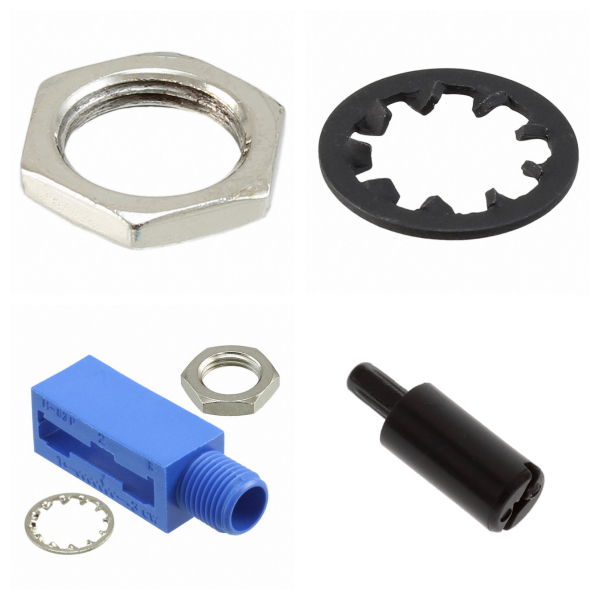
<h1> Accessories </h1> <p> Potentiometers, variable resistors accessories are used to control or adjust the resistance of a circuit. Potentiometers are usually used to control the voltage or current in a circuit, while variable resistors are used to control the resistance of a circuit. Potentiometers and variable resistors are often used in combination with other electronic components to create a variety of electronic circuits. Potentiometers and variable resistors come in a wide range of shapes and sizes, and can be used for a variety of applications. Common accessories for potentiometers and variable resistors include knobs, shafts, switches, and mounting hardware. </p> <p>
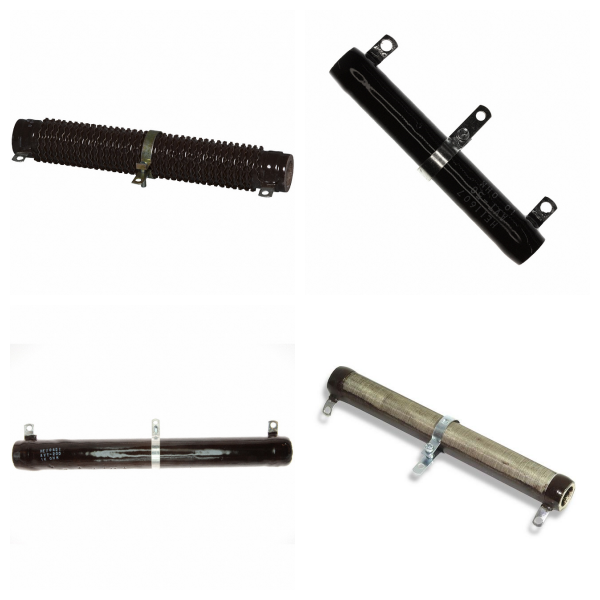
<h1> Adjustable Power Resistor </h1> <p> An adjustable power resistor (APR) is a variable resistor used for current and power control. Its resistance value can be adjusted manually or mechanically, making it suitable for high-power applications. </p> <p>   </p> <h2> 1. What are Adjustable Power Resistors? </h2> <p> Adjustable power resistors are primarily implemented using a rheostat, a two- or three-terminal device whose resistance value is adjusted by varying the length of the resistor path or the position of the contacts. Compared to standard adjustable resistors (such as potentiometers), these are designed for high power and typically feature larger dimensions and heat dissipation structures (such as ceramic housings or heat sinks) to handle higher currents and power dissipation. Common types include wirewound rheostats, whose resistor bodies are made of high-power-tolerant materials. </p> <p>   </p> <h2> 2. What are the Working Principles of Adjustable Power Resistors? </h2> <p> The effective resistor length is changed by mechanically sliding contacts or rotating a knob, thereby adjusting the current in the circuit (according to Ohm's law: U=IR). For example, increasing the resistance value in a series circuit reduces the current and load power; conversely, increasing the power output. Its core physical characteristic is the conversion of electrical energy into heat, so ensuring power dissipation remains within a safe range is crucial. </p> <p>   </p> <h2> 3. What are the Main Applications of Adjustable Power Resistors? </h2> <p> <strong>Motor Control</strong>: Regulating DC motor speed or starting current. </p> <p> <strong>Lighting Dimming Systems</strong>: Used for power regulation of incandescent lamps or older dimmers. </p> <p> <strong>Heating Equipment</strong>: Controlling the temperature of heating wires or heating elements. </p> <p> <strong>Test Load</strong>: Used as a variable load in power supply or generator testing. </p> <p>   </p> <p> It is important to note that while modern high-power applications (such as high-current motor control) have been gradually replaced by semiconductor devices (such as MOSFETs), adjustable power resistors are still widely used in low-power or low-cost applications. </p> <p>   </p> <h2> 4. What are the Key Parameters of Adjustable Power Resistors? </h2> <p> <strong>Power Rating</strong>: Indicates the maximum power that can be safely dissipated (in watts) and should be selected based on the application (e.g., 1W, 5W, or higher). </p> <p> <strong>Resistance Range</strong>: Typically ranges from a few ohms to several kiloohms (e.g., 10Ω–10kΩ), directly affecting current regulation accuracy. ‌ </p> <p> <strong>‌Tolerance and Lifespan‌</strong>: Tolerances are typically high (approximately 20%), and mechanical lifespan (number of contact rotations) is an important metric, especially in applications with frequent adjustments. ‌ </p> <p>   </p> <p> Power requirements, ambient temperature, and heat dissipation requirements should be considered when selecting a contactor. </p> <p>
<h1> Joystick Potentiometers </h1> <h2> 1. What are Joystick Potentiometers? </h2> <p> A joystick potentiometer is a variable resistor used to measure the angular position of a joystick. It converts the joystick's angular position into an electrical signal, which can then be used to control the direction or speed of a motor or other device. </p> <p>   </p> <h2> 2. How do Joystick Potentiometers Work? </h2> <p> A joystick potentiometer works by measuring the angular displacement of a joystick. The joystick is attached to a movable arm, which is connected to a potentiometer. When the joystick moves, the arm rotates the potentiometer, changing the resistance of the circuit. This change in resistance is then measured, and the position of the joystick can be determined. </p> <p>   </p> <h2> 3. What are the Functions of Joystick Potentiometers? </h2> <p> A joystick potentiometer is a variable resistor used to measure the angular position of a joystick. It helps convert the mechanical movement of the joystick into an electrical signal, which is then used to control the movement of a cursor or object on a computer screen. </p> <p>   </p> <h2> 4. What are the Types of Joystick Potentiometers? </h2> <p> <strong>Single-ganged Potentiometer</strong> </p> <p> This potentiometer is used with joysticks that move in a single axis, such as up and down. It measures the voltage output as the joystick moves and can measure the position of the joystick in a single direction. </p> <p>   </p> <p> <strong>Dual-Ganged Potentiometer</strong> </p> <p> This type of potentiometer is used for joysticks with two axes of motion, such as left and right. It measures the voltage output as the joystick moves, and can measure the joystick's position in both directions. </p> <p> <strong>Multi-Ganged Potentiometer</strong> </p> <p> This type of potentiometer is used for joysticks with multiple axes of motion, such as up, down, left, and right. It measures the voltage output as the joystick moves, and can measure the joystick's position in multiple directions. </p> <p>   </p> <p>
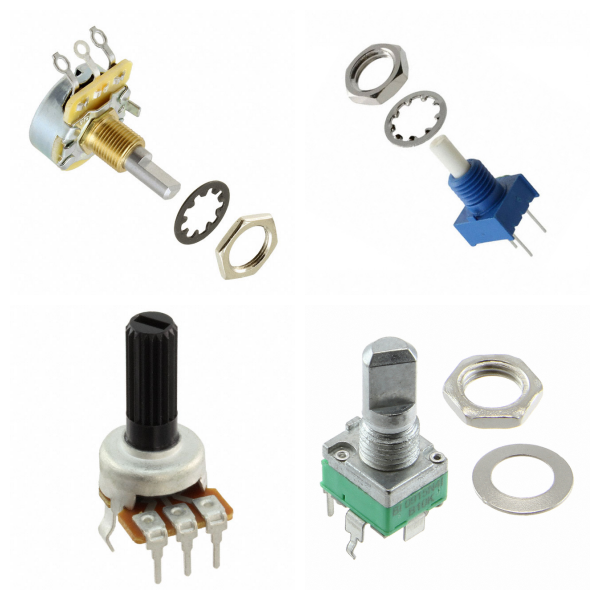
<h1> Rotary Potentiometers, Rheostats </h1> <p> Rotary potentiometers and rheostats are common variable resistors in electronic circuits, primarily used to manually adjust resistance values to control current, voltage, or signals. The following is a detailed introduction to their core characteristics, operating principles, types, and applications: </p> <p>   </p> <h2> 1. What are Rotary Potentiometers, Rheostats? </h2> <p> <strong>Rotary Potentiometers</strong>: A rotary potentiometer is a three-terminal device (two fixed terminals and one sliding terminal). A rotating shaft changes the position of a sliding contact on the resistor, thereby adjusting the resistance value or voltage division ratio. It typically consists of a resistor (such as a carbon film, metal film, or conductive plastic), a rotating shaft, and a housing, with a rotation range of over 270 degrees. </p> <p>   </p> <p> <strong>Rheostats</strong>:They are essentially two-terminal variable resistors commonly used to adjust current in circuits. They can be considered a simplified form of a potentiometer, but focus on current control rather than voltage division. Rheostats are typically wirewound or solid-core and have high power handling capabilities. </p> <p>   </p> <h2> 2. What are the Working Principles of Rotary Potentiometers, Rheostats? </h2> <p> The resistance change is due to the movement of a sliding contact (brush) across the resistor. Clockwise or counterclockwise rotation of the shaft drives the contact, changing the length of the resistor between the fixed and wiper terminals, thereby precisely adjusting the resistance value (e.g., 0-10kΩ) or the output voltage (e.g., 0-5V). For example, when the wiper terminal moves toward the higher potential end, the output resistance increases, and vice versa. </p> <p>   </p> <h2> 3. What are the Main Types of Rotary Potentiometers, Rheostats? </h2> <h3> 1) Classification by Material: </h3> <p> <strong>Carbon Film Potentiometers</strong>: Low cost, high resolution, widely used in consumer electronics (e.g., volume knobs). </p> <p> <strong>Wirewound Varistors</strong>: High temperature resistance, high power, suitable for high current applications (e.g., power supply regulation). </p> <p> <strong>Conductive Plastic Potentiometers</strong>: Long life, high linear accuracy, used in precision instruments (e.g., servo systems). </p> <p> <strong>Digital Potentiometers (Digipots)</strong>: Control resistance via digital signals, eliminate mechanical wear, and are suitable for remote control or high-frequency circuits. </p> <p>   </p> <h3> 2) Classification by Adjustment Method: </h3> <p> <strong>Rotary</strong>: Operated via a knob, this is the most common type. </p> <p> <strong>Slide</strong>: Linear adjustment, used in space-constrained designs. </p> <p> <strong>Solid Potentiometer</strong>: Compact, highly reliable, commonly used in industrial control. </p> <p>   </p> <h2> 4. What are the Applications of Rotary Potentiometers, Rheostats? </h2> <p> <strong>Voltage Division and Regulation</strong>: Adjusting volume in audio equipment or smoothing voltage fluctuations in power supply circuits. </p> <p> <strong>Current Control</strong>: Used as a variable resistor for LED dimming, motor speed control, or current limiting in thermal management systems. </p> <p> <strong>Sensor and Calibration</strong>: Combined with position sensors (such as angle detection), this potentiometer is used for calibrating automated equipment or instruments. </p> <p> <strong>Digital System Integration</strong>: Digital potentiometers support microprocessor control, enabling software-adjustable circuit parameters (such as gain control). </p> <p>   </p> <h2> 5. What are the Key Parameters and Selection of Rotary Potentiometers, Rheostats? </h2> <p> <strong>Resistance Range</strong>: Common values range from 1kΩ to 1MΩ, and must be matched to the circuit requirements. </p> <p> <strong>Power Rating</strong>: Variable resistors require attention to their power rating (e.g., 0.5W-5W) to prevent overheating and damage. </p> <p> <strong>Lifespan and Stability</strong>: Mechanical potentiometers have a lifespan of approximately 100,000 rotations, while digital potentiometers are insulated from physical wear and tear, offering higher reliability. </p> <p> <strong>Installation Precautions</strong>: Wiring method affects adjustment direction (e.g., clockwise increases or decreases resistance), so consult the data sheet. </p> <p>   </p> <p> In summary, rotary potentiometers and rheostats provide flexible manual adjustment capabilities in electronic design and are widely used in applications ranging from household appliances (such as induction cooktop knobs) to industrial systems. When choosing between them, consider the trade-offs between accuracy, durability, and environmental adaptability. </p> <p>
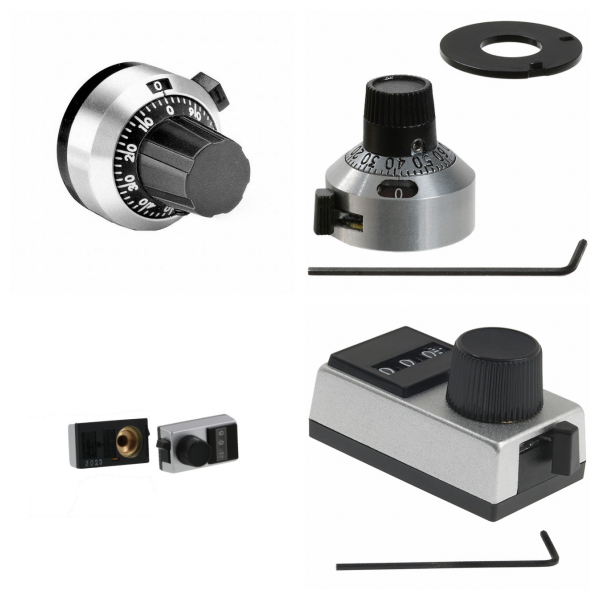
<h1> Scale Dials </h1> <p> Scale dials are mechanical or digital indicators used for precision measurement or parameter adjustment. Their core function is to accurately read or set parameters through a visual scale. </p> <p>   </p> <h2> 1. What are the Core Application Scenarios of Scale Dials? </h2> <p> <strong>Industrial Instrument Calibration</strong> </p> <p> Instruments such as pressure gauges and thermometers use scale dials to indicate measurement values. For example, pressure gauges with a diameter of 160mm or 250mm can achieve an accuracy level of up to 0.6, making them suitable for high-precision industrial environments. </p> <p>   </p> <p> <strong>Precision Measuring Tools</strong> </p> <p> Digital calipers (such as the EK-1504) feature integrated digital scale dials. They utilize a stainless steel material and a tungsten carbide stylus for height measurement and marking. They support RS232 data output and maintain error control that strictly complies with calibration standards. </p> <p>   </p> <h2> 2. What are the Technical Key Points of Scale Dials? </h2> <p> <strong>Material and Construction</strong>: High-end dials utilize a stainless steel body with hardened scales to ensure wear resistance and long-term stability. </p> <p> <strong>Precision Control</strong>: Micron-level resolution is achieved through laser etching or digital encoding technology. For example, the accuracy of a digital caliper should be clearly stated in the "Accuracy" field in the data sheet. </p> <p> <strong>Human-Computer Interaction Design</strong>: Single or dual scale layouts optimize readability, and some dials have built-in lighting to aid operation in low-light environments. </p> <p>   </p> <h2> 3. Model Selection and Datasheet Reference for Scale Dials </h2> <p> When selecting a model, focus on three parameters in the data sheet: </p> <p> Range—for example, a pressure gauge with a value of 0-100 MPa; </p> <p> Grad.—the minimum graduation value; </p> <p> Accuracy—complying with ISO standard grades. </p> <p>   </p> <p> Note: Mechanical dials require regular calibration, while digital dials require checking the battery stability. </p> <p>   </p> <h2> 4. Expanded Applications of Scale Dials </h2> <p> Digital dial technology has been extended to digital potentiometers in audio equipment and medical monitoring instruments, enabling stepless adjustment of resistance value and signal gain through programming, significantly improving system control accuracy. </p> <p>
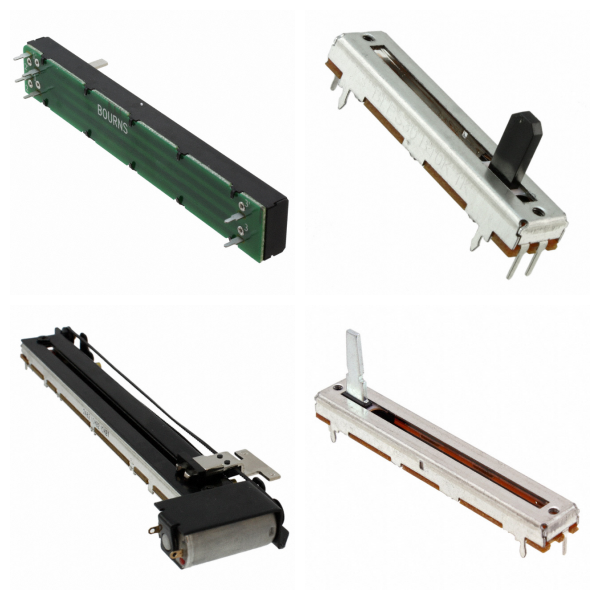
<h1> Slide Potentiometers </h1> <p> A slide potentiometer is an electronic component that changes resistance through linear displacement. It consists of three main components: a resistor, a sliding contact, and a mechanical guide. Its core principle follows Ohm's law: as the slider position changes, the resistance between the output terminal and the reference terminal changes linearly or nonlinearly. </p> <p>   </p> <h2> 1. What are the Types of Slide Potentiometers? </h2> <p> <strong>According to IEC 60393, they are mainly categorized as follows</strong>: </p> <p> <strong>Single-gang Type</strong>: Basic structure with a single resistor track </p> <p> <strong>Multi-gang Type</strong>: Parallel multiple tracks for synchronous adjustment </p> <p> <strong>With Switch Type</strong>: Integrated mechanical switch function </p> <p>   </p> <h2> 2. What are the Key Performance Parameters of Slide Potentiometers? </h2> <table> <tbody> <tr class="firstRow"> <td width="159" valign="top" style="padding: 0px 7px; border-width: 1px; border-color: windowtext; background: rgb(190, 190, 190);"> <p> Parameter </p> </td> <td width="219" valign="top" style="padding: 0px 7px; border-width: 1px; border-color: windowtext; background: rgb(190, 190, 190);"> <p> Typical Specification Range </p> </td> <td width="189" valign="top" style="padding: 0px 7px; border-width: 1px; border-color: windowtext; background: rgb(190, 190, 190);"> <p> Test Standard </p> </td> </tr> <tr> <td width="159" valign="top" style="padding: 0px 7px; border-left-width: 1px; border-left-color: windowtext; border-right-width: 1px; border-right-color: windowtext; border-top: none; border-bottom-width: 1px; border-bottom-color: windowtext;"> <p> Total Resistance </p> </td> <td width="219" valign="top" style="padding: 0px 7px; border-left-width: 1px; border-left-color: windowtext; border-right-width: 1px; border-right-color: windowtext; border-top: none; border-bottom-width: 1px; border-bottom-color: windowtext;"> <p> 100Ω-1MΩ </p> </td> <td width="189" valign="top" style="padding: 0px 7px; border-left-width: 1px; border-left-color: windowtext; border-right-width: 1px; border-right-color: windowtext; border-top: none; border-bottom-width: 1px; border-bottom-color: windowtext;"> <p> MIL-R-94 </p> </td> </tr> <tr> <td width="159" valign="top" style="padding: 0px 7px; border-left-width: 1px; border-left-color: windowtext; border-right-width: 1px; border-right-color: windowtext; border-top: none; border-bottom-width: 1px; border-bottom-color: windowtext;"> <p> Mechanical Life </p> </td> <td width="219" valign="top" style="padding: 0px 7px; border-left-width: 1px; border-left-color: windowtext; border-right-width: 1px; border-right-color: windowtext; border-top: none; border-bottom-width: 1px; border-bottom-color: windowtext;"> <p> 10,000-100,000 cycles </p> </td> <td width="189" valign="top" style="padding: 0px 7px; border-left-width: 1px; border-left-color: windowtext; border-right-width: 1px; border-right-color: windowtext; border-top: none; border-bottom-width: 1px; border-bottom-color: windowtext;"> <p> EIA RS-481 </p> </td> </tr> <tr> <td width="159" valign="top" style="padding: 0px 7px; border-left-width: 1px; border-left-color: windowtext; border-right-width: 1px; border-right-color: windowtext; border-top: none; border-bottom-width: 1px; border-bottom-color: windowtext;"> <p> Resolution </p> </td> <td width="219" valign="top" style="padding: 0px 7px; border-left-width: 1px; border-left-color: windowtext; border-right-width: 1px; border-right-color: windowtext; border-top: none; border-bottom-width: 1px; border-bottom-color: windowtext;"> <p> ±0.5%-±5% </p> </td> <td width="189" valign="top" style="padding: 0px 7px; border-left-width: 1px; border-left-color: windowtext; border-right-width: 1px; border-right-color: windowtext; border-top: none; border-bottom-width: 1px; border-bottom-color: windowtext;"> <p> DIN 41328 </p> </td> </tr> <tr> <td width="159" valign="top" style="padding: 0px 7px; border-left-width: 1px; border-left-color: windowtext; border-right-width: 1px; border-right-color: windowtext; border-top: none; border-bottom-width: 1px; border-bottom-color: windowtext;"> <p> Temperature Coefficient </p> </td> <td width="219" valign="top" style="padding: 0px 7px; border-left-width: 1px; border-left-color: windowtext; border-right-width: 1px; border-right-color: windowtext; border-top: none; border-bottom-width: 1px; border-bottom-color: windowtext;"> <p> ±100ppm/℃~±500ppm/℃ </p> </td> <td width="189" valign="top" style="padding: 0px 7px; border-left-width: 1px; border-left-color: windowtext; border-right-width: 1px; border-right-color: windowtext; border-top: none; border-bottom-width: 1px; border-bottom-color: windowtext;"> <p> JIS C 6440 </p> </td> </tr> </tbody> </table> <p>   </p> <h2> 3. What are the Application Scenarios of Slide Potentiometers? </h2> <p> <strong>Professional Audio Equipment</strong> </p> <p> Mixer faders and equalizers utilize conductive plastics for low noise (<1mV RMS). </p> <p>   </p> <p> <strong>Industrial Control Systems</strong> </p> <p> Require IP67 protection, such as injection molding machine parameter settings and CNC machine tool controls. </p> <p>   </p> <p> <strong>Consumer Electronics</strong> </p> <p> Game controller throttle levers and smart home brightness controls are trending towards miniaturization (<20mm travel). </p> <p>   </p> <p> <strong>Automotive Electronics</strong> </p> <p> Compliant with AEC-Q200 standards for automotive air conditioning panels and seat memory modules. </p> <p>   </p> <h2> 4. Selection Guide for Slide Potentiometers </h2> <h3> 1) Material Options: </h3> <p> <strong>Carbon Film</strong>: Economical ($0.2-1.5/piece) </p> <p> <strong>Cermet</strong>: High Precision (±1%) </p> <p> <strong>Conductive Plastic</strong>: Long Life (>500,000 cycles) </p> <p>   </p> <h3> 2) Interface Types: </h3> <p> THT Through-Hole (suitable for manual soldering) </p> <p> SMD (preferred for automated production) </p> <p>   </p> <h3> 3) Special Requirements: </h3> <p> Dust-Proof Design (for medical equipment) </p> <p> Explosion-Proof Certification (for petrochemical applications) </p> <p>
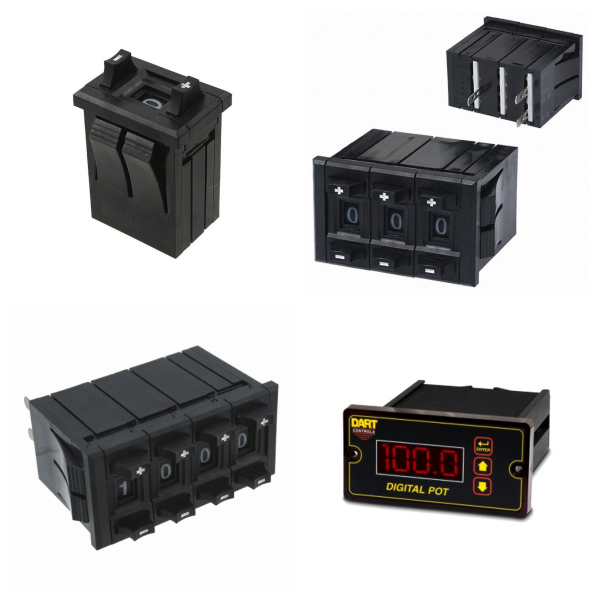
<h1> Thumbwheel Potentiometers </h1> <h2> 1. What are Thumbwheel Potentiometers? </h2> <p> Thumbwheel potentiometers allow manual adjustment of the resistance value within a circuit. Also known as thumbwheel trimmers, they offer side or top adjustment and feature a tactile edge on the actuator for easy user interaction and position indication. </p> <p>   </p> <h2> 2. How do Thumbwheel Potentiometers Work? </h2> <p> A thumbwheel potentiometer is a rotary potentiometer operated by turning a wheel or knob mounted on the potentiometer shaft. The wheel has a series of evenly spaced notches or detents that allow for precise adjustment. As the wheel is turned, the resistance of the potentiometer changes linearly. The output voltage of the potentiometer is directly related to the resistance, so as the wheel is turned, the output voltage increases or decreases accordingly. </p> <p>   </p> <h2> 3. What are the Types of Thumbwheel Potentiometers? </h2> <p> Linear Thumbwheel </p> <p> Logarithmic Thumbwheel </p> <p> Rotary Thumbwheel </p> <p> Dual-Ganged Thumbwheel </p> <p> Multiple-Ganged Thumbwheel </p> <p>   </p> <h2> 4. What are Thumbwheel Potentiometers Used for? </h2> <p> A thumbwheel potentiometer is a variable resistor used to control the input or output of an electronic circuit. It can be used to adjust the volume, brightness, speed, or other parameters of a device. It is often used as an adjustable voltage divider and to adjust the volume of electronic devices such as radios and amplifiers. </p> <p>   </p> <p>
<h1> Trimmer Potentiometers </h1> <h2> 1. What are Trimmer Potentiometers? </h2> <p> A trimmer potentiometer, also known as a trimmer pot, is a variable resistor or adjustable potentiometer that can be used to adjust, fine-tune, and calibrate circuits. These trimmer resistors are often used for initial calibration after device manufacturing. </p> <p>   </p> <h2> 2. How do Trimmer Potentiometers Work? </h2> <p> Resistance is adjusted by turning a small screw located on the top of the trimmer potentiometer, which moves a contact point along a track of different resistance levels. By changing the position of the contact point, the resistance of the circuit can be adjusted to achieve the desired effect. </p> <p>   </p> <h2> 3. What are the Types of Trimmer Potentiometers? </h2> <p> <strong>Linear Trimmer Potentiometer</strong> </p> <p> This is the most common type of trimmer potentiometer and is designed to provide linear adjustment of resistance value. </p> <p>   </p> <p> <strong>Logarithmic Trimmer Potentiometer</strong> </p> <p> These trimmer potentiometers adjust the resistance value on a logarithmic scale. </p> <p>   </p> <p> <strong>Digital Trimmer Potentiometer</strong> </p> <p> These are electronically adjusted trimmer potentiometers that use a digital signal to adjust the resistance value. </p> <p> <strong>Wirewound Trimmer Potentiometer</strong> </p> <p> This type of trimmer potentiometer uses wirewound elements to adjust the resistance value. </p> <p>   </p> <p> <strong>Cermet Trimmer Potentiometers</strong> </p> <p> These trimmer potentiometers use a ceramic-metal composite element to adjust resistance. </p> <p>   </p> <h2> 4. What are Trimmer Potentiometers Used for? </h2> <p> Trimmer potentiometers, also known as trimpots, are small, adjustable resistors used to fine-tune the performance of a circuit. They work by changing the resistance of a circuit, thereby affecting the circuit's current, voltage, or other parameters. </p> <p>   </p> <p>
<h1> Value Display Potentiometers </h1> <h2> 1. What are Value Display Potentiometers? </h2> <p> A digital potentiometer is an electronic component used to measure and adjust electrical signals. They consist of two components: a knob or knob-type controller and a digital display. When used with a digital display, they offer a variety of user-adjustable settings and provide accurate readings. Adjusting the knob changes the potentiometer's resistance, thereby changing the device's voltage or current output. </p> <p>   </p> <h2> 2. How do Value Display Potentiometers Work? </h2> <p> A digital potentiometer works by rotating a shaft to adjust the resistance between two terminals. This resistance produces a voltage drop, which is displayed on a digital display. The shaft can be adjusted to the desired resistance value, which is displayed on the digital display. This allows for easy adjustment and monitoring of voltage in a circuit. </p> <p>   </p> <h2> 3. What are the Types of Value Display Potentiometers? </h2> <p> <strong>Linear Potentiometers</strong> </p> <p> These are used to adjust the level of a signal, such as the volume of a sound system. </p> <p>   </p> <p> <strong>Logarithmic Potentiometers</strong> </p> <p> These are used to control the frequency of an audio signal, such as the bass or treble of a sound system. </p> <p>   </p> <p> <strong>Digital Potentiometers</strong> </p> <p> These are used to control the voltage and current of electronic devices, such as motors or heaters. </p> <p> <strong>Rheostats</strong> </p> <p> They are used to control the resistance of a circuit, such as in a light dimmer. </p> <p>   </p> <h2> 4. What are Value Display Potentiometers Used for? </h2> <p> Value Display Potentiometers are used to control and display the value of a variable, such as voltage or current. They are commonly used in electronic circuits and devices, such as volume controllers and other adjustable circuits. </p> <p>

Potentiometers, Variable Resistors

1. Potentiometers and Variable Resistors Overview‌

‌Potentiometer‌: A resistor element with three terminals and adjustable resistance. The resistance value is changed by sliding contacts to achieve voltage division or current limiting functions. Its core principle is to change the length of the current path or the contact area by adjusting the contact position, thereby changing the output resistance‌.

‌Variable Resistors‌: In a broad sense, it includes potentiometers, but in a narrow sense, it refers to variable resistors with only two effective terminals (such as fine-tuning resistors). The resistance value is changed by adjusting the mechanical structure, and it is often used for circuit calibration or debugging‌.

2. What is the ‌Structure and Working Principle of Potentiometers? ‌

‌Structure‌: The potentiometer consists of a resistor element (such as carbon film, and wire-wound resistor) and a sliding contact. The two ends of the resistor element are fixed terminals, and the sliding end (brush) changes the contact point position by rotation or linear movement‌.

‌Voltage division principle‌: The input voltage is applied to the two ends of the resistor element, and the voltage output between the sliding end and any fixed end is proportional to the contact position, realizing the voltage division function‌.

3. What are the Common Types of Potentiometers?

1)By adjustment method:

Rotary potentiometer: Adjusted by knob, widely used in volume control, brightness adjustment, etc.

Linear (sliding) potentiometer: Adjusted by linear sliding, suitable for scenarios requiring linear response (such as dimmers).

Trimmer: Miniaturized design requires tool adjustment and is used for circuit debugging or calibration.

2)By material and power:

Carbon film/ceramic film potentiometer: Low cost, suitable for low power scenarios.

Wire wound potentiometer: High power, high precision, used for industrial control.

4. What are Potentiometers Used for?

Voltage division and signal adjustment: Audio equipment volume control, sensor signal adjustment.

Power control: Light dimmer, motor speed adjustment (pay attention to power limit).

Calibration and debugging: Trimmer resistors are used for precise adjustment of circuit parameters (such as bias voltage).

5. What are the ‌Key Parameters of Potentiometers?‌

‌Resistance range‌: Commonly from a few hundred ohms to megohms, selected according to the application‌.

‌Power rating‌: Determines the maximum power consumption that can be tolerated (such as 0.1W to 5W).

‌Linearity‌: The corresponding relationship between the change in resistance and the movement of the contact, affects the control accuracy‌.

‌Mechanical life‌: The number of rotations or slides (usually tens of thousands of times)‌.

6. What is the ‌Special Function Design of Potentiometers?‌

‌Attached switch‌: Some potentiometers integrate power switches, which are common in volume control knobs (triggered off when the contact is adjusted to the minimum resistance value)‌.

‌Multi-gang potentiometer‌: Multiple resistance units are linked, used in stereo audio equipment‌.

7. Typical Brands for Potentiometers

BOURNS

‌VISHAY

TE‌

‌ALPHA

Panasonic

Amphenol

8. Potentiometers FAQs

1) What is the difference between a potentiometer and a variable resistor? ‌

‌Potentiometer‌: Usually used as a three-terminal component, it outputs a voltage proportional to the contact position through the voltage division principle.

‌Variable Resistor‌: Generally used as a two-terminal component, it only limits the current by adjusting the resistance value and has no voltage division function.

2) What are the advantages of digital potentiometers? ‌

It can be adjusted by a microprocessor or digital signal to support automatic control. ‌

Some models integrate non-volatile memory to retain the settings after power failure. ‌

It is small and high in precision, suitable for highly integrated circuits.

3) What are the ‌common faults and detection methods of potentiometers? ‌

‌Poor Contact‌: It is manifested as a jump in the output signal. A multimeter can be used to detect whether the resistance value changes continuously.

‌Mechanical Wear‌: Noise occurs when rotating or sliding, and the potentiometer needs to be replaced.

‌Detection Steps‌: Measure whether the total resistance of the two ends meets the nominal value, and check whether the resistance between the sliding end and the fixed end changes linearly with the adjustment.

4) Which special potentiometers have additional functions? ‌

‌Potentiometer with switch‌: The switch can be triggered when rotating or sliding to the extreme position, which is often used in the integrated design of power switches and volume adjustment (such as old radios).

‌Multi-gang potentiometer‌: Multiple potentiometers share the same adjustment axis, which is used to synchronously control multiple signals (such as stereo audio balance adjustment).

5) What role does the potentiometer play in analog-to-digital conversion? ‌

In the analog signal acquisition system, the potentiometer can be used as a voltage divider to provide a reference voltage and cooperate with the analog-to-digital converter (ADC) to convert analog signals (such as position and brightness) into digital signals.

‌Summary‌

Potentiometers and variable resistors adjust resistance values mechanically or digitally. They are core components of analog circuit control and are widely used in consumer electronics, industrial equipment, and debugging scenarios. Their selection needs to comprehensively consider resistance range, power, accuracy, and usage environment‌.