
New title

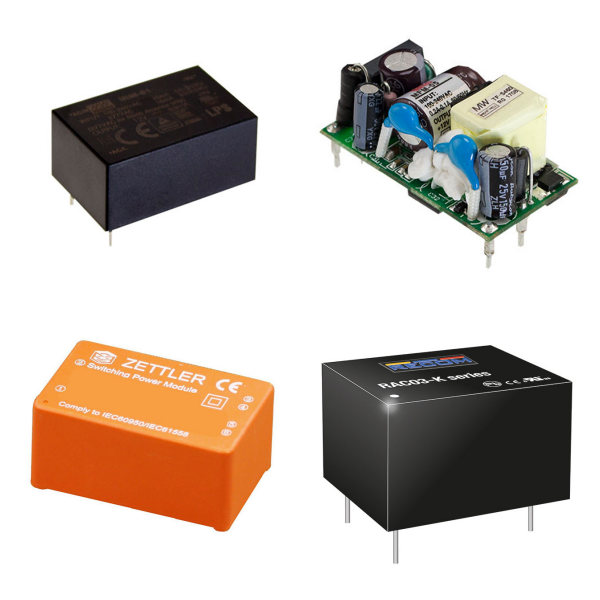
<h1> AC DC Converters </h1> <h2> 1. What are AC DC Converters? </h2> <p> An AC/DC converter is a circuit that converts alternating current (AC) input to direct current (DC) output. AC/DC converters are also called "rectifiers"; they convert the input AC voltage to a variable DC voltage, which is then optimized through a filter to produce an unregulated DC voltage. </p> <p>   </p> <h2> 2. How do AC DC Converters Work? </h2> <p> An AC-DC converter receives alternating current (AC) from a wall outlet and converts it to direct current (DC). It does this by first stepping down the voltage with a transformer, then rectifying it with a diode bridge, and finally smoothing the voltage with a capacitor. The converter's output is a regulated, low-voltage DC power supply. </p> <p>   </p> <h2> 3. What are the Different Types of AC DC Converters? </h2> <p> Buck and Buck-Boost Converters. </p> <p> Flyback Converter. </p> <p> Forward Converter. </p> <p> LLC Resonant Converter. </p> <p> PFC Converter - Single Phase Input. </p> <p> PFC Converter - Three Phase Input. </p> <p> PS ZVS FB converter. </p> <p> Two Switch Flyback Converter. </p> <p>   </p> <h2> 4. What are AC DC Converters Used for? </h2> <p> AC-DC converters convert the alternating current (AC) from the wall outlet into unregulated direct current (DC). These power supplies consist of a transformer (to change the voltage of the AC power passing through the wall outlet), a rectifier (to convert the AC power to DC), and a filter (to smooth out the noise from the peaks and valleys of the AC power). </p> <p>
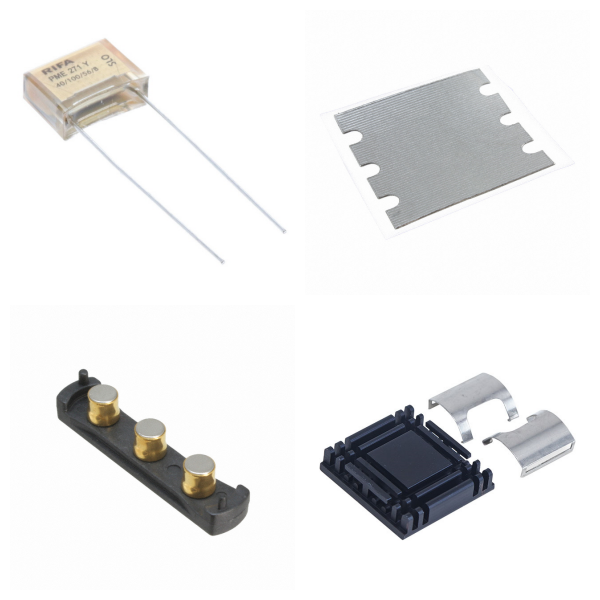
<h1> Board Mount Power Supply Accessories </h1> <p> Board mount accessories are components that are used in conjunction with board-mounted power supplies. These accessories can include items such as mounting brackets, screws, and washers that are used to secure the power supply to the board. Other board mount accessories might include terminal blocks and connectors for attaching the power supply to the rest of the system, as well as EMI filters and other components that help to ensure the power supply is operating safely and efficiently. </p>
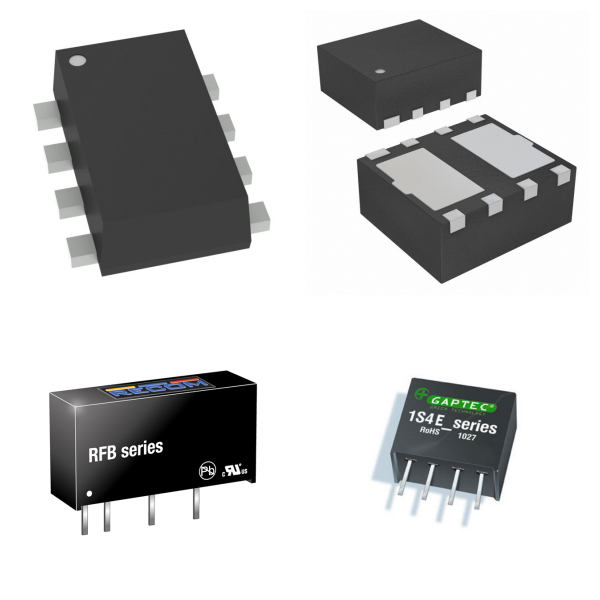
<h1> DC DC Converters </h1> <h2> 1. What are DC-DC Converters? </h2> <p> A DC-DC converter (called a chopper) is powered by a DC voltage source and typically consists of a diode rectifier and a DC link. The DC link consists of a large capacitor connected to the chopper input and usually (but not always) a series inductor. </p> <p>   </p> <h2> 2. How do DC-DC Converters Work? </h2> <p> A basic DC-DC converter takes in current and passes it through a "switching element." The switching element converts the signal into a square wave, or AC. This square wave then passes through another filter, which converts it back to a DC signal of the desired voltage. </p> <p>   </p> <h2> 3. What are the Types of DC-DC Converters? </h2> <p> <strong>There are two types of DC/DC converters</strong>: </p> <p> Linear </p> <p> Linear DC/DC converters use a voltage drop across a resistor to create and regulate a given output voltage. </p> <p>   </p> <p> Switched </p> <p> A switched-mode DC/DC converts energy by periodically storing input energy and then releasing that energy to the output at a different voltage. </p> <p>   </p> <p> For low-power DC/DC conversion-based applications, most modern power conversion is accomplished using three main types of power converters—buck, boost, and buck-boost. </p> <p>
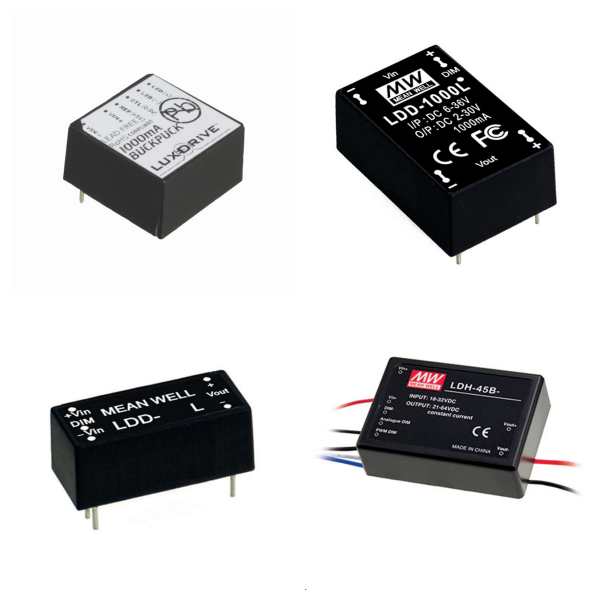
<h1> LED Drivers </h1> <h2> 1. What are LED Drivers? </h2> <p> An LED driver is an electrical device used to regulate the power to an LED or LED light string. It provides the correct current and voltage to the LED or LED light string, ensuring it operates within its rated specifications and avoids burnout. LED drivers may also provide dimming or other features. </p> <p>   </p> <h2> 2. What are the Main Types of LED Drivers? </h2> <p> <strong>There are two types of LED drivers</strong>: </p> <p> Constant Current LED Drivers </p> <p> Constant Voltage LED Drivers </p> <p>   </p> <h2> 3. What do LED Drivers do? </h2> <p> LED drivers rectify high-voltage AC power to low-voltage DC power. LED drivers also protect the LEDs from voltage or current fluctuations. Voltage variations can cause changes in the current flowing to the LEDs. </p> <p>   </p> <h2> 4. Can any LED Driver Work with any LED Lights? </h2> <p> The input voltage of the LED light and the output voltage of the LED driver should be compatible. Check these voltages before connecting to avoid damage. There are also constant current LED drivers available in 6V to 24V ranges that are suitable for certain types of LED lights. However, their compatibility is not universal. </p> <p>   </p> <p>

Power Supplies – Board Mount

1. Overview

1)‌Basic Concepts‌

“Power Supplies – Board Mount” refers to compact power modules that can be directly mounted on a printed circuit board (PCB), including AC/DC or DC/DC conversion functions, and are used to provide stable power for electronic devices.

 ‌

2)‌Main Types‌

‌Isolated Modules‌: The input and output ends are electrically isolated by a transformer, and the isolation voltage is usually 1.5kV-3kV, which is suitable for scenarios with high anti-interference requirements.

‌Non-isolated Modules‌: Smaller and lower in cost, suitable for applications with limited space and no isolation.

2. What are the Core Parameters and Features of Board Mounted Power?

1)‌Input/Output Range‌

‌Input Voltage‌: Covers a wide range of inputs, such as DC 0.7V-15V (low voltage scenario) or AC 90V-264V (universal AC input).

‌Output Voltage‌: Supports single or multiple outputs, such as DC 1.8V, 5V, 12V, 500V, etc., to meet different load requirements.

2)‌Power and Efficiency‌

The power range is from 4W (AC/DC module) to 120W (high-voltage DC/DC module), and the efficiency is generally higher than 85%, and some models can reach 88.5%‌.

Adopt interleaved PFC (power factor correction) and PSFB (phase-shifted full-bridge) topology to improve energy efficiency‌.

3)‌Safety and Certification‌

Complies with EN55022 Class B electromagnetic compatibility standard passes 3kV isolation voltage test and has overcurrent (OCP), overvoltage (OVP), and over temperature (OTP) protection functions‌.

3. What is Board Mounted Power Used for?

‌Industrial control equipment‌: such as PLC and sensor power supply, which need to withstand wide temperature environment (-40 °C to 100 °C) and vibration conditions‌.

‌Communication infrastructure‌: CRPS (common redundant power supply) architecture is used in servers and switches to support hot plugging and redundant backup‌.

‌Medical and test instruments‌: Modules that rely on high isolation voltage and low noise output to ensure equipment safety and accuracy‌.

4. How to Choose Board Mounted Power?

Load matching: Select a model with a power margin of ≥20% based on the device power consumption to avoid overload.

Installation method: Give priority to standard packaging (such as 1/8 Brick size) and compatible with PCB layout requirements.

Management interface: Some modules support PMBus/SMBus protocols to facilitate remote monitoring of power status.

5. Board Mounted Power FAQs

1) Which components are prone to power failure? ‌

‌Electrolytic Capacitors‌: Common failures include reduced capacity, leakage, or short circuits, which may cause unstable power output or complete failure.

‌Resistors‌: Low-resistance resistors are easily burned due to overcurrent, and high-resistance resistors may drift due to aging, affecting the voltage division or current limiting function of the power supply.

‌SMT Components‌: SMT components are small, and poor welding or thermal stress may cause contact failure. ‌

2) ‌How to detect power supply-related component failures? ‌

‌Capacitor Test‌: Use a multimeter to measure whether the capacity has decreased, or observe whether there is physical damage such as bulging or leakage.

‌Resistance Test‌: Low-resistance resistors are easy to identify when they are burnt and blackened, and high-resistance resistors need to measure whether the resistance is abnormal.

‌Short Circuit Troubleshooting‌: Use the adjustable power supply to gradually increase the pressure and observe the heating element to locate the short circuit point. ‌

3) What are the possible reasons for the abnormal output of the power module?

Capacitor Failure: The decrease in the capacity of the filter capacitor will cause the output voltage ripple to increase.

Welding Problem: Cold welding or cold welding may cause poor contact, which may be good or bad.

External Interference: Unshielded power lines may introduce noise, so grounding and shielding measures need to be checked. ‌

4) ‌How to test the stability of power supply output? ‌

‌Ripple Test‌: Use an oscilloscope to measure the AC component of the output voltage, which must meet the design specifications (such as <50mV)‌.

‌Load Regulation‌: Test the voltage fluctuation range under different loads‌.

‌Transient Response‌: Observe the recovery time and overshoot voltage through step load changes‌.